
In This Article
Introduction: Why a No Electricity Treadmill Deserves a Second Look
Picture this: the power goes out during a February ice storm, your motorized treadmill turns into a very expensive coat rack, and your workout streak quietly dies. Or maybe your apartment has exactly one outlet near the window, and it’s already busy with a space heater. A no electricity treadmill doesn’t care about any of that. You step on, you push, and the belt moves. ⚡🚫
That simplicity is exactly why manual machines are having a real moment in 2026. They’re showing up in off-grid cabins, garage gyms, home offices, and CrossFit boxes. The idea itself is old; the history of the treadmill stretches back centuries before electric motors entered the picture. What’s new is the range of options. Today, a manual treadmill can be a 47-pound folding walker that slides into a closet or a 350-pound curved sprint machine built for elite athletes.
The catch? The category is messy. Budget walkers, magnetic-resistance trainers, sled-style climbers, and curved runners all get lumped together, even though they deliver completely different workouts. Buy the wrong type and you’ll either be bored in a week or gasping on a machine you can’t control.
This guide sorts it out. Below, you’ll find seven real models available to US shoppers, analyzed from manufacturer spec sheets, independent reviews, and aggregated customer feedback. Note: we haven’t personally tested these machines; every verdict is reasoned from published specs and documented owner experiences, and we flag where data is thin.
What Is a No Electricity Treadmill?
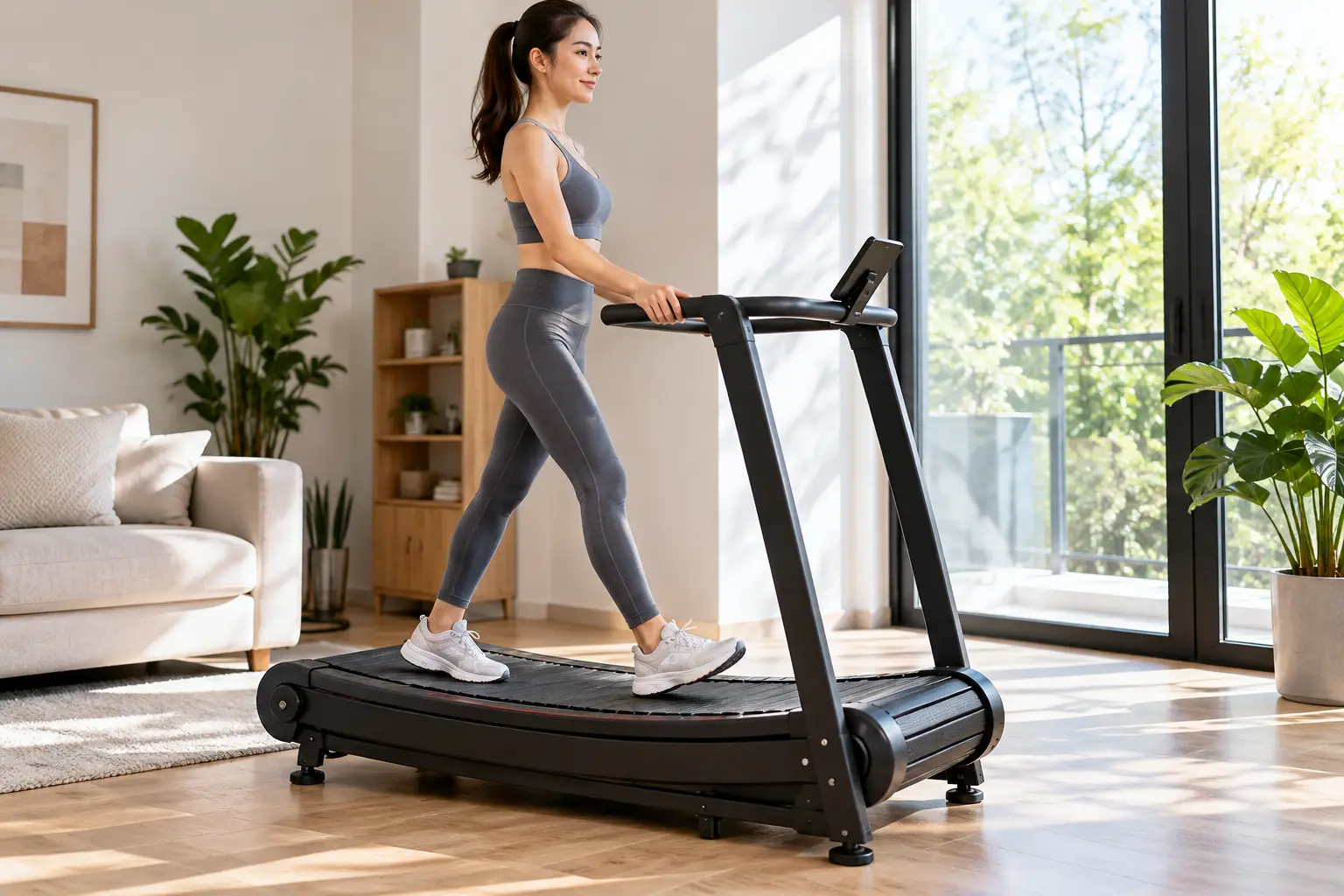
A no electricity treadmill is a manual, motorless treadmill whose belt moves only when your feet push it. Instead of a plug-in motor, it relies on a fixed incline, a flywheel, or a curved running deck to keep the belt rolling, and many models add magnetic resistance. Most consoles run on simple AA batteries.
Quick Comparison: The 7 Best No Electricity Treadmills at a Glance
| Model | Type | Max User Weight | Resistance / Incline | Approx. Price Range | Best For |
|---|---|---|---|---|---|
| Sunny Health & Fitness SF-T1407M | Flat, folding | 220 lb | Fixed ~13.5% incline | Under $200 | Sunny SF-T1407M: budget walkers in tiny spaces |
| Sunny Health & Fitness SF-T1407SMART | Flat, folding, Bluetooth | 300–330 lb (listings vary) | Fixed ~14% incline | ~$200–$250 | Sunny SF-T1407SMART: app-guided beginners |
| Exerpeutic 100XL | Flat, folding, magnetic | ~325 lb (per retailer listings) | Magnetic knob + incline positions | ~$200–$350 | Exerpeutic 100XL: heavier walkers on a budget |
| Sunny Health & Fitness SF-T7723 Force Fitmill | Flat, dual flywheel | 300 lb | 16 magnetic levels, fixed ~13% | ~$450–$650 | Sunny SF-T7723: incline power walking and HIIT |
| Xebex Trekker 4000 | Flat, sled/hike | 265 lb | 10 levels, 22% or 27% incline | ~$1,000–$1,500 | Xebex Trekker 4000: hikers, ruckers, sled lovers |
| AssaultRunner Pro | Curved | 350 lb | Self-paced, no speed cap | ~$3,000–$3,500 | AssaultRunner Pro: sprinters and HIIT athletes |
| Xebex AirPlus Runner | Curved + magnetic | 350 lb | 8 magnetic levels | ~$3,500–$5,000 | Xebex AirPlus Runner: sprint + sled power training |
Looking at the table, the price jumps tell the real story. Everything under roughly $650 is a flat-belt machine with a built-in slope, which means you’re essentially always walking uphill, great for low-impact cardio but not designed for genuine running. The Xebex Trekker 4000 sits in a niche of its own, trading running ability for brutally steep climbs and sled pushes.
Once you cross into curved territory with the AssaultRunner Pro and Xebex AirPlus Runner, you’re paying for something different: a deck that lets you sprint with no speed ceiling, plus commercial-grade frames rated for 350-lb users. If you mostly walk, that premium buys you nothing. If you sprint, nothing cheaper truly substitutes.
One more pattern worth noticing: weight capacity doesn’t track price neatly. The Exerpeutic 100XL and Sunny SF-T1407SMART both list higher capacities than the far pricier Xebex Trekker 4000, so heavier buyers should filter by capacity first and budget second. Prices shown are approximate ranges at the time of writing; check the current price on each listing.
💬 One click helps other shoppers make an informed choice too! 😊
Top 7 No Electricity Treadmills: Expert Analysis
1. Sunny Health & Fitness SF-T1407M — cheapest way to walk off-grid
If your goal is simply to walk more without paying for, or plugging in, a motor, this is the lowest-friction entry point in the category.
The Sunny SF-T1407M uses a fixed 13.5% incline, so gravity and your stride work together to pull the belt backward. In practice, even a slow pace feels like walking up a steady hill, which raises effort without forcing you to move faster. At about 46.7 lb, it folds and rolls on transport wheels, so it can genuinely live in a closet between sessions. The LCD tracks time, speed, distance, and calories, though you should treat that calorie number loosely (more on why later).
Based on the specs, this machine suits apartment dwellers under 220 lb who want 20- to 30-minute incline walks while catching up on a show. It’s a poor fit for runners, taller users with long strides, or anyone near the weight limit. The warranty, a 3-year frame and 180-day parts, matches its budget positioning.
Customer sentiment is broadly positive: the brand’s own site shows a 4.4-star average across 85 reviews, while independent reviewers consistently describe it as simple and limited, flagging the short deck and low weight limit as the main trade-offs.
Pros:
- ✅ Usually priced under $200, the lowest entry cost here
- ✅ Light enough to fold and store in a closet
- ✅ Fixed incline adds challenge without needing speed
Cons:
- ❌ 220-lb limit rules out many adult users
- ❌ Short deck feels cramped for long strides
💲 At under $200, the Sunny SF-T1407M is excellent value if you fit its size and weight limits, and money wasted if you don’t.
2. Sunny Health & Fitness SF-T1407SMART — budget walker with app coaching and more capacity
This is the “same idea, more headroom” upgrade: compact and motorless, but with higher listed capacity and guided workouts.
The Sunny SF-T1407SMART keeps the folding, fixed-incline concept, with retailer listings citing a roughly 14% slope and a 42 x 13-inch non-slip walking surface. That 13-inch width is narrow; practically, you’ll need to stay centered, which most walkers adapt to within a few sessions. The headline addition is Bluetooth pairing with the free SunnyFit app, which offers trainer-led workouts and scenic routes, useful if structure is what keeps you consistent. Listed capacity varies by retailer between 300 and 330 lb, so confirm the figure on the specific listing before you buy.
Our honest read: if you’re between roughly 220 and 300 lb, or you know you’ll quit without guided sessions, the modest premium over the Sunny SF-T1407M buys meaningful headroom. If you only want a basic walk, the cheaper model does the same physical job.
On reviews, transparency matters: this is a newer listing, and we couldn’t verify a large body of long-term owner feedback yet. Early retailer descriptions emphasize quiet operation for apartments, but durability over years remains unproven.
Pros:
- ✅ Higher listed capacity than the original model
- ✅ App connectivity adds structure and motivation
- ✅ Quiet manual system suits shared living spaces
Cons:
- ❌ Narrow 13-inch surface demands a centered stride
- ❌ Limited long-term review history so far
💲 Around $200–$250, the Sunny SF-T1407SMART is a smart-value pick for beginners who want coaching without a subscription-heavy machine.
3. Exerpeutic 100XL — magnetic tension and high capacity on a budget
The Exerpeutic 100XL targets buyers who need a sturdier, higher-capacity frame without leaving budget territory.
Its main features are a magnetic tension knob and multiple incline positions, with retailer roundups listing capacity at around 325 lb. Magnetic resistance, in theory, lets you make the belt harder to push without changing incline, which helps you progress over weeks. In practice, though, the incline is the dominant force here: owners repeatedly describe it as steep even on the lowest setting.
Based on aggregated customer reviews summarized by Fakespot, the most consistent praise is quick assembly (attach the legs and console, insert batteries) and strong value for the price. The most consistent complaints are that steep starting incline (several owners place a sturdy board under the rear to flatten it) and a tension knob that some find stiff, with a few saying the resistance change is hard to feel.
That makes it a solid choice for heavier walkers who prioritize stability and capacity over refinement. If you’re looking for fine-grained resistance control, step up to the Sunny SF-T7723. One note: we couldn’t confirm a full current spec sheet (belt dimensions, warranty) from the manufacturer, so double-check those details on the listing.
Pros:
- ✅ High listed capacity for a budget machine
- ✅ Reviewers report quick, simple assembly
- ✅ Magnetic tension adds an extra difficulty lever
Cons:
- ❌ Steep minimum incline surprises many buyers
- ❌ Tension knob feel draws mixed reviews
💲 Typically around $200–$350, the Exerpeutic 100XL offers fair value for capacity-focused walkers who accept a rough edge or two.
4. Sunny Health & Fitness SF-T7723 Force Fitmill — most resistance per dollar
This is where a manual treadmill stops being “just a walker” and starts feeling like a training tool.
The Sunny SF-T7723 pairs a dual flywheel with 16 levels of magnetic resistance and a fixed incline of roughly 13% (some listings say 13.5%). The dual flywheel matters more than it sounds: added rotating mass smooths the belt between strides, so it feels less jerky than single-flywheel budget models. The 16 levels let you move from a brisk walk to a heavy, sled-like push, and the 53 x 16-inch deck gives far more room than the SF-T1407 series. Capacity is 300 lb, the footprint is 59 x 27 x 55 inches, and a soft-drop hydraulic fold lowers the deck gently.
Based on comparing specs, this is the sweet spot for most buyers: real progressive overload without crossing the $1,000 mark. It suits incline power walkers, interval fans, and anyone who outgrew a starter walker. It is not a sprint machine; the fixed incline and flywheel mass cap how fast you can comfortably go.
Review data is limited but encouraging: the brand site lists a 4.7-star average, though from only 23 reviews, so treat it as an early signal rather than proof of long-term durability.
Pros:
- ✅ 16 magnetic levels allow real progression
- ✅ Dual flywheel delivers a smoother stride
- ✅ Larger deck than budget folding walkers
Cons:
- ❌ Fixed incline limits flat-ground or sprint work
- ❌ Small pool of verified reviews so far
💲 In the $450–$650 range, the Sunny SF-T7723 delivers the best resistance-per-dollar ratio in this lineup.
5. Xebex Trekker 4000 — steepest climbs and sled pushes in a folding frame
The Xebex Trekker 4000 isn’t trying to be a running treadmill; it’s a mountain in a box.
It offers two incline settings, 22% and 27%, plus 10 resistance levels, a 51 x 18-inch deck, and three modes: hike, trek, and sled. For context, most motorized home treadmills top out around 12–15% incline, so 27% is a different universe; testers describe it as functioning more like a climber machine. It weighs about 143 lb, folds with a slow-drop system, and its console can pair with a heart rate monitor. Practically, the sled mode lets you lean into the handles and drive the belt like a weighted push sled, a full-body conditioning move most home gyms can’t fit.
Independent testers noted three things worth knowing: they felt little difference between the 22% and 27% settings, the lowest-numbered resistance levels felt hardest (counterintuitive, so read the manual), and the 265-lb capacity falls short of the 275-lb figure reviewers treat as an industry baseline.
Based on that profile, it’s ideal for backpackers, hunters prepping for elk season, rucking enthusiasts, and CrossFit fans who miss sled pushes. Skip it if you want to run or you’re above 265 lb.
Pros:
- ✅ Extreme 22–27% incline for hiking simulation
- ✅ Sled mode adds full-body power training
- ✅ Folds despite its commercial-style build
Cons:
- ❌ 265-lb capacity is below industry norms
- ❌ Short belt and limited speeds for running
💲 Roughly $1,000–$1,500, the Xebex Trekker 4000 is excellent value for climbers, and the wrong buy for runners.
6. AssaultRunner Pro — the benchmark curved trainer for speed work
If you’ve seen a manual treadmill in a CrossFit box, it was probably an Assault machine, and the AssaultRunner Pro is the brand’s most popular model.
Its curved slat belt is the key feature: lean forward and run toward the front, and the belt speeds up; drift back, and it slows. That means no speed cap and instant transitions, perfect for intervals. Specs include a 17 x 62-inch running surface, a 350-lb capacity, roughly 280–289 lb of machine weight, Bluetooth and ANT+ connectivity, built-in interval programs, and a belt rated for 150,000 miles. The console runs on four AA batteries, the only “power” it needs.
Based on the specs and reviewer consensus, this is for sprinters, HIIT athletes, and form-focused runners. Because the curve encourages a midfoot strike, many runners use it to clean up overstriding. It’s a poor match for anyone who wants to zone out on a long walk; the machine demands constant engagement.
Reviewers consistently praise its durability, traction, and steady build, while recurring complaints include its sheer weight, a learning curve on the curve itself, a plastic shell that can crack, and a fast-spinning belt. Warranty terms differ across versions and sellers (frame coverage cited anywhere from 5 to 7 years), so confirm on the listing.
Pros:
- ✅ No speed ceiling for true sprint training
- ✅ Belt rated for 150,000 miles
- ✅ 350-lb capacity supports loaded carries
Cons:
- ❌ Extremely heavy and hard to relocate
- ❌ Curved deck takes real practice to master
💲 Around $3,000–$3,500, the AssaultRunner Pro justifies its price only if sprinting and HIIT are your core training.
7. Xebex AirPlus Runner — curved runner that doubles as a sled
The Xebex AirPlus Runner answers a specific question: what if your sprint treadmill could also replace your push sled?
It combines a curved deck with an “AirPlus” magnetic lever offering 8 resistance levels, from a slight drag to very heavy. A multi-grip handle lets you lock in for sled pushes and pulls, and you can even do backward drives. The running surface is 10 mm vulcanized rubber, designed to soften impact. Specs list a 350-lb capacity, 352-lb machine weight, and a 71 x 35 x 65-inch footprint, plus Bluetooth app compatibility and console readouts for watts, RPM, and pace. A practical bonus: Xebex says its pillow-block bearings can be swapped in under five minutes.
Here’s what to weigh: one in-depth independent review called it a tank and loved the sled work, but felt it’s less ideal than dedicated curved runners for pure running. So it’s best for athletes and garage-gym owners who prioritize power and conditioning. If sprint speed is everything, the AssaultRunner Pro is the simpler choice.
Aggregated owner reviews are sparse; most available feedback comes from independent testers rather than large customer pools, so long-term reliability data is limited.
Pros:
- ✅ Eight magnetic levels enable sled-style training
- ✅ Thick rubber surface softens joint impact
- ✅ Easy bearing service reduces long-term upkeep
Cons:
- ❌ Heaviest machine here at about 352 lb
- ❌ Less refined for pure running than rivals
💲 Typically $3,500–$5,000 depending on seller, the Xebex AirPlus Runner is premium value for hybrid athletes, overkill for everyone else.
Side-by-Side: How the Top 7 Stack Up in Daily Use
| Model | Deck / Surface | Machine Weight | Folds? | Review Sentiment (aggregated) | Best For |
|---|---|---|---|---|---|
| Sunny SF-T1407M | Short, flat | ~47 lb | Yes | Simple, good value; short deck | Sunny SF-T1407M: casual walking |
| Sunny SF-T1407SMART | 42 x 13 in, flat | ~47 lb | Yes | Limited long-term data | Sunny SF-T1407SMART: guided beginners |
| Exerpeutic 100XL | Flat | Not confirmed | Yes | Great value; steep incline | Exerpeutic 100XL: heavier walkers |
| Sunny SF-T7723 | 53 x 16 in, flat | Not confirmed | Yes | Positive, small sample | Sunny SF-T7723: progressive training |
| Xebex Trekker 4000 | 51 x 18 in, flat | ~143 lb | Yes | Brutal workout; low capacity | Xebex Trekker 4000: hiking prep |
| AssaultRunner Pro | 17 x 62 in, curved | ~280–289 lb | No | Durable; heavy; learning curve | AssaultRunner Pro: sprints |
| Xebex AirPlus Runner | Curved, 10 mm rubber | ~352 lb | No | Tank-like; sled-focused | Xebex AirPlus Runner: power work |
The biggest practical divide here is portability. The first five machines fold, and the two Sunny walkers weigh about as much as a large dog, which matters enormously in apartments. Both curved machines weigh more than most refrigerators and stay put wherever the delivery crew leaves them, so measure your space and plan the path before ordering. Notice, too, that the best-documented review histories belong to the cheapest and the most expensive machines, while the middle of the market has thinner data, a reason to buy from sellers with generous return windows.
✨ Don’t miss these top-rated off-grid picks!
🔍 Take your home cardio to the next level with this carefully curated lineup. Click a highlighted model to check current pricing and availability. These picks will help you build fitness that keeps going even when the power doesn’t! 🏃♀️⚡
Getting Started: Your First 30 Days on a Manual Treadmill
A manual treadmill feels different from the first step, and most early frustration comes from expecting a motorized experience. Here’s how to make the transition smooth. 🚶♂️
Week 1: Learn the machine, not the workout. Keep sessions to 10–15 minutes. On flat-belt models like the Sunny SF-T1407M or Sunny SF-T7723, hold the handrails lightly and focus on a steady rhythm; the incline means the belt “wants” to move, so shuffling feels awkward. On a curved deck like the AssaultRunner Pro, practice speed control: step forward to accelerate, drift toward the back to slow down.
Week 2: Set a baseline. Pick one repeatable session, say 20 minutes at a comfortable effort, and record distance. Because there’s no motor setting a pace, distance becomes your progress metric.
Week 3: Add one variable. Increase either duration, magnetic resistance, or interval count, never all three. On the Sunny SF-T7723, moving up two resistance levels per week is a sensible ramp.
Week 4: Introduce intervals. Try 30 seconds hard, 90 seconds easy, repeated six to eight times. Manual belts respond instantly to effort, which makes them ideal for this.
Maintenance from day one:
- ✅ Check and tighten frame bolts after the first week, since new frames settle
- ✅ Wipe the belt and deck weekly to keep dust off rollers
- ✅ Replace console batteries proactively before long sessions
Common first-month mistakes: gripping the rails so hard that your legs do less work, wearing overly cushioned running shoes that make curved decks feel unstable, and judging the machine on day two. Most users report the “weird” feeling fades within a couple of weeks.
Which Model Fits Your Life? Three Real-World Buyer Profiles
Specs only become useful when they’re matched to a real routine. Here are three common situations and the reasoning behind each match.
Profile 1: The apartment remote worker
Budget: under $250. Use: 30 minutes, five days a week, between calls. Space and noise are the constraints. The Sunny SF-T1407SMART wins here: it folds flat, rolls into a closet, makes no motor hum to annoy downstairs neighbors, and its app gives structure on low-motivation days. If you’re under 220 lb and don’t care about the app, the Sunny SF-T1407M saves a bit more. Why not a curved runner? A machine weighing nearly 300 lb on a second floor raises floor-load and moving concerns no apartment dweller wants.
Profile 2: The backcountry hiker in a snowy state
Budget: around $1,500. Use: three sessions a week, 45 minutes, from November through March. This person needs sustained climbing, not speed. The Xebex Trekker 4000 simulates steep trails at 22–27% incline, and wearing a weighted pack on it mirrors real backpacking demands, provided the combined weight of hiker and pack stays below 265 lb. If that combined weight exceeds 265 lb, the Sunny SF-T7723 is the fallback, trading steepness for a 300-lb rating.
Profile 3: The garage-gym HIIT athlete
Budget: $3,000–$5,000. Use: four short, intense sessions weekly. Sprint repeats and conditioning circuits are the goal. The AssaultRunner Pro is the cleaner sprint tool, while the Xebex AirPlus Runner suits athletes who want sled pushes too, consolidating two pieces of equipment into one footprint. Both handle loaded carries thanks to their 350-lb ratings, and neither needs an outlet in a detached garage.
Problem → Solution: Fixing the Most Common Manual Treadmill Headaches
Even the best no electricity treadmill has quirks. Here are the problems owners mention most, with practical fixes. 🔧
Problem 1: “The incline is way too steep.” This is the most common complaint about the Exerpeutic 100XL. ✅ Solution: Some owners place a sturdy, flat board under the rear supports to reduce the angle. Make sure it’s stable and full-width, and check with the manufacturer, since modifications may affect warranty coverage.
Problem 2: “The belt feels jerky between steps.” Single-flywheel budget machines lose momentum between strides. ✅ Solution: Shorten your stride and increase cadence slightly; quicker, lighter steps keep the belt moving. If it still bothers you, a dual-flywheel design like the Sunny SF-T7723 is the structural fix.
Problem 3: “I can’t control my speed on the curved deck.” ✅ Solution: Remember the rule: front of the curve speeds you up, back of the curve slows you down. Practice holding position at the “sweet spot” midpoint at walking pace before attempting sprints on the AssaultRunner Pro or Xebex AirPlus Runner.
Problem 4: “The console went blank mid-workout.” ✅ Solution: It’s almost always the batteries. Keep a spare set nearby and swap them on a schedule, for example every few months with regular use.
Problem 5: “My calves and shins are on fire.” ✅ Solution: Fixed-incline walkers load the lower legs heavily. Start with shorter sessions, stretch your calves afterward, and build volume gradually over several weeks.
How to Choose a No Electricity Treadmill
Choosing well comes down to matching the machine type to your actual workout. Follow these steps in order:
- Define your main activity. Walking points to flat-belt models; sprinting points to curved decks; hiking and sled work point to the Xebex Trekker 4000. This single choice eliminates most of the market.
- Check user weight capacity first. Add a safety buffer of at least 20–30 lb above your body weight, more if you’ll wear a weighted vest or pack.
- Measure your space and your path. Note both the footprint and machine weight. A 280-lb curved runner needs a ground-floor path without tight turns.
- Look at resistance options. Magnetic resistance, like the 16 levels on the Sunny SF-T7723, lets you progress without changing machines.
- Evaluate deck size against your stride. Taller users and runners need longer, wider decks; narrow 13-inch surfaces demand a centered gait.
- Read the warranty carefully. Frame, parts, and belt coverage often differ, and premium curved models may vary by version and seller.
- Confirm the return policy. Freight-shipped machines can be expensive to send back, so know the terms before you click buy.
Get steps 1 and 2 right and you’ve avoided the two most expensive mistakes in this category.
Manual Treadmill vs Motorized Treadmill: Which Should You Buy?
The honest answer: it depends on whether you want the machine to set the pace or want to set it yourself.
| Factor | No Electricity Treadmill | Motorized Treadmill | Best For |
|---|---|---|---|
| Power needs | None (AA batteries for console) | Wall outlet, often a dedicated circuit | Sunny SF-T1407M: off-grid or outlet-poor spaces |
| Speed control | You control it instantly | Buttons, with a lag to change | AssaultRunner Pro: intervals |
| Effort at same speed | Higher | Lower | Sunny SF-T7723: efficient workouts |
| Mechanical complexity | No motor or control board | Motor, belt drive, electronics | Xebex AirPlus Runner: low-maintenance builds |
| Hands-free pacing | No; constant engagement | Yes; easy to zone out | Motorized fits steady long walks |
Research backs up the “harder workout” claim. A study comparing motorized and curved non-motorized treadmills found the energy cost of walking was about 37% higher, and of running about 17% higher, on the curved non-motorized machine. In plain terms, you burn more at the same speed, which is great for efficient sessions, but it also means beginners tire faster than expected.
Motorized treadmills still win for steady, hands-free walking, long marathon-pace runs, and users with balance concerns who prefer a predictable belt speed. Manual machines win for intervals, power, and independence from the grid. If you mainly want to watch a movie while walking at a constant pace, be honest with yourself; a motor may suit you better.
Features That Actually Matter (and Ones That Don’t)
Marketing copy loves to inflate small details. Here’s what deserves your attention, and what you can safely ignore.
Features that matter:
- ✅ Weight capacity and frame rating: the most reliable proxy for build quality across budget models.
- ✅ Flywheel design: dual flywheels, like those on the Sunny SF-T7723, smooth out the stride noticeably on flat-belt machines.
- ✅ Real resistance adjustment: magnetic levels let one machine grow with you over months.
- ✅ Deck dimensions: length and width decide whether you can jog comfortably or must shuffle.
Features that matter less than you’d think:
- ❌ Calorie readouts: treat them as rough estimates. A University of Wisconsin–La Crosse study of a curved treadmill console found displayed calorie values overestimated measured expenditure by 67–117%. A chest-strap heart rate monitor gives a far better picture.
- ❌ Speed readouts on budget walkers: useful for consistency, but not lab-grade accuracy.
- ❌ App content as a deciding factor: the SunnyFit integration on the Sunny SF-T1407SMART is a nice bonus, but it shouldn’t outweigh capacity or deck size.
The takeaway: spend your money on frame, flywheel, and deck. Screens and software are the easiest parts to replace with your phone.
Long-Term Cost and Maintenance
A manual treadmill’s total cost of ownership is mostly its sticker price, which is a major part of its appeal. 💰
| Model | Upfront Range | Running Cost | Key Wear Items | Best For |
|---|---|---|---|---|
| Sunny SF-T1407M | Under $200 | AA batteries | Belt, rollers | Sunny SF-T1407M: lowest lifetime cost |
| Sunny SF-T7723 | ~$450–$650 | AA batteries | Belt, magnetic system | Sunny SF-T7723: best mid-range value |
| AssaultRunner Pro | ~$3,000–$3,500 | AA batteries | Slats, bearings | AssaultRunner Pro: high-volume training |
| Xebex AirPlus Runner | ~$3,500–$5,000 | Console power only | Bearings (quick swap) | Xebex AirPlus Runner: low service downtime |
Comparing these, budget walkers win on absolute cost, but they also carry the shortest parts coverage, such as the 180-day parts warranty on the Sunny SF-T1407M. Premium curved models cost far more upfront, yet their slat belts are rated for very long lifespans, the AssaultRunner Pro cites 150,000 miles, so per-workout cost can drop sharply for heavy daily users.
A simple maintenance schedule:
- Weekly: wipe the deck and belt; clear dust and pet hair from underneath.
- Monthly: check all bolts and the folding mechanism; listen for new squeaks.
- Every few months: replace console batteries; inspect the belt and slats for wear.
- Yearly: follow the manufacturer’s guidance on bearing inspection or lubrication.
With no motor, motor control board, or electrical components to fail, the most common expensive repairs on motorized machines simply don’t exist here. Keep the frame tight and the belt clean, and most owners report years of trouble-free use.
Safety, Regulations, and Standards
“No motor” doesn’t mean “no risk,” so it’s worth understanding where the real hazards sit. ⚠️
First, the good news: a manual belt stops when you stop. There’s no runaway belt and no need for an emergency safety key. That said, curved decks can spin very fast during sprints, and stepping off mid-stride is a common way to fall. Always slow down by drifting to the rear of the curve before dismounting.
Second, children and pets. Federal regulators have documented serious injuries involving children pulled beneath treadmill rear rollers, most notably the Consumer Product Safety Commission’s 2021 warning about a motorized model. While a belt that only moves under human power reduces that risk, a heavy flywheel or spinning curved deck can still pinch small fingers. Keep kids and pets away during use, and fold or block access when it’s not in use.
Third, standards. The primary US voluntary treadmill standard, ASTM F2115, is written for motorized machines, and because manual models don’t plug in, they don’t need UL or ETL electrical certification. Bluetooth consoles, such as those on the Sunny SF-T1407SMART and AssaultRunner Pro, fall under FCC rules for wireless devices. Before buying, check for recalls and incident reports on SaferProducts.gov, the CPSC’s public database, and report any incident you experience.
Finally, respect the stated weight limit, including any vest or pack you wear. It’s a structural rating, not a suggestion.
Common Mistakes to Avoid When Buying a Non Electric Treadmill
Most buyer’s remorse in this category traces back to a handful of avoidable errors.
Mistake 1: Buying a walker and expecting to run. Budget fixed-incline machines like the Sunny SF-T1407M are designed for walking. Jogging is possible, but the short deck and slope make sustained running uncomfortable. If running is the goal, budget for a curved deck.
Mistake 2: Ignoring the incline. Fixed incline is a feature on most flat manual treadmills, not a setting you can turn off. Owners of the Exerpeutic 100XL frequently say the slope surprised them. If you have knee, Achilles, or calf issues, talk to your doctor or physical therapist first.
Mistake 3: Underestimating weight and delivery. Curved machines like the AssaultRunner Pro and Xebex AirPlus Runner ship freight and weigh hundreds of pounds. Confirm delivery terms, whether assembly or threshold delivery is included, and whether your doorways and stairs can handle it.
Mistake 4: Choosing by price alone. A $150 machine that’s below your weight limit isn’t a bargain; it’s a safety risk. Filter by capacity, then by activity type, and only then by price.
Mistake 5: Skipping the return policy. Freight returns can be costly. Read terms carefully, especially for marketplace sellers.
Avoid these five, and you’ll land on a machine you’ll actually use for years rather than one that ends up on a resale site.
FAQ: No Electricity Treadmill Buying Questions
❓ Is a no electricity treadmill worth buying in 2026?
❓ What is the best no electricity treadmill for heavy people?
❓ Do manual treadmills need batteries?
❓ Can I use a self-powered treadmill under a standing desk?
❓ Is a curved manual treadmill good for weight loss?
Conclusion: Find Your Perfect No Electricity Treadmill
A no electricity treadmill isn’t a downgrade from a motorized machine; it’s a different tool. You trade hands-free pacing for instant speed control, higher effort per mile, no electric bill, and far fewer parts that can break. The key is choosing the right type for the workout you’ll actually do.
For budget walking in a small space, the Sunny SF-T1407M and Sunny SF-T1407SMART deliver the most accessible entry point. Heavier walkers on a budget can consider the Exerpeutic 100XL, provided they’re ready for its steep incline. The Sunny SF-T7723 remains the best all-around value for anyone who wants real, progressive resistance without spending four figures.
If climbing is your passion, the Xebex Trekker 4000 turns your spare room into a mountain trail. And for sprinters and hybrid athletes, the AssaultRunner Pro and Xebex AirPlus Runner offer commercial-grade curved decks that reward every ounce of effort you put in.
Whatever you choose, start slow, track distance rather than calories, and keep the frame tight. Your legs are the motor now, so treat them well. 🏃♂️💪
🚀 Ready to power your workouts with nothing but your own two feet?
🔍 Click any highlighted model above to check current pricing and availability on Amazon. Pick the machine that fits your space, your stride, and your goals, and start building fitness that never depends on an outlet! ✨
Recommended for You
- Laptop Monitor Arm Guide: 7 Best Picks That Actually Work (2026)
- Keyboard Stand with Laptop Holder: 7 Brilliant Picks for 2026
- hidden computer monitor desk: 7 Smart Picks That Vanish (2026)
Disclaimer: This post contains affiliate links. As an Amazon Associate, I earn from qualifying purchases made through these links, at no additional cost to you.
✨ Found this article helpful? Share it with someone who needs it! 💬🤗