
In This Article
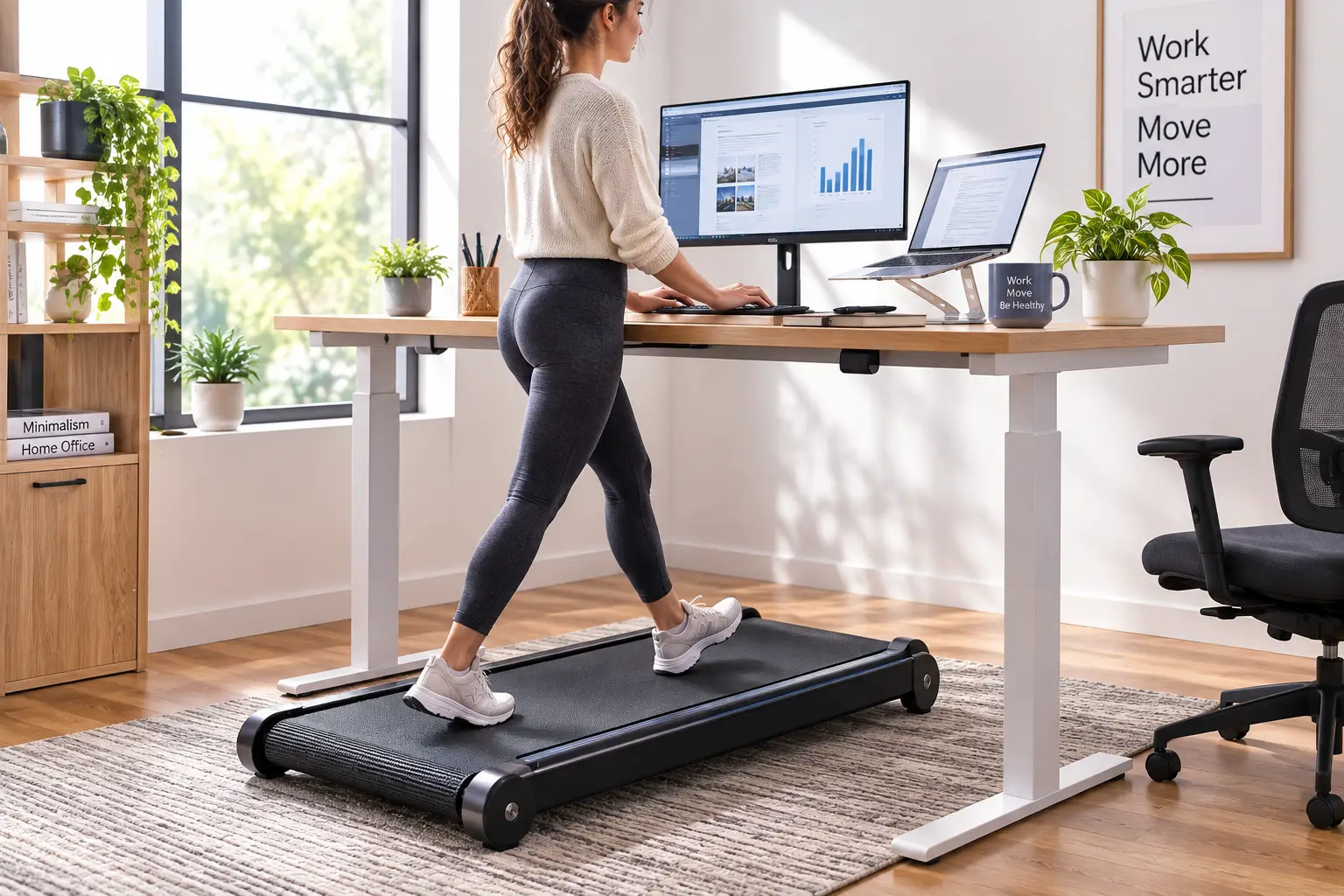
A manual treadmill under desk is a non-motorized walking machine, powered entirely by your own steps, low-profile enough to sit beneath a standing desk or tuck into a small home office. Unlike electric walking pads, it needs no outlet, runs on flywheel or magnetic resistance instead of a motor, and lets you set your own pace instead of following a preset speed dial.
If you’ve spent the past few years bouncing between a standing desk and a chair, wondering whether there’s a real middle ground, you’re not alone. Most American adults fall well short of the roughly 150 minutes of moderate weekly activity recommended by the CDC, and a big part of the problem is that the workday itself is built around sitting still. A manual walking treadmill under desk setup is one of the few fixes that actually fits inside a real workday instead of competing with it — no gym bag, no commute, no interruption to a video call.
This guide breaks down 7 real manual treadmills you can currently order for a home office setup, ranging from budget flywheel models around $100 to a near-commercial curved-deck unit closer to $1,000. We compare specs honestly, flag real complaints pulled from aggregated customer reviews, and walk through how to actually use one without wrecking your workflow — or your ankles. Whether you’re after a simple non-motorized under desk treadmill for light walking during calls or a sturdier manual walking treadmill for office use that can handle a full workday, you’ll find a genuinely available option below, along with the reasoning to pick the right one for your body, your desk, and your budget.
At a Glance: Quick Comparison
| Product | Weight Capacity | Incline | Best For |
|---|---|---|---|
| ProGear 190 | 230 lbs | 2 fixed levels (6°/10°) | Budget incline training |
| Sunny Health & Fitness SF-T1407M | 220 lbs | Fixed 13.5% | Reliable all-around pick |
| Sunny Health & Fitness SF-T1407Smart | 330 lbs | Fixed 14% | App-connected tracking |
| Stamina InMotion | 225 lbs (170 lbs recommended) | 2 fixed levels (8%/10%) | Smallest footprint |
| Exerpeutic 100XL | 325 lbs | 3 levels (8°/10°/15°) | Heart-rate tracking, higher capacity |
| MaxKare Manual Walking Treadmill | 242 lbs | Fixed 10° | Lightweight ultra-budget option |
| SB Fitness CT250 | 300 lbs | None (curved self-paced) | Premium, rail-free desk design |
Looking at the table, the split is pretty clean: the ProGear 190, Stamina InMotion, and MaxKare Manual Walking Treadmill compete on price and footprint, the two Sunny Health & Fitness models sit in the reliable middle ground with the strongest review history, and the Exerpeutic 100XL and SB Fitness CT250 serve heavier users or buyers who want a sturdier, more gym-grade build. Weight capacity turns out to be the real dividing line in this category more than price does — several budget models cap out well under 250 lbs, which matters more for desk use than it might for a treadmill you only use for scheduled workouts.
💬 One click helps other shoppers make an informed choice too! 😊
Top 7 Manual Treadmills Under Desk: Expert Analysis
1. ProGear 190 — best budget pick with real incline
The ProGear 190 earns its spot first because it’s one of the few sub-$150 manual treadmills that still gives you adjustable incline instead of a single fixed angle.
Its twin cast-iron flywheels are the mechanical heart of the unit — they’re what keep the belt moving smoothly under your feet instead of jerking with every step, a common failure point on cheaper single-flywheel designs. The two incline positions (6° and 10°) let you shift the workout from a light desk-walk pace to something that noticeably raises your heart rate, and the whole unit folds down with transport wheels for storage between uses. Based on comparing the specs against similarly priced competitors, the ProGear 190 punches above its price point specifically because of that incline feature, which most $100–$150 manual treadmills skip entirely.
This is the pick for someone testing the manual-treadmill-under-desk concept for the first time without committing serious money, or for a smaller home office where storage matters more than raw durability. Reviews consistently report that assembly takes under 30 minutes and that the unit is genuinely quiet enough for calls, but a recurring theme in owner feedback is concern about long-term frame durability for users approaching the 230-lb weight limit — the 1-year frame warranty reinforces that this is built to a price point, not for heavy daily abuse.
Pros:
- ✅ Adjustable 2-level incline at a budget price
- ✅ Folds flat with wheels for easy storage
- ✅ Quiet twin-flywheel operation for desk calls
Cons:
- ❌ 230-lb weight capacity excludes many users
- ❌ Frame warranty is limited to just 1 year
Typically priced around $100 to $130, the ProGear 190 is solid value for lighter users who specifically want incline — just don’t expect it to hold up to heavy year-round use near its weight limit.
2. Sunny Health & Fitness SF-T1407M — most reliable all-around pick
The Sunny Health & Fitness SF-T1407M lands as the most dependable all-rounder in this lineup, backed by one of the largest verified review bases in the manual treadmill category.
Its dual weighted flywheels are tuned for what Sunny calls “controlled performance,” which in practice means the belt responds quickly the moment you step on it rather than lagging behind your stride — a small detail that matters a lot when you’re trying to walk naturally while typing. The fixed 13.5% incline can’t be adjusted, but it’s steep enough to turn a slow desk walk into a genuine low-impact workout without you having to think about a setting. What most buyers overlook with this model is the floor stabilizers, which keep the deck from rocking on uneven flooring — a common complaint with cheaper competitors that skip this feature.
Aggregated customer reviews put the Sunny Health & Fitness SF-T1407M at 4.3 stars across roughly 120 ratings, with recurring praise for smooth operation out of the box and criticism clustered around occasional belt misalignment after heavy use and setup instructions that some buyers found unclear. It’s a strong match for someone who wants a “just works” manual treadmill under desk without app features or a big price tag, and the 3-year structural frame warranty is unusually generous for this price tier.
Pros:
- ✅ Strong 4.3-star rating across roughly 120 reviews
- ✅ Floor stabilizers reduce wobble on uneven surfaces
- ✅ 3-year structural frame warranty
Cons:
- ❌ Fixed incline can’t be adjusted or turned off
- ❌ Some owners report belt misalignment over time
Around $200, the Sunny Health & Fitness SF-T1407M is arguably the safest first purchase in this whole category — proven, well-reviewed, and easy to set up.
3. Sunny Health & Fitness SF-T1407Smart — best app-connected option
The Sunny Health & Fitness SF-T1407Smart takes the same core mechanical platform as the SF-T1407M and adds Bluetooth connectivity, making it the pick for anyone who actually wants to log their walking data.
Feature-wise, it pairs with Sunny’s free SunnyFit app, unlocking access to guided workouts and thousands of virtual scenic walking routes, plus real-time syncing to Bluetooth-enabled fitness devices. In practice, that means your step count and distance stop living only on a small LCD readout and start feeding into the same ecosystem you might already use for other workouts. The bump to a 330-lb weight capacity — noticeably higher than its sibling model — also makes this the more inclusive choice for larger users who still want a manual (not electric) unit.
Reviews mirror the SF-T1407M almost exactly, sitting at 4.3 stars across about 108 ratings, which suggests the shared mechanical platform is the real driver of satisfaction rather than the smart features being a gimmick. A common thread in customer feedback is appreciation for the higher weight rating specifically, with several reviewers noting they’d been turned away by the 220-lb cap on cheaper alternatives. The tradeoff is that the fixed 14% incline is even steeper than the standard model’s, so it’s a slightly more demanding walk from the first step.
Pros:
- ✅ 330-lb weight capacity, higher than most rivals
- ✅ Bluetooth app tracking with guided routes
- ✅ Consistent 4.3-star rating across 108 reviews
Cons:
- ❌ Fixed 14% incline is steep for slow, casual walking
- ❌ App features add little if you don’t use fitness apps
Priced similarly to its sibling at around $200, the Sunny Health & Fitness SF-T1407Smart is the better buy specifically for heavier users or anyone who wants their walking data synced automatically.
4. Stamina InMotion — smallest footprint for tight spaces
The Stamina InMotion has been a fixture in the compact manual treadmill category for over a decade, and it earns its spot here purely on footprint — it folds down to roughly 17 by 22 inches, small enough to slide under a bed or into a closet.
Mechanically, it relies on dual-weighted flywheels and offers two incline positions (8% and 10%), with a battery-powered LCD monitor tracking time, speed, distance, and calories through a single button. Here’s what to weigh before buying: Stamina itself lists a 225-lb weight capacity, but reviewers consistently recommend treating 170 lbs as the practical ceiling for stable, comfortable use — a meaningfully more conservative number than the spec sheet suggests. That gap between marketed and practical capacity is the single most important thing to know about this unit before ordering it.
Aggregated review sentiment is best described as cautiously mixed. Reviews consistently report that the unit is “better than expected” for light use or gentle rehab-style walking, but a recurring and specific complaint is belt slippage that requires mid-session adjustment, along with monitor readings that don’t always track accurately. The honest takeaway: this is a fine choice for a smaller-framed user who mainly wants the smallest possible footprint and light, low-impact movement — not a durable daily-driver for a full workday of walking.
Pros:
- ✅ Extremely compact folded footprint
- ✅ Simple one-button LCD monitor
- ✅ Easy, fast assembly out of the box
Cons:
- ❌ Belt slippage is a recurring complaint
- ❌ Practical weight limit is lower than advertised
At around $130, the Stamina InMotion is best suited to light users who prioritize storage size above everything else.
5. Exerpeutic 100XL — best for heart-rate tracking and higher capacity
The Exerpeutic 100XL stands out from the rest of this list by combining a 325-lb weight capacity with built-in heart-rate sensors, making it the most complete manual option for anyone tracking cardio effort rather than just steps.
Its dual-flywheel system offers 8 magnetic resistance levels — a genuine step up from the fixed or two-position incline setups on cheaper models — paired with 3 manual incline positions (8°, 10°, and 15°) for a wider range of intensity. The pulse sensors built into the handlebars feed a heart-rate reading to the LCD display alongside time, speed, distance, and calories, which turns a basic desk-walk into something you can actually train with. Based on comparing the spec sheet against the rest of this list, the 325-lb capacity and 8-level resistance combination is unmatched below the SB Fitness CT250’s price tier.
Review sentiment leans positive, with the unit frequently described as “punching above its weight” for budget-conscious buyers who still want real resistance adjustability. The most common criticism isn’t about the mechanics — it’s assembly, which several owners describe as more involved than competitors, plus occasional reports of the frame feeling less stable during faster-paced walking. For most desk-based walking at a moderate pace, though, stability isn’t a practical issue.
Pros:
- ✅ 325-lb weight capacity, among the highest here
- ✅ 8 magnetic resistance levels plus 3 inclines
- ✅ Built-in heart-rate pulse sensors
Cons:
- ❌ Assembly is reported as more difficult than average
- ❌ Some owners note reduced stability at faster paces
In the $350 to $400 range, the Exerpeutic 100XL is the strongest value for larger users who want real resistance control, not just an incline switch.
6. MaxKare Manual Walking Treadmill — lightest ultra-budget option
The MaxKare Manual Walking Treadmill rounds out the budget tier as the lightest unit on this list at roughly 46 lbs, making it the easiest to lift, angle, or move out of the way after a work session.
Its fixed 10° incline sits in the middle of the pack — steeper than a flat walking surface but not as aggressive as the Sunny models’ 13–14% grades — and the compact frame (about 50 by 23 by 45 inches) is noticeably smaller than most of its direct competitors. The LCD monitor and foam handlebars cover the basics without adding complexity, and the low overall weight means one person can realistically reposition it solo, which isn’t true of heavier units like the SB Fitness CT250. What the spec sheet doesn’t say, but the footprint implies, is that this is designed first for portability and only second for heavy-duty daily mileage.
MaxKare has built its broader catalog around compact home fitness gear, and this manual model follows that pattern closely — it’s a newer entrant to the manual treadmill space compared to established names like Sunny or Stamina, so the independent review history is thinner than on longer-running models. That’s worth factoring in honestly: it’s a reasonable bet for light, casual use, but buyers wanting a long review track record should lean toward the Sunny or ProGear options instead.
Pros:
- ✅ Lightest unit on this list at about 46 lbs
- ✅ Compact frame fits tighter spaces easily
- ✅ Simple, no-fuss LCD monitor and handlebars
Cons:
- ❌ Thinner independent review history than rivals
- ❌ Fixed incline offers no adjustability
Typically listed in the $150 to $200 range, the MaxKare Manual Walking Treadmill is a reasonable pick for light users prioritizing weight and portability over a long track record.
7. SB Fitness CT250 — premium, rail-free desk design
The SB Fitness CT250 is the clear high-end pick here, and it’s the only model on this list purpose-built with a curved, self-generated deck that lets you walk naturally without needing to grip a handrail — which is exactly what makes it genuinely desk-friendly rather than desk-adjacent.
Its curved slat belt moves entirely from your own footfall, with no motor and no fixed incline to fight against — instead, the curvature itself creates resistance that increases the harder you push off, so the workout scales naturally with your effort. The medical-grade handrails run the full length of the frame for anyone who wants them nearby, but the low 7.5-inch step-up height and 50-by-16-inch walking track mean most users can walk hands-free while typing, which the rail-dependent budget models in this list simply can’t offer. Here’s what most buyers overlook: the 300-lb weight capacity and 5-year frame warranty put this closer to commercial-grade equipment than to the other six products here, which is exactly why it costs roughly eight times as much as the cheapest option on this list.
Because this is a newer, higher-end release from a smaller US-based equipment brand, its aggregated review volume is lower than long-established names like Sunny — so treat the sentiment as directionally positive but not yet as deep a sample size. What’s verifiable is the spec sheet and the warranty terms, both of which are genuinely stronger than anything else in this category.
Pros:
- ✅ Curved deck allows hands-free, rail-free walking
- ✅ 300-lb capacity with 5-year frame warranty
- ✅ Low 7.5-inch step-up height for easy entry
Cons:
- ❌ Roughly 8x the price of the cheapest option here
- ❌ Smaller review sample than established competitors
In the $900 to $1,000 range, the SB Fitness CT250 is the pick for buyers who’ve confirmed they want to commit to manual desk walking long-term and are willing to pay for commercial-grade build quality.
How to Choose a Manual Treadmill Under Desk
Picking between these seven options gets easier once you rank your priorities in this order:
- Weight capacity first. Check your actual body weight against the listed capacity, then mentally discount it by 10-15% based on the practical-vs-marketed gap seen with models like the Stamina InMotion.
- Desk clearance second. Measure the height from your floor to the underside of your desk, then compare it against the treadmill’s deck height — most manual units run 7 to 9 inches tall at the walking surface.
- Incline style third. Decide whether you want a fixed incline (simpler, usually cheaper, like the Sunny Health & Fitness models) or adjustable levels (more flexible, like the ProGear 190 or Exerpeutic 100XL).
- Handrail dependency fourth. If you plan to type or hold a mouse while walking, prioritize models with a low step-up height and minimal reliance on rails, like the SB Fitness CT250.
- Noise tolerance fifth. All manual treadmills are quieter than motorized ones, but flywheel mechanisms still produce a rhythmic hum — a real factor if you’re on frequent video calls.
- Review depth sixth. Favor models with larger review samples (the two Sunny Health & Fitness units) if you want more certainty before buying, and treat newer entrants like MaxKare as a calculated risk.
- Budget last, not first. Buying the cheapest option and being disappointed by its weight limit costs more in the long run than starting one tier higher.
Working through these criteria in order — rather than starting with price — is what actually prevents the most common return reason in this category: buying a unit, then discovering the weight capacity or incline doesn’t match how the buyer actually intended to use it.
How to Set Up and Use Your Manual Treadmill Under a Desk
Getting a manual treadmill under desk right isn’t just about assembly — it’s about the first two weeks of actual use, which is where most people either build the habit or quietly abandon the machine in a corner.
Start with desk height. Most manual treadmill decks add 7 to 9 inches of standing height, so if you’re using a fixed-height desk rather than an adjustable one, measure first — a desk that felt fine standing on the floor can suddenly feel too low once you’re standing on a treadmill deck. Next, position the unit so the console or flywheel housing sits fully underneath the desk, leaving your walking surface exposed; most manual treadmills, including the ProGear 190 and Stamina InMotion, come with transport wheels specifically so you can slide them in and out without lifting.
For your first sessions, resist the urge to match your normal walking pace. Manual treadmills require your own momentum to keep the belt moving smoothly, so a too-slow first step can feel jerky — start at a moderate, steady pace for 10-15 minutes and let your stride adjust to the flywheel’s resistance before typing anything complex. Most new owners find that reading emails or attending audio-only calls works well in week one, while detailed typing or video calls with heavy screen focus are easier to introduce once your balance adapts, typically after 5-7 sessions.
A quick maintenance habit worth building early: wipe down the belt and check for any lateral drift every couple of weeks, since minor misalignment (a common complaint on cheaper models like the ProGear 190) is far easier to correct early than after months of use. Tightening the belt-tension bolts, usually located at the rear rollers, resolves most drift issues in under five minutes.
📝 Save these setup steps and revisit them during your first two weeks of walking-while-working.
Real-World Scenarios: Which Manual Treadmill Fits Your Work Style
Scenario 1: The all-day remote worker on a budget. If you’re working 8-hour remote shifts and want to walk during calls without a big upfront investment, the Sunny Health & Fitness SF-T1407M is the practical match — its fixed incline keeps effort consistent without requiring you to fiddle with settings mid-call, and its review history gives you real confidence before buying.
Scenario 2: The larger-frame user who’s been turned away by low weight limits. If you’ve checked a few “under desk treadmill” listings and kept hitting 220-lb capacity ceilings, both the Exerpeutic 100XL (325 lbs) and the Sunny Health & Fitness SF-T1407Smart (330 lbs) solve that specific problem, with the Exerpeutic adding heart-rate tracking as a bonus for anyone treating this as real cardio, not just background movement.
Scenario 3: The small-apartment worker with limited storage. If your home office doubles as a bedroom or living space and the treadmill has to disappear when you’re done, the Stamina InMotion or MaxKare Manual Walking Treadmill are built for that constraint — both are light enough to lift solo and fold down to a footprint that fits in a closet.
Scenario 4: The buyer who’s already committed to walking daily. If you’ve tested the concept with a cheaper unit and know you’ll use it for years, the SB Fitness CT250‘s rail-free curved deck and 5-year warranty make more financial sense than replacing a budget model every couple of seasons — the total cost of ownership evens out faster than it looks on the price tag alone.
Scenario 5: The incline-focused user chasing a harder workout. If flat walking feels too easy and you want your desk sessions to double as light cardio training, the ProGear 190‘s adjustable incline or the Exerpeutic 100XL‘s 3-level incline plus 8-level resistance give you room to progress instead of plateauing on a fixed grade.
Common Problems and Solutions With Manual Treadmills Under a Desk
Problem: The belt slips or drifts to one side. This is the most frequently reported issue across budget models like the ProGear 190 and Stamina InMotion. Solution: locate the tension bolts at the rear rollers (usually two, one per side) and tighten in small quarter-turns, checking belt centering after each adjustment rather than over-tightening at once.
Problem: The treadmill feels too tall for your existing desk. Solution: either raise your desk on risers (cheap and effective, typically 2-4 inches), switch to an adjustable-height desk, or choose a lower-profile model — the MaxKare Manual Walking Treadmill and ProGear 190 run slightly lower than the Sunny models.
Problem: You lose balance or feel unsteady in the first few sessions. Solution: this is normal and typically resolves within a week. Start hands-near-rail even on rail-optional models like the SB Fitness CT250, keep initial sessions under 15 minutes, and avoid checking your phone while walking until your stride feels automatic.
Problem: The console or LCD monitor gives inconsistent readings. Solution: this shows up most in reviews of the Stamina InMotion and budget flywheel models generally — treat the built-in monitor as a rough estimate rather than a precise tracker, and pair a separate fitness watch if accurate calorie or distance data matters to you.
Problem: Noise is more noticeable than expected during video calls. Solution: place a thin rubber mat under the unit to dampen flywheel vibration transfer to the floor, and mute your mic between speaking turns — most manual treadmills produce a low rhythmic hum rather than motor noise, which is far less disruptive than an electric walking pad but still audible in a quiet room.
Common Mistakes to Avoid When Buying a Manual Treadmill Under Desk
Even careful shoppers tend to repeat a handful of avoidable mistakes in this category. Buying based on price alone tops the list — a $100 unit that can’t safely support your weight isn’t actually cheaper once you factor in a second purchase down the line. Ignoring the practical-versus-marketed weight capacity gap is a close second; as the Stamina InMotion example shows, manufacturer specs and real-world comfort don’t always match, so it pays to read aggregated reviews specifically for weight-related complaints before trusting the number on the box.
Skipping desk-height measurement is another common misstep — buyers frequently discover only after unboxing that their fixed-height desk sits too low once a 7-9 inch deck is added underneath. Overlooking incline type causes regret too: buyers who want a gentle, flat walk sometimes end up with a fixed 13-14% incline model like the Sunny Health & Fitness units, which is more demanding than expected for slow, all-day background walking.
Finally, many buyers underestimate the assembly and floor-space commitment. Even folding units like the ProGear 190 need floor clearance to fold and unfold safely, and skipping that step check before purchase leads to units that end up permanently unfolded and in the way, defeating the point of buying a compact model in the first place.
Manual Treadmill vs Electric Walking Pad: Which Is Right for Your Desk?
The core tradeoff between a manual treadmill under desk and an electric walking pad comes down to control versus convenience. A manual unit like the SB Fitness CT250 or ProGear 190 requires zero electricity, produces less mechanical noise since there’s no motor housing, and scales resistance naturally with your own effort — the harder you push, the more resistance you feel. An electric walking pad, by contrast, sets a fixed speed for you, which some users find easier to sustain consistently but which also means the machine is dictating your pace rather than the other way around.
| Factor | Manual Treadmill | Electric Walking Pad |
|---|---|---|
| Power required | None | Wall outlet |
| Best for | Variable-pace desk walking | Consistent fixed-speed walking |
| Noise level | Low, mechanical hum | Low-to-moderate motor hum |
| Typical price range | $100–$1,000 | $150–$600 |
| Maintenance | Belt tension, no motor to service | Belt plus motor components |
Looking at the table, manual treadmills generally win on simplicity and cost of ownership — there’s no motor to eventually fail — while electric walking pads win on consistency for users who prefer not to self-regulate pace. If your priority is truly hands-free, distraction-free walking during long calls, the fixed pace of an electric pad can actually be less mentally taxing; but if you want a machine that costs nothing to run and responds directly to your own movement, a manual walking treadmill for office use remains the simpler, more durable long-term choice.
🔍 Compare your shortlist side by side before you commit to either style — it’s easier to switch plans now than after assembly.
Manual Treadmill Under Desk for Different Users
For remote workers with long call schedules: prioritize the quietest, most stable-feeling options — the Sunny Health & Fitness SF-T1407M and SF-T1407Smart both benefit from floor stabilizers that reduce the wobble that can translate into visible camera shake during video calls.
For larger-bodied users: the Exerpeutic 100XL and Sunny Health & Fitness SF-T1407Smart are the only two options here clearing the 300+ lb mark, and both back that capacity with wider decks that reduce the feeling of walking on a narrow strip.
For smaller apartments or shared spaces: the Stamina InMotion and MaxKare Manual Walking Treadmill solve the storage problem most directly, at the cost of a lower practical weight ceiling and thinner review history, respectively.
For older adults or anyone easing back into activity: a lower, more gradual incline matters more than raw resistance — the ProGear 190‘s lower 6° starting incline or the SB Fitness CT250‘s self-paced curve (which lets you start essentially flat and build up gradually) are gentler entry points than the steeper fixed-incline Sunny models.
This kind of everyday-performance mismatch — buying based on specs alone rather than how a machine actually feels for your body type and daily routine — is exactly the gap that aggregated reviews are useful for closing, since real owners tend to flag exactly this kind of fit issue that a spec sheet alone can’t capture. Broader research on workplace movement backs this up directionally: a 2022 review in Frontiers in Public Health on non-exercise activity thermogenesis in the workplace found that small, sustainable increases in incidental movement during work hours are more likely to stick long-term than occasional intense exercise sessions — which is a strong case for choosing a treadmill that actually fits your specific work style over one that simply has the flashiest spec sheet.
Long-Term Cost and Maintenance
Sticker price only tells part of the ownership story with a manual treadmill under desk. The cheapest options here — the ProGear 190 at around $100-$130 and the Stamina InMotion at around $130 — carry shorter frame warranties (1 year in the ProGear’s case) and more frequent reports of belt-related wear, which means a realistic 2-3 year lifespan under regular use is a fair expectation rather than a worst-case scenario.
The mid-tier Sunny Health & Fitness models change that math meaningfully: a 3-year structural frame warranty at roughly the same $200 price point as far shorter-warrantied competitors effectively lowers the cost-per-year of ownership, even though the sticker price looks similar to some cheaper units. The Exerpeutic 100XL, priced higher in the $350-$400 range, trades some of that warranty confidence for genuinely higher-capacity hardware, which matters more if you’re near the weight limits of cheaper models.
At the top end, the SB Fitness CT250‘s 5-year frame and 2-year parts warranty, paired with medical-grade components, functionally shifts it into a different ownership category — closer to how you’d budget for commercial-grade equipment than a typical home accessory. Maintenance costs across the entire category stay low regardless of tier: no motor means no motor replacement, and the main recurring task is periodic belt-tension adjustment, which takes minutes and costs nothing beyond the hex key most units ship with.
Safety, Regulations, and Standards
Manual treadmills aren’t regulated identically to their motorized counterparts, but the same core safety logic applies. The Consumer Product Safety Commission maintains voluntary safety standards for treadmills developed through ASTM International’s F08.30 committee, and while these standards were written primarily with motorized units in mind, reputable manual treadmill manufacturers generally design to comparable structural and stability benchmarks even though compliance isn’t always independently certified for non-motorized equipment the way it is for electric models.
Practical safety for desk use comes down to a few consistent habits: keep the walking area clear of cables and cords (a real risk with treadmills placed under a desk full of monitor and charging cables), maintain the recommended weight capacity rather than treating it as a soft suggestion, and inspect belt tension periodically, since a loose or misaligned belt is both a performance and a tripping-hazard issue. Consumer Reports’ guidance on treadmill safety also recommends keeping a stable hand position available during the first several sessions on any new treadmill, manual or electric, until your balance fully adapts — advice that applies directly to models like the SB Fitness CT250 that are designed to eventually be used hands-free.
None of the seven products here carry federal recalls as of this writing, and manual treadmills as a category carry meaningfully lower injury risk than motorized units specifically because there’s no motor to suddenly accelerate the belt out from under you — the machine only moves as fast as you do.
Full Side-by-Side Comparison of All 7 Manual Treadmills
| Product | Weight Capacity | Incline | Price Range | Rating |
|---|---|---|---|---|
| ProGear 190 | 230 lbs | 2 levels (6°/10°) | $100–$130 | Not independently verified at scale |
| Sunny Health & Fitness SF-T1407M | 220 lbs | Fixed 13.5% | ~$200 | 4.3★ (~120 reviews) |
| Sunny Health & Fitness SF-T1407Smart | 330 lbs | Fixed 14% | ~$200 | 4.3★ (~108 reviews) |
| Stamina InMotion | 225 lbs | 2 levels (8%/10%) | ~$130 | Mixed, cautiously positive |
| Exerpeutic 100XL | 325 lbs | 3 levels (8°/10°/15°) | $350–$400 | Generally positive |
| MaxKare Manual Walking Treadmill | 242 lbs | Fixed 10° | $150–$200 | Limited review history |
| SB Fitness CT250 | 300 lbs | None (curved) | $900–$1,000 | Positive, smaller sample |
Side by side, the two Sunny Health & Fitness models stand out as the only ones with a large, consistent review base backing up their specs, which is worth weighing heavily if buying confidence matters as much as raw features to you. The SB Fitness CT250 and Exerpeutic 100XL justify their higher prices with genuinely higher weight capacities and sturdier engineering, while the ProGear 190, Stamina InMotion, and MaxKare Manual Walking Treadmill compete mainly on being the cheapest realistic entry point into the category.
Frequently Asked Questions
❓ Is a manual treadmill under desk hard to use while typing?
❓ How much does a manual treadmill under desk cost?
❓ Do manual treadmills fit under a standard desk?
❓ Are manual treadmills noisy enough to disrupt video calls?
❓ Can a manual treadmill under desk handle a heavier user safely?
Conclusion
A manual treadmill under desk isn’t a magic fix for a sedentary workday, but it’s one of the few pieces of equipment that genuinely fits inside the hours you’re already spending at your desk rather than asking for more time you don’t have. The right pick really does depend on your specific situation: the Sunny Health & Fitness SF-T1407M remains the safest, most proven all-around choice for most home offices, the ProGear 190 and Stamina InMotion serve tighter budgets and smaller spaces well, the Exerpeutic 100XL and Sunny Health & Fitness SF-T1407Smart step up for larger users who need higher weight capacity, and the SB Fitness CT250 stands alone for buyers ready to invest in a rail-free, commercial-grade experience.
Whichever model you land on, the buying process outlined above — checking weight capacity honestly, measuring your desk clearance, and reading aggregated reviews for the specific complaints that matter to your use case — will save you from the most common regret in this category: a treadmill that looked great on paper but didn’t fit your body, your desk, or your daily routine. Start with the option that matches where you actually are today, not where you hope to be in six months, and build the habit from there.
Recommended for You
- Height Adjustable Corner Desk: 7 Best Picks for 2026
- Laptop Monitor Mount: 7 Best Picks for an Ergonomic Desk in 2026
- Desk With Hidden Monitor Lift: 7 Best Options to Try in 2026
Disclaimer: This post contains affiliate links. As an Amazon Associate, I earn from qualifying purchases made through these links, at no additional cost to you.
✨ Found this article helpful? Share it with someone who needs it! 💬🤗