
In This Article
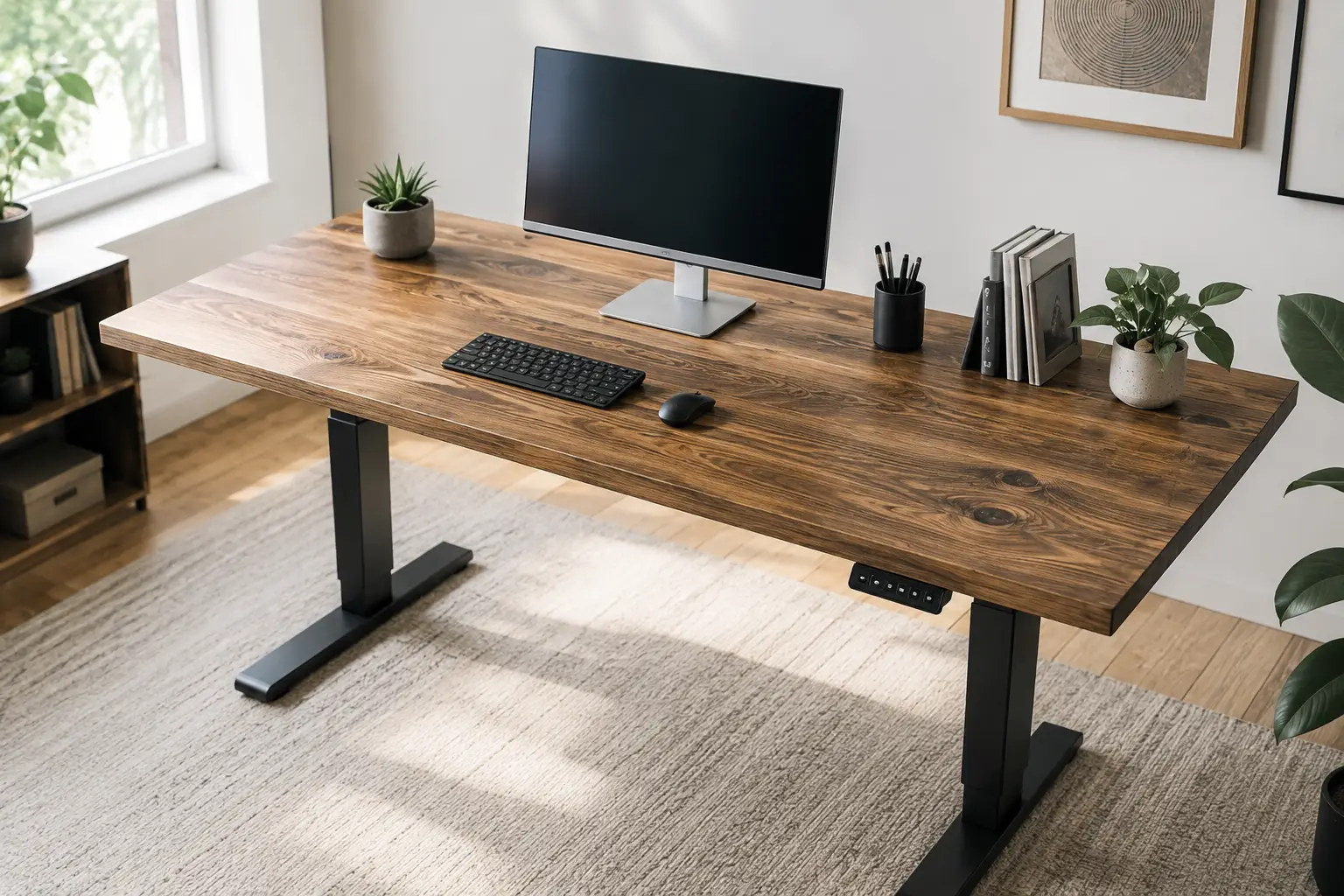
A standing desk table top is the surface that actually determines how your sit-stand setup looks, feels, and holds up over years of daily use — yet most buyers spend all their research time comparing motors and frames, then grab whatever desktop ships in the box. Mayo Clinic research has repeatedly linked reduced sitting time to measurable health benefits, and the tabletop is the part of that setup you’ll physically touch, lean on, and stare at every single day.
Buying a standing desk table top separately from the frame — or replacing a damaged, scratched, or simply outdated one — opens up options that pre-bundled desks rarely offer: real solid wood, thicker butcher-block construction, or a universal fit that lets you keep a motorized frame you already like while upgrading everything above it. This guide covers seven real, currently available tabletop options, from budget particle board to premium bamboo, with honest specs and real aggregated review sentiment so you can match a surface to your frame, your budget, and how hard you actually plan to use it.
Here’s the short version: if you already own a compatible frame, check its grommet spacing and mounting hole pattern before anything else — that single detail eliminates more bad purchases in this category than price or material ever does.
Quick Comparison: Standing Desk Table Top Options at a Glance
| Product | Material | Thickness | Price Range | Best For |
|---|---|---|---|---|
| SANODESK Whole-Piece Particle Board Table Top | Particle board/laminate | About 1 inch | Around $60–$90 | Budget-friendly upgrades |
| VIVO Universal Table Top | Engineered wood/MDF | About 1 inch | Around $80–$110 | Widest frame compatibility |
| COREMINDED Solid Wood Desk Table Top | Solid rubberwood | About 1.2 inches | Around $100–$140 | Real solid wood on a budget |
| VWINDESK Solid Bamboo Desk Table Top | Solid bamboo | About 1 inch | Around $110–$160 | Water-resistant bamboo finish |
| UPLIFT Bamboo Desktop (Ergo-Edge) | Carbonized bamboo | About 1 inch | Around $250–$400 | Premium, long warranty |
Scanning this table, the real dividing line isn’t brand — it’s material and thickness, which together determine both how the surface feels day to day and how well it resists sagging over a multi-year lifespan. Particle board and MDF options like the SANODESK Whole-Piece Particle Board Table Top and VIVO Universal Table Top keep costs down but are more prone to moisture damage at the edges, while solid wood and bamboo options like the COREMINDED Solid Wood Desk Table Top and UPLIFT Bamboo Desktop cost more but hold up meaningfully better under daily monitor arms, clamps, and spills.
💬 Bookmark this table — you’ll want it again once you’ve compared the full lineup below!
Top 7 Standing Desk Table Top Picks — Expert Analysis
1. SANODESK Whole-Piece Particle Board Table Top — most affordable entry point
For anyone replacing a damaged desktop or building a first standing desk on a tight budget, the SANODESK particle board top is built to be the least expensive real option rather than a compromise you’ll regret in a year. It’s constructed as a single whole-piece panel with a laminate wear layer, rather than the flimsier hollow-core boards sometimes found at the very bottom of this category.
What “whole-piece” construction means in practice: unlike hollow or honeycomb-core budget desktops, a solid particle board core resists the drumming, hollow-sounding flex you get when you tap or lean on cheaper alternatives, and it holds screws for monitor arms and clamps more securely over time. Reviews consistently report that the laminate surface resists everyday scuffs and coffee rings well, though a recurring theme in customer feedback is that the exposed edge banding can lift slightly if consistently exposed to standing water rather than a quick wipe-up.
This is the pick for renters, students, or anyone testing whether a standing desk setup works for them before investing in a pricier surface. Given its price point, expect a genuinely functional, honest particle board top — not a premium material dressed up in marketing language.
Pros:
- ✅ Solid whole-piece core resists hollow flexing
- ✅ Laminate surface handles daily scuffs well
- ✅ Among the most affordable real options available
Cons:
- ❌ Edge banding can lift with prolonged moisture exposure
- ❌ Less premium look and feel than solid wood options
Priced around $60 to $90 depending on size, it delivers real functional value for buyers prioritizing budget over long-term luxury.
2. VIVO Universal Table Top — the widest frame compatibility
VIVO built its reputation in this category on genuinely universal mounting hole patterns, meaning this MDF-core desktop is designed to bolt onto a broader range of motorized and manual frames than most brand-specific alternatives. That universality matters most for anyone who bought a frame separately and needs a top that isn’t locked to a single manufacturer’s mounting spec.
The desktop uses an engineered wood core wrapped in a scratch-resistant laminate, which practically means it resists the everyday wear of sliding a keyboard tray or repositioning a monitor arm better than raw particleboard alone. Reviews consistently highlight how straightforward the mounting hole alignment is across different frame brands, with most buyers reporting successful installs without needing to drill new holes — a common frustration with less carefully engineered budget tops.
Pros:
- ✅ Genuinely broad compatibility across frame brands
- ✅ Scratch-resistant laminate wear layer
- ✅ Straightforward mounting hole alignment
Cons:
- ❌ MDF core is heavier than solid wood of the same size
- ❌ Less resistant to moisture than solid bamboo options
Expect to pay around $80 to $110 depending on size and finish, making it a strong mid-budget pick specifically for buyers matching a top to an existing frame.
3. COREMINDED Solid Wood Desk Table Top — real solid wood without the premium price
Unlike the engineered-wood options above, the COREMINDED top is genuine solid rubberwood, pre-finished at roughly 1.2 inches thick — noticeably heftier than the typical 1-inch engineered tops in this category. Rubberwood is a sustainably farmed hardwood byproduct of rubber plantations, which keeps the cost meaningfully lower than premium hardwoods like walnut or oak while still delivering a real solid-wood look and feel.
What that extra thickness and solid construction mean in practice: it resists sagging under heavy multi-monitor setups better than thinner engineered alternatives, and because it’s genuine wood rather than a veneer over composite, minor surface scratches can be sanded and refinished rather than requiring a full replacement. Reviews describe the grain pattern and finish quality as noticeably nicer than budget laminate tops, with the most common complaint being that its extra weight makes solo installation more difficult than lighter engineered-wood alternatives.
Pros:
- ✅ Genuine solid wood, not a veneer or laminate
- ✅ Thicker profile resists sagging under heavy loads
- ✅ Scratches can be sanded and refinished over time
Cons:
- ❌ Noticeably heavier, harder to install solo
- ❌ Costs more than comparable engineered-wood tops
Priced around $100 to $140, it’s one of the better values in this guide for buyers who want authentic solid wood without paying premium-brand pricing.
4. VWINDESK Solid Bamboo Desk Table Top — water-resistant bamboo built specifically for standing frames
VWINDESK markets this top explicitly as “desk table top only,” meaning it’s designed from the ground up to be purchased separately and paired with an existing standing desk frame, with grommet holes pre-cut to match common motorized frame mounting patterns. It’s constructed from 100% solid bamboo rather than a bamboo veneer, carbonized for its darker tone and coated with a UV-cured varnish layer.
That varnish coating is the detail that matters most in daily use: it makes the surface genuinely water-resistant rather than merely wipeable, which practically means an accidental coffee spill left for a few minutes won’t immediately warp or discolor the wood the way it would on an unsealed surface. Reviews consistently praise the natural grain variation, since bamboo’s fast growth cycle produces a distinctive look that differs from piece to piece, and most buyers report the pre-drilled grommet holes lined up correctly with common frame brands without modification.
Pros:
- ✅ 100% solid bamboo, not a thin veneer
- ✅ UV-cured varnish adds real water resistance
- ✅ Pre-drilled holes fit common motorized frames
Cons:
- ❌ Bamboo grain pattern varies unpredictably piece to piece
- ❌ Carbonized finish shows scratches more than lighter woods
Expect to pay around $110 to $160 depending on size, positioning it as a strong mid-to-upper option for buyers who want a genuinely sustainable, water-resistant material.
5. FLEXISPOT Bamboo Desktop (Whole Piece) — the reliable brand-matched bamboo option
FlexiSpot sells this bamboo desktop as a standalone accessory specifically engineered to pair with its own line of electric standing desk frames, though the mounting pattern is common enough that many buyers successfully use it with other brands’ frames as well. It’s built as a whole-piece solid bamboo panel rather than a laminated strip assembly, which reviewers frequently note gives it a more substantial, premium feel underfoot — or rather, under-hand — than composite alternatives.
What matters most here for buyers already invested in the FlexiSpot ecosystem: because it’s designed and tested specifically against FlexiSpot’s own frames, mounting hole alignment is essentially guaranteed rather than a gamble, removing one of the biggest sources of buyer frustration in this category. Reviews consistently describe the bamboo grain and finish quality as a genuine step up from FlexiSpot’s included default tops, with most buyers citing it as a worthwhile upgrade when replacing an original desktop.
Pros:
- ✅ Guaranteed mounting compatibility with FlexiSpot frames
- ✅ Whole-piece bamboo construction feels substantial
- ✅ Meaningful upgrade over stock included desktops
Cons:
- ❌ Mounting pattern less certain on non-FlexiSpot frames
- ❌ Priced higher than generic universal alternatives
Priced around $130 to $180 depending on size, it’s a smart, low-risk upgrade specifically for existing FlexiSpot frame owners.
6. Bme Hevea Solid Wood Butcher Block Table Top — the thickest, most heavy-duty option
Where most desktops in this category run about an inch thick, the Bme Hevea butcher-block top comes in at roughly 1.5 inches — genuinely substantial, closer to a kitchen countertop than a typical desk surface. It’s constructed from Hevea (rubberwood) strips glued into a traditional butcher-block pattern, sold unfinished so buyers can apply their own stain, oil, or sealant to match their space.
That extra thickness translates directly into real-world durability: it resists sagging under heavy dual-monitor arms or a full desktop tower far better than thinner tops, and its butcher-block construction is inherently more resistant to warping than a single wide plank would be. Because it ships unfinished, reviews are split along a predictable line — woodworking-inclined buyers consistently praise the ability to customize the finish exactly to their taste, while buyers hoping for a ready-to-use surface out of the box are frequently caught off guard by the sealing step required before daily use.
Pros:
- ✅ Genuinely thick, heavy-duty butcher-block construction
- ✅ Highly resistant to sagging under heavy loads
- ✅ Fully customizable finish since it ships unsealed
Cons:
- ❌ Requires sealing or finishing before regular use
- ❌ Significant weight makes handling and mounting harder
Priced around $150 to $220 depending on size, it earns its place for buyers who specifically want DIY-level thickness and are willing to do the finishing work themselves.
7. UPLIFT Bamboo Desktop (Ergo-Edge) — the premium pick with the longest warranty
UPLIFT’s bamboo desktop line is frequently cited by independent buying guides as a top-tier option in this category, and the headline detail is its industry-leading 15-year warranty — a genuinely rare commitment compared to the one-to-three-year warranties typical of budget and mid-range competitors. It’s carbonized bamboo, UV-cured with no added VOCs during finishing, and available in an Ergo-Edge curved profile designed to reduce forearm pressure during long typing sessions.
What that Ergo-Edge curve means in practice: the front edge of the desktop is contoured rather than a hard 90-degree corner, which practically reduces the pressure point on your wrists and forearms during extended keyboard and mouse use compared to a flat-edged alternative. Reviews consistently describe the fit and finish as noticeably more refined than budget bamboo alternatives, and the long warranty is repeatedly cited as a major factor in buyer confidence, particularly for anyone installing it on a frame they expect to keep for a decade or more.
Pros:
- ✅ Industry-leading 15-year warranty coverage
- ✅ Ergo-Edge curve reduces wrist and forearm pressure
- ✅ VOC-free UV-cured finish process
Cons:
- ❌ Significantly higher price than every other option here
- ❌ Curved profile limits some accessory clamp placements
Expect to pay around $250 to $400 depending on size and finish, making it the clear premium choice for buyers prioritizing long-term durability and warranty confidence over upfront savings.
Comparing All 7 Products Side by Side
| Product | Material | Thickness | Grommets | Price Range | Best For |
|---|---|---|---|---|---|
| SANODESK Whole-Piece Particle Board Table Top | Particle board/laminate | ~1 in | Pre-drilled | $60–$90 | Budget upgrades |
| VIVO Universal Table Top | MDF/laminate | ~1 in | Universal pattern | $80–$110 | Widest frame fit |
| COREMINDED Solid Wood Desk Table Top | Solid rubberwood | ~1.2 in | Pre-drilled | $100–$140 | Real wood, lower cost |
| VWINDESK Solid Bamboo Desk Table Top | Solid bamboo | ~1 in | Pre-drilled | $110–$160 | Water-resistant bamboo |
| FLEXISPOT Bamboo Desktop | Solid bamboo | ~1 in | FlexiSpot pattern | $130–$180 | FlexiSpot frame owners |
| Bme Hevea Butcher Block Table Top | Solid Hevea wood | ~1.5 in | Unfinished, drill as needed | $150–$220 | Heavy-duty DIY finish |
| UPLIFT Bamboo Desktop (Ergo-Edge) | Carbonized bamboo | ~1 in | UPLIFT-compatible | $250–$400 | Premium, longest warranty |
Reading across this table, thickness and material track price closely, but frame compatibility is the variable that actually determines whether a purchase succeeds or fails on arrival. The VIVO Universal Table Top and SANODESK Whole-Piece Particle Board Table Top win on flexibility and price respectively, while the UPLIFT Bamboo Desktop and Bme Hevea Butcher Block Table Top serve buyers who’ve already decided durability and finish quality matter more than upfront cost.
✨ Ready to see which surface fits your frame? 🔍 Check current sizing and availability for the picks above!
How to Measure and Install a Standing Desk Table Top
Before ordering anything, measure your existing frame’s mounting bracket width and grommet hole spacing, not just the tabletop dimensions — a top that’s the right length but doesn’t match the bracket pattern is the single most common return reason in this category. Most standing desk frames use either a fixed bracket width or a slotted, adjustable bracket that accommodates a small range of hole spacings; check your frame’s manual or manufacturer page before assuming compatibility.
Once the correct top arrives, lay it face-down on a soft blanket or moving pad to avoid scratching the finish, then position the frame’s mounting brackets according to the manufacturer’s spacing guidance — typically a few inches in from each edge for balanced weight distribution. Pre-drill pilot holes slightly smaller than your mounting screws if the top doesn’t already have pre-cut holes, since driving screws directly into solid wood or bamboo without a pilot hole risks splitting the material. Finally, flip the assembled desk upright with a second person if the top is solid wood or butcher block — these thicker, heavier tops are a genuine two-person lift, and attempting it solo is the most common cause of dropped-and-damaged desktops in the first 30 days.
Real-World Scenarios: Matching the Right Tabletop to Your Setup
Consider a college student setting up a first standing desk in a shared apartment, where budget and easy relocation matter more than long-term investment. The SANODESK Whole-Piece Particle Board Table Top solves this directly — genuinely functional, inexpensive enough to not stress over scuffs, and light enough to move between rooms or apartments without help.
Now consider a remote professional who already owns a FlexiSpot frame and wants a meaningful visual and tactile upgrade without gambling on mounting compatibility. The FLEXISPOT Bamboo Desktop removes that risk entirely, since it’s engineered specifically for the frames the buyer already owns.
Finally, picture a woodworker or DIY enthusiast who wants full creative control over the finish and doesn’t mind the extra weekend project. The Bme Hevea Solid Wood Butcher Block Table Top rewards exactly that mindset, offering a genuinely custom result that pre-finished options simply can’t match.
Problem → Solution: Fixing the Most Common Standing Desk Table Top Issues
Problem: The new tabletop’s grommet holes don’t line up with the existing frame. Before returning the product, check whether your frame uses an adjustable slotted bracket — many can be repositioned within a range without needing an exact factory match.
Problem: A laminate or engineered-wood top has started to bubble at the edges. This is almost always moisture intrusion at an exposed seam; wiping spills immediately and applying edge sealant at the first sign of lifting prevents it from spreading further.
Problem: A solid wood or bamboo top feels like it’s flexing slightly under a heavy monitor arm. Confirm the mounting bracket screws are fully tightened and evenly spaced — most perceived “flex” in solid tops traces back to an under-tightened bracket rather than the material itself.
Problem: An unfinished butcher-block top absorbs stains or water marks quickly. This is expected before sealing; applying a food-safe or furniture-grade sealant, as intended for products like the Bme Hevea top, resolves it and should be done before regular use begins.
How to Choose a Standing Desk Table Top
- Measure your frame’s bracket spacing before shopping by material or price. A perfect-looking desktop that doesn’t match your mounting pattern isn’t a bargain at any price.
- Match thickness to your actual load. Multiple monitors, a monitor arm, and a full-size keyboard tray all benefit from a thicker, sturdier top than a single-laptop setup requires.
- Decide how much moisture exposure is realistic. A kitchen-adjacent home office or a household with frequent drink spills benefits from a sealed, water-resistant finish over raw or unfinished wood.
- Weigh maintenance tolerance honestly. Unfinished butcher-block tops reward buyers willing to seal and occasionally re-oil the surface; pre-finished laminate or varnished tops suit buyers who want zero ongoing maintenance.
- Consider ergonomic desk height guidance from OSHA when sizing your setup. Desk surface height and leg clearance matter as much as the tabletop material for long-term comfort.
- Check the warranty length as a durability signal. A longer warranty, like UPLIFT’s 15-year coverage, often reflects genuine manufacturer confidence in the material and finish.
- Confirm the weight two people can safely lift during installation. Solid wood and butcher-block tops are meaningfully heavier than engineered-wood alternatives and should be planned for accordingly.
Solid Wood vs. Engineered Wood Table Tops: Which One Actually Wins?
There’s no universal winner here — the right material depends on what you’re optimizing for. Solid wood and bamboo tops, like the entries from COREMINDED, VWINDESK, and UPLIFT, win on long-term durability, refinishing potential, and a genuinely premium look and feel. Because they’re a uniform material rather than a thin veneer over composite, minor damage can often be sanded out rather than requiring full replacement, and they tend to hold their shape better under sustained heavy loads over many years.
Engineered wood options — MDF or particle board with a laminate wear layer, like the SANODESK and VIVO entries — win decisively on upfront cost and weight, making installation and relocation meaningfully easier for one person to handle alone. Bamboo itself is technically a fast-growing grass rather than a hardwood, which is part of why bamboo desktops tend to land at a lower price point than genuine hardwoods like oak or walnut while still offering solid-material durability.
| Factor | Solid Wood / Bamboo | Engineered Wood (MDF/Particle Board) |
|---|---|---|
| Upfront cost | Higher | Lower |
| Weight | Heavier | Lighter, easier to install solo |
| Refinishing potential | Sandable, repairable | Not repairable if damaged |
| Moisture resistance | Depends on finish | Vulnerable at exposed edges |
| Best use case | Long-term primary desk | Budget or temporary setups |
For most buyers planning to keep a standing desk for more than a couple of years, a solid wood or bamboo top like the VWINDESK Solid Bamboo Desk Table Top or COREMINDED Solid Wood Desk Table Top delivers meaningfully better long-term value, even at a higher upfront price.
Common Mistakes to Avoid When Buying a Standing Desk Table Top
The single most frequent and costly mistake is ordering by overall dimensions alone without confirming the mounting bracket spacing — a tabletop can be the exact right length and width and still be unusable if the grommet or screw pattern doesn’t match the frame underneath it. A close second is underestimating weight: buyers regularly order a thick solid wood or butcher-block top expecting a solo install, only to discover it genuinely requires two people to safely flip and mount.
Buyers also commonly overlook finish requirements, assuming an unfinished butcher-block top is ready to use immediately out of the box when it actually needs sealing first to resist stains and moisture. Finally, don’t assume every “universal” desktop fits every frame equally well — always cross-reference the specific hole pattern against your frame’s documentation rather than relying on marketing language alone.
What to Expect: Everyday Performance
On paper, most tabletops in this category advertise similar weight capacities in the 150 to 300 pound range, largely governed by the frame rather than the tabletop material itself. In everyday use, the differences show up more in surface feel and long-term wear than in raw capacity numbers — a laminate top feels noticeably cooler and harder under the wrists than a sealed bamboo or solid wood surface, which many users report as more comfortable during long typing sessions.
Edge durability also varies meaningfully in daily use beyond what spec sheets suggest. Laminate and MDF edges are the first place visible wear appears, typically after a year or two of regular elbow contact and equipment sliding, while solid wood and bamboo edges tend to show wear more gradually and can often be lightly sanded to refresh the finish rather than replaced outright.
Long-Term Cost and Maintenance
Engineered wood tops have effectively zero maintenance requirements beyond routine wiping, but they also have no meaningful path to repair once the laminate chips or the core swells from moisture — at that point, replacement is the only real option. Solid wood and bamboo tops cost more upfront but can typically be lightly sanded and re-oiled or re-varnished every few years to restore their original look, which meaningfully extends the useful lifespan compared to a one-and-done engineered-wood surface.
Over a five-year span, a household that buys a mid-range solid wood or bamboo top and performs occasional maintenance will often land at a lower total cost than replacing a budget engineered-wood top twice in the same period after edge damage or moisture swelling. The practical takeaway: if you expect to keep your standing desk for more than three or four years, the math tends to favor paying more upfront for a genuinely repairable material.
Safety, Regulations, and Standards for Standing Desk Table Tops
Composite tabletops built from particle board or MDF — including budget options in this category — are subject to real federal oversight, not just marketing claims. According to the EPA’s formaldehyde emission standards for composite wood products, hardwood plywood, medium-density fiberboard, and particleboard sold in the United States must be certified as TSCA Title VI compliant, which sets legal limits on formaldehyde emissions from these materials and requires third-party certification and labeling.
When shopping for a budget or mid-range engineered-wood tabletop, look for a TSCA Title VI or CARB compliance label on the packaging or product listing — its presence is a genuine, independently verified indicator that the composite core meets federal emission limits, not just a general environmental claim. Solid wood and bamboo tops sidestep this specific concern since they contain little or no added urea-formaldehyde resin, though buyers with chemical sensitivities should still check for the specific finish or varnish used, since some coatings carry their own VOC considerations during the initial off-gassing period after unboxing.
Frequently Asked Questions
❓ Can I buy a standing desk table top separately from the frame?
❓ What's the best material for a standing desk table top?
❓ How thick should a standing desk table top be?
❓ Do standing desk table tops fit any frame?
❓ How much does a standing desk table top cost?
Conclusion
Choosing the right standing desk table top comes down to matching material and thickness to how long you plan to keep the desk and how heavily you’ll actually use it. For genuinely budget-friendly upgrades, the SANODESK Whole-Piece Particle Board Table Top and VIVO Universal Table Top deliver honest, functional value without overpromising. For buyers who want real solid material without premium pricing, the COREMINDED Solid Wood Desk Table Top and VWINDESK Solid Bamboo Desk Table Top strike the strongest balance. FlexiSpot frame owners get the safest, most guaranteed fit from the FLEXISPOT Bamboo Desktop, DIY enthusiasts will get the most satisfaction from the Bme Hevea Solid Wood Butcher Block Table Top, and anyone prioritizing long-term warranty confidence should look closely at the UPLIFT Bamboo Desktop.
Whichever you choose, measure your frame’s mounting pattern first, check current pricing and sizing before buying, and remember that the tabletop — not just the motor underneath it — is what you’ll actually be resting your hands on every working day.
Recommended for You
- 7 Best Manual Crank Standing Desks (2026 Picks)
- 7 Best Executive Sit Stand Desk Models for Executive Offices (2026)
- 72×30 Desk Guide: 5 Best Large Desks Tested in 2026
Disclaimer: This post contains affiliate links. As an Amazon Associate, I earn from qualifying purchases made through these links, at no additional cost to you.
✨ Found this article helpful? Share it with someone who needs it! 💬🤗