
In This Article
Introduction: Why Your Standing Desk Needs an Ergonomic Standing Chair
You bought the standing desk. You raised it with a little ceremony. And by 3 p.m. on day two, your feet were throbbing, your lower back felt tight, and you caught yourself slumped over the desktop on your elbows like a bored bartender. Sound familiar? 🙃
Here’s the part the standing-desk ads skip: standing all day isn’t the cure for sitting all day. Movement is. That’s exactly where an ergonomic standing chair earns its place. It’s the missing middle position between sitting and standing, and it’s the one piece of gear most sit-stand setups forget.
The research backs up the “keep switching” idea. Cornell ergonomist Alan Hedge’s widely cited sit-stand work guidance from Cornell University proposes a ballpark rhythm for every half hour: about 20 minutes sitting, 8 minutes standing, and 2 minutes moving. Over a 7.5-hour workday, that adds up to roughly 16 sit-to-stand changes. A regular task chair that tops out around 21 or 22 inches simply can’t follow your desk up to standing height. A sit-stand stool, a leaning stool, or a tall drafting chair can.
In this guide, you’ll find 7 real products available to US shoppers, from budget wobble stools to a premium sit-lean-stand hybrid. To be transparent about method: we did not hands-on test these chairs. Every recommendation is built from published spec sheets, manufacturer data, independent long-form reviews, and aggregated customer sentiment, so you get honest analysis instead of invented anecdotes. You’ll also get setup tips, buyer profiles, and the features that actually matter.
What Is an Ergonomic Standing Chair?
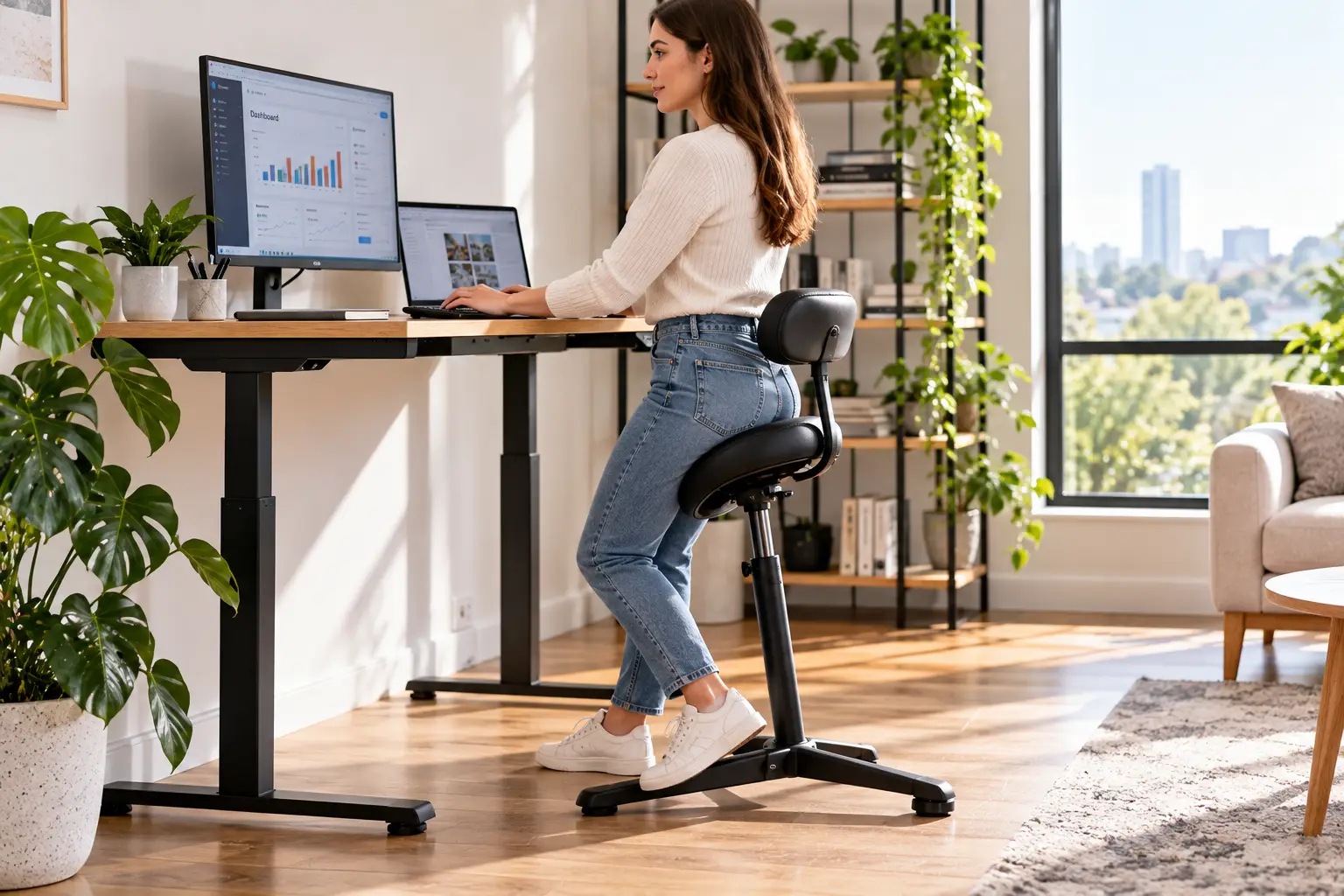
An ergonomic standing chair is a tall, height-adjustable seat built for standing or sit-stand desks. Instead of locking you into a 90-degree sitting posture, it supports a “perch”: hips higher than knees, feet on the floor. Your legs carry part of your weight, the seat carries the rest, and your spine stays closer to its natural curve.
In practice, the category splits into four families, and knowing which one you need saves you from the most expensive mistake in this whole market (buying the wrong type):
- ⚡ Leaning or perching stools let you rest your backside against a tilted seat while you stay mostly upright.
- 🔄 Wobble or active stools sit on a rounded or flexible base, so the seat rocks with you and your core does light work.
- 🪑 Drafting chairs are tall task chairs with a backrest and a footring, made for long sessions at counter height.
- 🧩 Hybrid sit-lean-stand chairs combine a very wide height range, a seat that tilts, and a stable platform under your feet.
Why does the perch matter? When you sit low, your hip angle closes to around 90 degrees, which tends to pull the pelvis backward and flatten the lower back. Perching opens that angle (many stool makers design around something in the 120 to 135 degree range), which keeps the pelvis more neutral. Think of it as the posture you naturally take when you lean on a kitchen counter, except supported and adjustable.
Quick Comparison: The 7 Best Ergonomic Standing Chairs at a Glance
Before the deep dives, here’s the short version. Heights and weight limits come from manufacturer or authorized-retailer spec sheets; price ranges are approximate at the time of writing, so check the current price before you buy.
| Product | Type | Seat height range | Max user weight | Price range | Best for |
|---|---|---|---|---|---|
| LeanRite Elite | Sit/lean/stand hybrid | 22.5″–46.3″ | 270 lb | $450–$700 | LeanRite Elite: all-day standing desk users |
| Aeris Muvman | Leaning stool | 20″–33″ (Tall: 23″–36″) | 265 lb | $450–$550 | Aeris Muvman: true perching |
| Varier Move | Rocking active stool | ~22″–32″ (medium size) | Check listing | $500–$650 | Varier Move: design-led spaces |
| HON Volt Task Stool | Drafting stool with backrest | 22⅞”–32⅜” | 250–275 lb (varies by listing) | $350–$450 | HON Volt Task Stool: long seated sessions |
| Office Star DC Series Deluxe Mesh Drafting Chair | Drafting chair | ~24″–34″ | 250–275 lb (varies by listing) | $140–$220 | Office Star DC Series: budget back support |
| UPLIFT Engage Stool | Wobble stool | 21.8″–31.4″ | Not published | $120–$160 | UPLIFT Engage Stool: light, portable movement |
| Backerz Standing Desk Stool | Wobble stool | 21″–31″ | 220 lb | Under $150 | Backerz Standing Desk Stool: tight budgets |
Looking at the table, the split is less about price and more about posture. The LeanRite Elite and Aeris Muvman are the only two that genuinely reach leaning height for most adults, while the UPLIFT Engage Stool and Backerz Standing Desk Stool top out near 31 inches, which makes them better “high sitting” stools than true leaning supports. If you need a backrest for long stretches, only the HON Volt Task Stool and Office Star DC Series deliver one, and the Office Star does it for well under half the HON’s price.
One more thing worth noticing: two products don’t publish a clear weight rating. That’s not automatically a red flag, but if you’re near or above 250 pounds, favor the models with a stated (and ideally certified) capacity.
💬 One click helps other shoppers make an informed choice too! 😊
Top 7 Ergonomic Standing Chairs: Expert Analysis
Each pick below follows the same logic: what the spec means in real life, who it suits, what buyers actually report, and where it falls short.
1. LeanRite Elite — the most versatile sit-lean-stand hybrid
The LeanRite Elite is the only chair on this list that genuinely covers sitting, perching, leaning, and plain standing in one unit.
Its dual gas springs deliver a 22.5″ to 46.3″ range according to distributor specs, which means it can rise almost to elbow height and let you lean rather than sit. Those springs also act as shock absorbers, so dropping your weight onto the seat doesn’t jolt your spine. The base doubles as a built-in anti-fatigue mat: you stand on the chair’s own footprint, which keeps it from scooting away when you lean back. It’s rated for 270 lb and for users roughly 5’0″ to 6’5″.
Based on comparing the specs, this is the pick for people who spend most of the day at standing height and want one product instead of a stool plus a mat. The trade-off is bulk: at roughly 37 to 39 lb with a 30-inch-deep base, it’s not something you’ll carry between rooms, although the integrated handle and rollers help.
Independent reviewers consistently praise the build quality and the all-in-one concept. A recurring caveat: assembly takes longer than simpler stools, and one detailed review noted the heel lever can be bumped at mid-height, dropping the seat unexpectedly.
Pros:
- ✅ Covers sit, perch, lean, and stand positions
- ✅ Built-in anti-fatigue mat adds real value
- ✅ Dual gas springs cushion every drop
Cons:
- ❌ Heavy and deep for small home offices
- ❌ Heel lever can trigger by accident
💰 Typically $450 to $700 depending on version and seller; premium, but it replaces two products.
2. Aeris Muvman — the purest leaning stool
The Aeris Muvman is the long-time benchmark for perching, from the German company behind the Swopper.
The standard model adjusts from 20″ to 33″, and a Tall version stretches to 23″ to 36″. A permanent 4° forward tilt in the column opens your hip angle without any fiddling, while a flexible joint at the base lets the stool tilt with you as the weighted base stays planted. At about 13.9 lb with a carry handle and a 15-inch base, it slides aside in seconds when you want to stand unaided. It’s rated for 265 lb with a 3-year warranty.
What most buyers overlook: the Aeris Muvman is built for leaning back against, not sitting on top of at full height. Aeris’s own data sheet recommends the standard model for people up to about 6’1″, so taller users should go straight to the Tall version.
Long-form reviews report that it behaves like a normal stool when lowered and becomes a proper leaning support when raised. Some users who tried perching on top at full height said it felt precarious, and perching stools in general get less comfortable over long seated stretches.
Pros:
- ✅ Genuine leaning height for most adults
- ✅ Light enough to move one-handed
- ✅ Tilting base keeps your legs engaged
Cons:
- ❌ Small seat isn’t for long sitting
- ❌ No backrest or lumbar support
💰 Usually in the $450 to $550 range; worth it if leaning is your main posture.
3. Varier Move — Scandinavian design with a rocking base
The Varier Move, designed by Per Øie, is the one stool here that looks as good in a living room as in an office.
Its convex disk base rocks in every direction, so you’re never truly still, and the saddle-like seat shifts your weight backward and your knees outward. In practice, that combination keeps your pelvis tilted forward and your core lightly active. Varier sells it in several sizes; the medium version covers roughly 22″ to 32″ according to its data sheet, so pick the size that matches your desk height rather than assuming one fits all.
Here’s what to weigh: an independent lab-style review found the Varier Move much easier to sit on top of than to lean against, so it behaves more like a high, mobile perch than a true leaning stool. That suits people who want gentle motion at counter or bar height.
The same review reported that heavier users (around 250 lb) noticed the cushioning compress over time. Varier doesn’t make the weight rating prominent in US listings, so confirm it before ordering.
Pros:
- ✅ Gorgeous, furniture-grade wood and fabric finish
- ✅ Constant rocking keeps posture dynamic
- ✅ Multiple sizes for different desk heights
Cons:
- ❌ Not ideal for true leaning postures
- ❌ Cushion may compress for heavier users
💰 Generally $500 to $650; you’re paying partly for design.
4. HON Volt Task Stool — real back support at drafting height
The HON Volt Task Stool (model 5705) is a contract-grade tall chair for people who actually sit for hours at counter height.
Pneumatic adjustment runs from 22⅞” to 32⅜”, and the footring adjusts with a simple knob so your feet stay supported instead of dangling. The contoured back includes lumbar shaping, and the seat stays upright with no recline, which keeps you close to the work surface. A five-star base with casters makes it mobile. Retailers list ANSI/BIFMA certification and HON’s lifetime limited warranty; weight capacity appears as 250 lb on some listings and 275 lb on others, so confirm the exact SKU.
On paper, this is the strongest choice for a fixed-height standing desk or lab bench where you can’t lower the surface. It’s not an active seat, though; it’s a tall office chair, and that’s the point.
On a major US retailer listing for the mesh-back variant, the HON Volt Task Stool holds roughly a 4.3-out-of-5 average across more than a thousand ratings. We couldn’t verify detailed review themes, so lean on the certification and warranty.
Pros:
- ✅ Lumbar-shaped backrest for long sessions
- ✅ Knob-adjusted footring supports your feet
- ✅ Lifetime limited warranty from HON
Cons:
- ❌ Doesn’t reach true leaning height
- ❌ Heavier and pricier than drafting rivals
💰 Typically $350 to $450; strong long-term value for heavy daily use.
5. Office Star DC Series Deluxe Mesh Drafting Chair — best value with a backrest
The Office Star DC Series proves you don’t need a $400 budget to get a tall chair with real back support.
The breathable mesh back includes built-in lumbar support, the padded seat adjusts pneumatically to roughly 24″ to 34″ depending on the variant, and an 18-inch footring moves independently of the seat. That last detail matters more than it sounds: you can set the seat for your desk and the ring for your legs, instead of compromising on both. Listed capacity is 250 to 275 lb depending on version and retailer.
Based on comparing the specs, the Office Star DC Series is ideal for artists, home offices with counter-height desks, and anyone who wants drafting-chair comfort without commercial pricing. It won’t reach leaning height for taller users, but that’s not its job.
Reviews and roundups consistently praise the mesh breathability and sturdy footring. A common complaint is that the standard carpet casters can feel slippery on hardwood or tile, which a cheap caster swap fixes.
Pros:
- ✅ Mesh back with built-in lumbar support
- ✅ Independent, height-adjustable footring
- ✅ Excellent price-to-support ratio
Cons:
- ❌ Carpet casters slide on hard floors
- ❌ Too low for leaning when you’re tall
💰 Usually $140 to $220; the best value here if you want a backrest.
6. UPLIFT Engage Stool — lightest active stool for movers
The UPLIFT Engage Stool is the successor to UPLIFT’s discontinued Motion Stool, and it’s built for people who never sit still for long.
It adjusts from 21.8″ to 31.4″ and weighs just 12.2 lb, with integrated handles, so carrying it between your desk and the kitchen island takes one hand. A 360° motion base with a rubber-treaded grip keeps it from skating, and a subtle lip limits how far it can tip. The rounded-square “superellipse” seat works saddle-style or conventionally, and the recycled polypropylene shell wipes clean easily. UPLIFT backs it with a 15-year warranty.
What the spec sheet doesn’t say: UPLIFT doesn’t publish a rated user weight for this model, and 31.4″ is low for leaning if you’re over about 5’10”. Treat the UPLIFT Engage Stool as an active high stool, not a leaning support.
Because it’s a newer model, independent long-term review data is still limited. If verified reviews matter to you, check the latest Amazon feedback before buying.
Pros:
- ✅ Featherlight and easy to carry
- ✅ Anti-slip base with an over-lean lip
- ✅ Long 15-year UPLIFT warranty
Cons:
- ❌ No published weight capacity
- ❌ Height range limits taller users
💰 Around $120 to $160; a fair price for a well-warrantied active stool.
7. Backerz Standing Desk Stool — the budget way to try active sitting
The Backerz Standing Desk Stool is the low-risk entry point if you’re not sure active sitting is for you.
It adjusts from 21″ to 31″, weighs about 13 lb, and sits on a compact 12.6-inch anti-slip base with a gentle rocking motion and swivel. That small footprint is the headline: it tucks under a desk or into a studio-apartment corner without eating floor space. The 220 lb capacity, however, is the lowest in this lineup.
Here’s what to weigh: the Backerz Standing Desk Stool is great for short perching sessions, students, and small spaces, but it isn’t a full-day chair and lacks the certifications of contract brands. If you love it, you can graduate to a premium model later.
Aggregated review roundups show roughly four-star sentiment, with buyers praising the controlled wobble and smooth height adjustment. The recurring caution is long-term durability, since it isn’t BIFMA-certified like contract-grade seating.
Pros:
- ✅ Very compact, space-saving footprint
- ✅ Smooth wobble keeps you moving
- ✅ Lowest-cost way to test perching
Cons:
- ❌ 220 lb capacity is the lowest here
- ❌ Durability less proven than contract brands
💰 Generally under $150 at the time of writing; excellent value as a trial run.
✨ Don’t miss these smart seating upgrades!
🔍 Take your standing desk setup to the next level with this carefully curated lineup. Click a highlighted chair to check current pricing and availability. These picks will help you work longer, stand smarter, and finally stop leaning on your elbows!
How to Set Up Your Ergonomic Standing Chair: A 30-Day Starter Plan
A great chair set up badly feels worse than a cheap chair set up well. Here’s a practical first month that Amazon listings never explain.
Day 1: Fit the chair to the desk, not the other way around
- Set your desk first. Raise it so your elbows rest at roughly 90 degrees with relaxed shoulders while standing.
- Adjust the seat second. For a leaning stool like the Aeris Muvman, set the seat just below your glutes, then step your feet a few inches forward and lean back. For a drafting chair like the Office Star DC Series, set the seat so your hips sit slightly above your knees.
- Set the footring last. On the HON Volt Task Stool, lock the ring where your thighs stay level and your heels feel supported.
Week 1: Short perches, frequent switches
Start with 15- to 20-minute perching blocks between standing and seated periods. The University of Pennsylvania’s adjustable workstation fact sheet translates the 20-8-2 pattern into a daily total of about 5 hours sitting, 2 hours standing, and 30 minutes moving. Use that as a ceiling, not a quota, while your legs adapt.
Weeks 2 to 4: Build stamina and habits
- 🔋 Stretch perching blocks to 30 minutes once your calves stop complaining.
- ⏰ Use a phone timer or calendar nudge for every transition.
- 🦶 Add an anti-fatigue mat if your stool doesn’t include one, like the LeanRite Elite does.
Monthly maintenance checklist
Tighten seat and base bolts, wipe the gas cylinder, and check casters for trapped hair. If a gas column starts sticking, some stool makers (including Muvman distributors) suggest a very light film of grease on the stem, then cycling the height a few times.
Common first-month mistakes: perching too high so you slide forward, locking your knees while leaning, and treating a wobble stool as an all-day office chair.
Real-World Scenarios: Which Chair Fits Your Workday?
Specs only mean something when you match them to a life. Here are three realistic buyer profiles.
👩💻 Profile 1: The remote developer with an electric desk
Maya is 5’10”, works 8-hour days at an electric sit-stand desk, and has a budget around $500. She already owns a good office chair for focused seated work. What she lacks is a support for her standing blocks. The Aeris Muvman fits her best: genuine leaning height, light enough to roll aside, and a natural partner to an existing task chair. If she wants to retire her office chair entirely and stand most of the day, the LeanRite Elite justifies its higher price.
🎓 Profile 2: The grad student in a studio apartment
Jordan works from a kitchen counter about 36 inches high, uses a laptop 4 to 5 hours a day, and has $150 to spend. Floor space is precious. The Backerz Standing Desk Stool or the UPLIFT Engage Stool makes the most sense: both are compact, light, and cheap enough to be a low-risk experiment. Jordan should add a laptop stand and external keyboard so the stool’s posture benefits aren’t erased by hunching over a screen.
🎨 Profile 3: The illustrator at a fixed-height drafting table
Priya sits 6 or more hours a day at a fixed 38-inch table and has lower-back sensitivity. She needs a backrest, a footring, and durability. The Office Star DC Series delivers that on a budget; the HON Volt Task Stool is the upgrade for heavy daily use, thanks to its contract-grade build and lifetime limited warranty.
Problem → Solution: Fixing the 5 Most Common Standing Chair Complaints
Even the best ergonomic standing chair can feel wrong at first. Most complaints have simple, specific fixes.
- “I keep sliding forward off my leaning stool.” The seat is too high or your feet are too close. Lower the seat an inch and move your feet slightly forward to widen your base. On the Aeris Muvman, the fixed 4° tilt helps, so the issue is usually height.
- “My thighs go numb.” The front edge is pressing into your legs. Lower the seat so your thighs angle downward, and take a 2-minute movement break every half hour.
- “My feet dangle on my drafting chair.” Raise the footring until your thighs are level. On the Office Star DC Series, the ring adjusts independently, so you never have to compromise seat height.
- “The chair rolls or skids on my hard floor.” Swap carpet casters for hard-floor (rubber or urethane) wheels, or choose a stool with a rubber-treaded base like the UPLIFT Engage Stool.
- “My lower back still aches.” A backless stool can’t fix a support problem. Switch to the HON Volt Task Stool, the Office Star DC Series, or the lumbar position on the LeanRite Elite, and keep perching blocks short. If pain persists, see a physical therapist or physician; seating helps, but it isn’t treatment.
How to Choose an Ergonomic Standing Chair
Choosing well comes down to seven questions, asked in this order.
- Decide your main posture. Leaning most of the day points to a leaning stool; sitting high for hours points to a drafting chair with a backrest.
- Measure your standing desk height. Your seat’s maximum should reach a few inches below your standing elbow height, or you’ll never truly perch.
- Check the max user weight. Choose a rating comfortably above your body weight, since dynamic rocking loads a seat harder than static sitting.
- Match the base to your floor. Casters roll; weighted or rubber bases stay put. The OSHA Computer Workstations eTool recommends stable bases and casters suited to your flooring.
- Decide whether you need back support. If you’ll sit more than an hour at a stretch, a backrest beats a backless stool.
- Look for certification and warranty. ANSI/BIFMA testing and long warranties signal the manufacturer expects the product to last.
- Consider portability. If you move between rooms, a 12 lb stool beats a 39 lb hybrid every time.
Standing Desk Chair vs Traditional Office Chair
Should a standing desk chair replace your office chair, or sit next to it? For most people, it’s a partner, not a replacement. A good task chair is still the best tool for long, focused seated work, while a perching seat covers the hours you’d otherwise spend standing until your feet hurt.
| Factor | Ergonomic standing chair | Traditional office chair | Best for |
|---|---|---|---|
| Height range | Reaches 30″+ (up to 46″ on the LeanRite Elite) | Usually tops out near 21″–22″ | Standing chair: sit-stand desks |
| Hip angle | Open, more neutral pelvis | Closer to 90° | Standing chair: active posture |
| Back support | Often none (except drafting chairs) | Full backrest and lumbar | Office chair: long seated focus |
| Footprint | Compact; many under 16″ bases | Wide five-star base | Standing chair: small spaces |
| Muscle engagement | Light, continuous | Minimal | Standing chair: movement breaks |
Reading the table, the pattern is clear: the standing desk chair wins on height, posture variety, and space, while the office chair wins on sustained support. That’s why the HON Volt Task Stool and Office Star DC Series exist: they borrow the office chair’s backrest but lift it to standing-desk height. If you can only own one seat and you sit most of the day, a drafting chair is the safest compromise.
Features That Actually Matter in an Ergonomic Stool for Standing Desk Use (and Ones That Don’t)
Marketing copy loves buzzwords. Here’s how to separate signal from noise when shopping for an ergonomic stool for standing desk use.
Features that matter:
- ✅ Height range that reaches your desk. Every other feature is irrelevant if the seat can’t get high enough.
- ✅ Seat tilt. A forward tilt (fixed like the Aeris Muvman, or adjustable like the LeanRite Elite) is what opens your hip angle.
- ✅ Base stability. Weighted, rubber-treaded, or anti-tip designs prevent the scary moment when a stool skates out.
- ✅ Footring adjustability. On drafting chairs, an independent ring is the difference between support and dangling legs.
Features that matter less than you think:
- ❌ “Core strengthening” claims. Light wobbling keeps you moving, but it isn’t a workout. Even UPLIFT notes its stools aren’t meant to replace an exercise ball.
- ❌ Memory foam everything. Thick foam feels great in the first five minutes, then can trap heat and compress, as one review of the Varier Move noted for heavier users.
- ❌ Endless color options. Nice to have, but never at the expense of height or capacity.
Common Mistakes to Avoid When Buying a Sit-Stand Stool
Most returns in this category come from a handful of predictable errors. Avoid these and your sit-stand stool will feel right from week one.
- Buying for your seated desk height. A sit-stand stool that only reaches 31″ won’t support a true lean for a 6-foot user. Measure your standing height first.
- Ignoring the weight rating. The Backerz Standing Desk Stool tops out at 220 lb, while the LeanRite Elite handles 270 lb. Pick with a margin.
- Expecting a backless stool to replace your office chair. Backless designs like the UPLIFT Engage Stool are for movement and short perches, not 8-hour seated focus.
- Forgetting the floor. Carpet casters on hardwood slide; rubber bases on deep carpet can feel unstable.
- Chasing the cheapest model for daily heavy use. A budget stool is a fine trial, but for 6+ hours a day, certified contract-grade seating usually lasts longer and costs less per year.
- Skipping the return policy. Fit is personal. Buy from sellers with easy returns in case your body disagrees with the spec sheet.
Choosing a Leaning Stool for Standing Desk Use: Tall Users, Petite Users, and Sensitive Backs
One-size-fits-all rarely fits anyone. Here’s tailored advice for picking a leaning stool for standing desk setups based on your body.
📏 Tall users (6’0″ and up)
Prioritize maximum height above all else. The Aeris Muvman Tall version (23″ to 36″) or the LeanRite Elite (up to about 46″) are your realistic options. Most wobble stools that stop at 31″ will feel like sitting on a bar stool rather than leaning.
🧍 Petite users (under 5’4″)
You have the opposite problem: some premium stools start too high. The Aeris Muvman standard version starts at 20″, and wobble stools like the Backerz Standing Desk Stool start around 21″. On a drafting chair, the footring is your best friend, so make sure it adjusts independently.
🩺 Sensitive or recovering backs
Choose support over novelty. A drafting chair with lumbar shaping, like the HON Volt Task Stool, is gentler than a stool that demands constant balance. Introduce perching gradually, and if you’re managing a diagnosed back condition, run your setup by a physical therapist first.
Long-Term Cost and Maintenance
Sticker price is only half the story. Here’s a simple total-cost-of-ownership view, dividing the midpoint price by the warranty or a conservative expected lifespan.
| Product | Approx. price range | Warranty | Rough cost per year | Best for |
|---|---|---|---|---|
| HON Volt Task Stool | $350–$450 | Lifetime limited | ~$40/yr over 10 yrs | HON Volt Task Stool: heavy daily use |
| UPLIFT Engage Stool | $120–$160 | 15 years | ~$14/yr over 10 yrs | UPLIFT Engage Stool: long-warranty value |
| Office Star DC Series | $140–$220 | Check listing | ~$36/yr over 5 yrs | Office Star DC Series: budget backrest |
| Aeris Muvman | $450–$550 | 3 years | ~$100/yr over 5 yrs | Aeris Muvman: premium leaning |
| LeanRite Elite | $450–$700 | Check listing | ~$115/yr over 5 yrs | LeanRite Elite: replaces stool + mat |
The numbers reframe the decision. The UPLIFT Engage Stool and HON Volt Task Stool look excellent once long warranties stretch the cost over a decade, while the premium leaning stools cost more per year but deliver postures cheaper options can’t. Also remember the LeanRite Elite replaces a separate anti-fatigue mat, which can be worth $50 to $150 on its own.
Maintenance is cheap: tighten bolts monthly, vacuum fabric seats, swap worn casters, and replace a failing gas cylinder rather than the whole chair when your model allows it.
Safety, Regulations, and Standards
No US law requires a stool to carry a specific ergonomic certification, but several standards are worth recognizing.
- 🛡️ ANSI/BIFMA: The industry’s main durability and safety tests for office seating. Retailers list ANSI/BIFMA certification on the HON Volt Task Stool; many budget stools don’t claim it.
- 🔥 California TB117-2013: A flammability standard for upholstered furniture you’ll often see on US labels.
- 🌿 GREENGUARD: Indicates low chemical emissions; some Office Star DC listings reference it.
- 📐 ANSI/HFES 100-2007: The human-factors standard many universities use. Duke University’s workstation standards, based on it, place standing keyboard heights roughly in the 37″ to 50″ range, a good benchmark for how high your perch must go.
Practical safety tips: never exceed the rated weight, avoid reaching sideways off a tilting stool, and inspect gas cylinders for leaks or sudden sinking. If a product is recalled, the US Consumer Product Safety Commission publishes notices at cpsc.gov.
FAQ: Ergonomic Standing Chair Questions Shoppers Ask Most
❓ Is an ergonomic standing chair worth buying if I already own a good office chair?
❓ How much should I spend on a standing desk chair?
❓ Which ergonomic standing chair is best for heavy users?
❓ Do standing desk stools work on carpet?
❓ Can I buy an ergonomic stool with HSA or FSA funds?
Conclusion: Find the Ergonomic Standing Chair That Matches How You Actually Work
The best ergonomic standing chair isn’t the most expensive one; it’s the one that matches your desk height, your body, and the posture you’ll use most. Let’s recap the lineup.
- 🏆 LeanRite Elite: the most versatile option if you live at standing height and want a built-in mat.
- 🪶 Aeris Muvman: the purest leaning stool, light and genuinely tall.
- 🎨 Varier Move: the design-lover’s rocking perch for counter-height work.
- 🪑 HON Volt Task Stool: contract-grade back support for long sessions.
- 💵 Office Star DC Series: the best-value chair with a backrest and footring.
- 🔄 UPLIFT Engage Stool: a featherweight active stool with a long warranty.
- 🧪 Backerz Standing Desk Stool: the low-cost way to test active sitting.
Whatever you choose, the chair is only half the solution. Set it up properly, switch positions often, and add short movement breaks. The goal isn’t to stand more or sit less; it’s to stop staying still. Start small, listen to your legs and back for the first month, and adjust from there. Your future self, the one who no longer ends the day leaning on both elbows, will thank you.
✨ Ready to upgrade your sit-stand setup?
🛒 Click any highlighted chair above to check current pricing and availability, then pick the perch that fits your body and your workday. Your back deserves better than leaning on the desk!
Recommended for You
- End Table Desk: 7 Smartest Space-Saving Picks for 2026
- White Oak Monitor Riser: 7 Best Picks That Actually Last (2026)
- Standing Desk PC Mount: 7 Best Picks That Actually Hold Up in 2026
Disclaimer: This post contains affiliate links. As an Amazon Associate, I earn from qualifying purchases made through these links, at no additional cost to you.
✨ Found this article helpful? Share it with someone who needs it! 💬🤗