
In This Article
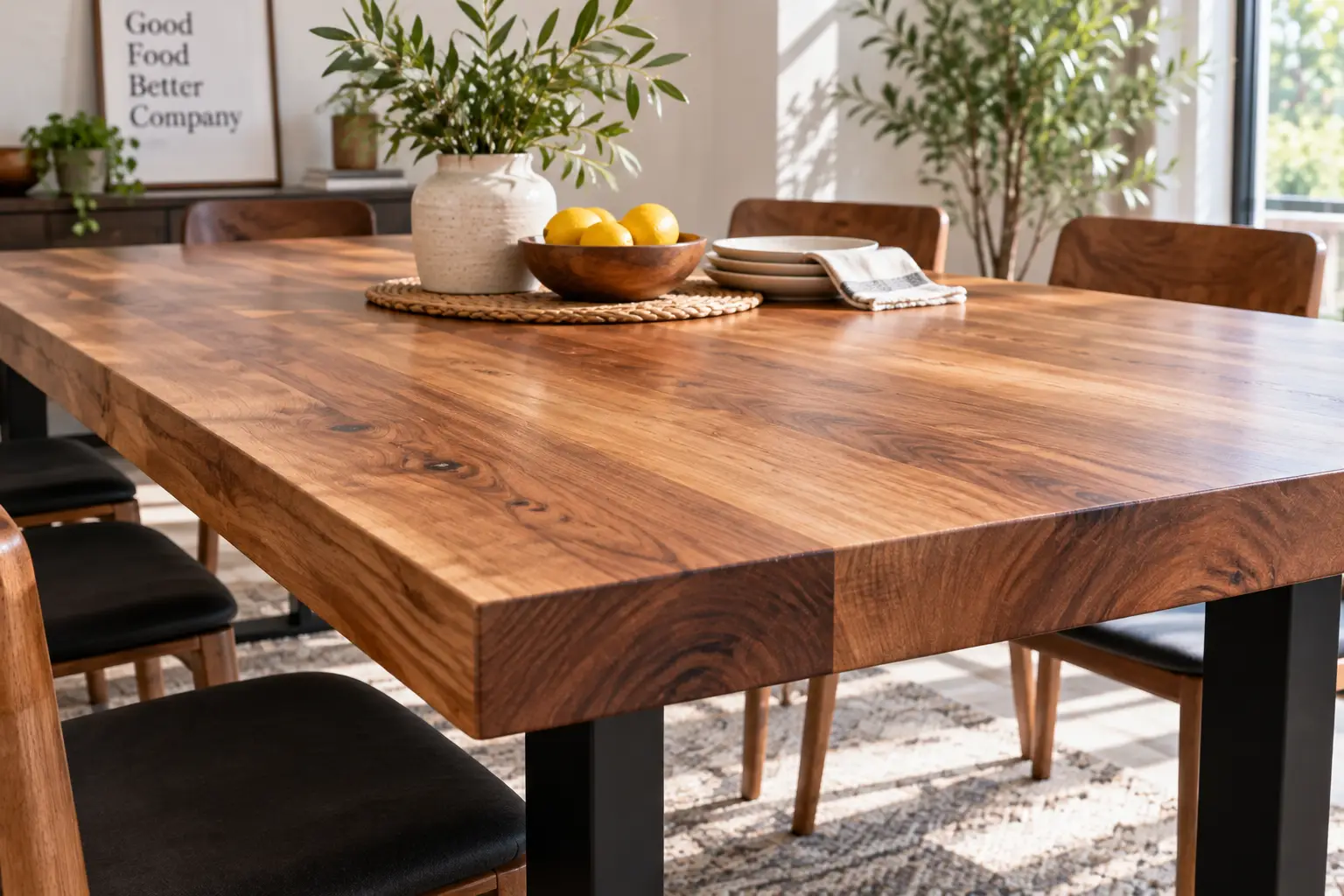
Shopping for a solid wood tabletop sounds simple until you actually start scrolling through listings — acacia, rubberwood, hard maple, “solid wood texture,” butcher block, one-piece, finger-jointed panels — and suddenly you’re not sure what you’re even buying. A solid wood tabletop is a work or dining surface milled from real, uninterrupted wood boards (rather than particleboard, MDF, or a veneer glued over a composite core), typically joined edge-to-edge and sealed with an oil or polyurethane finish. That single distinction — real wood all the way through versus a wood-look laminate — is the difference between a surface that can be sanded and refinished for decades and one that has to be replaced the first time it chips.
This guide skips the marketing copy and gets into the actual differences that matter: wood species, thickness, finish quality, weight capacity, and how each option holds up once you’ve had it for a year or two. We researched seven real, currently available products spanning entry-level acacia desktops to heirloom-grade maple butcher block, pulled together what verified customer reviews consistently say, and broke down who each one is actually built for — the remote worker upgrading a wobbly desk, the home cook who wants a real prep surface, and the buyer who just wants one tabletop that will outlast three cheaper ones. As Wikipedia’s overview of solid wood notes, one of its core advantages is that repairs are relatively easy because the material is consistent all the way through — which is exactly why it’s worth understanding what you’re paying for before you buy.
Disclosure: This post contains affiliate links. As an Amazon Associate, I earn from qualifying purchases made through these links, at no additional cost to you.
Quick Comparison: Solid Wood Tabletop Options at a Glance
| Product | Wood Type | Thickness | Price Range | Best For |
|---|---|---|---|---|
| COREMINDED Solid Wood Desk Table Top | Acacia/rubberwood | 1.2″ | Around $150–$220 | Budget desk upgrades |
| FlexiSpot EN1 Standing Desk | Poplar/eucalyptus | ~1″ | Around $180–$280 | First standing desk |
| Howizz Solid Wood Table Top | Teak-stained acacia | ~1″ | Around $170–$260 | Larger home offices |
| CONSDAN Butcher Block Countertop | USA-grown hard maple | 1.5″ | Around $180–$350 | Kitchen/desk crossover use |
| Bme Hevea Butcher Block Countertop | Hevea (rubberwood) | 1.5″ | Around $220–$350 | DIY islands and long runs |
| FlexiSpot E7 Pro Standing Desk | Solid wood desktop | ~1″ | Around $700–$1,000 | Premium daily-use desk |
| John Boos Butcher Block Table Top | Solid Appalachian maple | 1.5″ | Around $500–$900 | Heirloom-quality, made-in-USA |
Looking at the table, the split is pretty clean: the first three options are desk-oriented tabletops built to drop onto a standing or fixed frame, the middle two are food-safe butcher block that can double as desk or kitchen surfaces, and the last two are the “buy it once” tier — a premium engineered standing desk system and a commercial-grade maple block, respectively. If you’re outfitting a home office on a budget, start with the top three; if durability and resale-proof craftsmanship matter more than price, the bottom two are where the real value shows up over a 10-plus-year ownership horizon.
💬 Bookmark this page — the full breakdown below includes real review sentiment, pros and cons, and what each option is actually like to live with.
Top 7 Solid Wood Tabletops: Expert Analysis
1. COREMINDED Solid Wood Desk Table Top — best entry point into real wood
COREMINDED earns its spot as the easiest on-ramp into genuine solid wood because it skips the gimmicks and just delivers a well-built acacia surface at a fair price. The 1.2-inch-thick panel is finger-jointed rather than a single slab, which sounds like a downgrade until you understand what that construction actually does for you.
Finger-jointing means the panel is assembled from shorter wood segments interlocked at the seams, and in practice that’s what keeps a budget tabletop from warping or cracking the way a single wide board can when humidity shifts. The listing specifies no MDF and no veneer, backed by three UV base coats and two polyurethane top coats — a finish stack that’s genuinely above average for this price tier and explains why the surface resists scuffs better than typical big-box desktops. At 48 by 24 inches, it fits nearly any standing desk frame without custom drilling, since the underside ships smooth and undrilled.
This is the pick for someone replacing a hollow, flexy desktop without spending premium-desk money — students, remote workers on a first apartment budget, or anyone retrofitting an existing frame. Reviews aggregated from the listing consistently describe the surface as noticeably heavier and more rigid than the particleboard tops it usually replaces, with the acacia grain reading as more premium than the price suggests; a recurring critique is that the edges can feel slightly sharp out of the box until lightly sanded or waxed.
Pros:
- ✅ Genuine finger-jointed solid wood, not MDF or veneer
- ✅ Backed by a 3-year manufacturer warranty
- ✅ Universal underside fits nearly any desk frame
Cons:
- ❌ Edges may need light sanding for a fully smooth feel
- ❌ Single-piece slabs above 48″ get noticeably heavier to handle
At the time of writing, this tabletop runs in the $150–$220 range depending on size and finish. For the amount of real wood and warranty coverage you’re getting, it’s one of the strongest value plays in this entire lineup — check the current price before ordering since availability by size fluctuates.
2. FlexiSpot EN1 Standing Desk — best beginner standing desk with a true one-piece top
The FlexiSpot EN1 solves a problem most budget standing desks don’t even admit they have: a lot of cheap desktops are actually two spliced boards screwed to the frame, which flexes and creaks the moment you lean on it. This one ships with a genuine 48-by-24-inch single-piece wood desktop, and that structural difference is the whole reason to consider it over similarly priced competitors.
Beyond the top itself, you’re getting a complete electric sit-stand desk — a height range of roughly 29 to 48.6 inches, four programmable memory presets, and a weight capacity in the 175-pound range that comfortably handles dual monitors and a laptop dock. What that range means in practice is that the EN1 covers the ergonomic sweet spot for the vast majority of adult heights without needing an upgraded frame. Tabletop finish options include mahogany, maple, black, and white, all described by the manufacturer as a solid wood texture over poplar and eucalyptus substrate for stability.
This is the desk to buy if you’ve never owned a standing desk and want to test the habit without committing to a $900 setup. Verified reviews and independent coverage of the EN1 consistently flag the one-piece top as unusually solid for its price bracket, with the main complaint being that the memory controller’s button layout takes a session or two to learn.
Pros:
- ✅ True one-piece top eliminates the wobble of spliced desktops
- ✅ Four programmable height presets for quick transitions
- ✅ Strong value relative to full standing-desk competitors
Cons:
- ❌ Controller layout isn’t immediately intuitive
- ❌ Fewer premium wood-species options than higher-tier FlexiSpot desks
Pricing for the EN1 typically sits between $180 and $280, and it occasionally dips lower during sales — always check the current price and availability rather than assuming a listed figure is accurate. As a full desk-and-top bundle, the value math is hard to beat if you’re starting from zero.
3. Howizz Solid Wood Table Top — best for larger home office layouts
Howizz targets a specific gap in the market: people who need more surface area than a standard 48-inch desktop but don’t want to jump to a commercial-grade countertop. The 60-by-25-inch teak-stained acacia top gives you real room for a dual-monitor arm, a laptop dock, and actual desk space left over — something the smaller entries on this list can’t match.
The acacia species itself matters here. It’s a dense, tight-grained hardwood that resists dents better than pine or poplar, and the teak-stained finish is applied specifically to even out acacia’s naturally high color variation between boards, so the tabletop reads as more uniform than raw acacia typically does. At roughly 1 inch of thickness, it’s thinner than the butcher-block options later in this list, which keeps the overall weight manageable for a single person to install without help — a real consideration if you’re setting this up solo on a standing desk frame.
Buyers furnishing a home office that doubles as a creative or hobby workspace tend to gravitate toward this one because the extra depth (25 inches versus the more common 24) leaves room for supplies without crowding the monitor setup. Aggregated customer feedback describes the grain and stain as looking noticeably better in person than in photos, with an occasional complaint about faint tool marks on the underside — cosmetically irrelevant once mounted, but worth knowing before you order.
Pros:
- ✅ Extra depth (25″) for hobby or creative workspace use
- ✅ Acacia hardwood resists dents better than softer species
- ✅ Teak stain evens out natural acacia color variation
Cons:
- ❌ Thinner profile than premium butcher-block alternatives
- ❌ Larger size makes solo installation more physically demanding
Expect to pay somewhere in the $170–$260 range depending on the exact dimensions ordered, always subject to current pricing at checkout. For the added real estate, it’s a strong middle-tier pick between the entry-level acacia tops and the heavier butcher-block category.
4. CONSDAN Butcher Block Countertop — best food-safe crossover surface
CONSDAN stands out because it’s built to a higher functional standard than a typical desk top: it’s food-safe. Made from USA-grown solid hard maple and finished with a food-grade oil, this 1.5-inch-thick countertop is rated for direct cutting use, which tells you something about the density and finish quality even if you’re buying it for a desk or workbench instead of a kitchen island.
What that food-safe rating means in practice is a tighter grain structure and a harder wear layer than most desk-specific tabletops use, since kitchen surfaces have to survive knife contact and moisture exposure that office furniture never faces. The listing specifies no sanding needed out of the box, with eased edges and a fully polished surface on delivery — a meaningful convenience compared to unfinished alternatives that require you to sand and oil the surface yourself before use. Sizes scale from a compact 12×25 inches up to 96×25 inches, so the same core product works as a small desk accent or a full kitchen island top.
This is the pick for anyone repurposing a piece of furniture across rooms — a kitchen island today, a home office desk tomorrow — or who simply wants the added durability of hardwood built for cutting contact. Real customer feedback on CONSDAN’s listings is a mixed bag depending on size ordered: smaller pieces get consistently strong marks for finish quality, while a recurring theme on the largest panels is that seams between glued boards are more visible than buyers expect at that price point.
Pros:
- ✅ Food-safe finish rated for direct cutting use
- ✅ Ships pre-sanded and polished, ready to use
- ✅ USA-grown hard maple, denser than typical desk woods
Cons:
- ❌ Board seams more visible on the largest sizes
- ❌ Requires periodic oiling to maintain the food-safe finish
Price scales heavily with size — smaller panels run around $60–$90, while the larger 48-to-96-inch lengths land in the $180–$350 range. Check the current price for your specific size, since CONSDAN’s per-inch pricing shifts with length.
5. Bme Hevea Solid Wood Butcher Block Countertop — best for large DIY builds on a budget
Bme’s Hevea butcher block earns its place here as the practical choice for anyone building rather than buying — a kitchen island, a garage workbench, or a long desk run where a pre-fabricated desktop simply doesn’t come in the size needed. At up to 96 by 25 by 1.5 inches, unfinished, it’s sold as raw material you finish yourself, and that’s precisely the appeal for the DIY-minded buyer.
Hevea, also known as rubberwood, is a byproduct of latex-tapping trees repurposed once they stop producing sap — which makes it one of the more sustainably sourced hardwoods on the market, and it machines and stains predictably, which matters if you’re planning to cut it down, drill it, or apply a custom finish. Buying it unfinished costs less than a pre-sealed equivalent, but it also means you’re responsible for sanding, sealing, and maintaining the surface from day one — not a good fit if you want something ready to use out of the box.
This is the right call for someone comfortable with basic woodworking who wants the largest usable surface for the lowest cost per square foot, or who needs a nonstandard size that off-the-shelf desktops don’t offer. Real reviews consistently praise the wood quality and price-per-inch value relative to pre-finished alternatives, with the most common complaint being that unfinished boards can arrive with a rougher surface than expected, requiring more initial sanding than some buyers anticipated.
Pros:
- ✅ Largest available size on this list at a competitive price
- ✅ Sustainably sourced rubberwood with predictable machining
- ✅ Flexible for custom finishes, stains, or shapes
Cons:
- ❌ Requires sanding and sealing before use
- ❌ Not a plug-and-play option for non-DIY buyers
At the time of writing, this countertop runs roughly $220–$350 depending on length, generally undercutting pre-finished maple block per square inch. It’s the best per-inch value here if you’re willing to put in the finishing work yourself.
6. FlexiSpot E7 Pro Standing Desk — best premium daily-use desk
The FlexiSpot E7 Pro is what you buy once you’ve outgrown the entry-level tier and want a desk that disappears into the background of your workday instead of reminding you it’s a budget purchase. Independent reviewers have called it a genuine upgrade over the original E7, with a beautiful wood-texture top, a substantially higher lifting capacity, and a wider height range than most home-office desks offer.
The dual-motor frame and reinforced structure translate into meaningfully less wobble at full extension — a common failure point on cheaper standing desks that only becomes obvious after months of daily raising and lowering. That extra rigidity matters most for anyone running dual monitors or a heavier monitor arm setup, since a shakier frame transmits every keystroke into visible screen jitter. The desktop itself carries the “solid wood texture” finish across a poplar and eucalyptus substrate, matching the material approach used across FlexiSpot’s line but with noticeably better fit-and-finish at this tier.
This is the desk for someone who works from home full time and treats their desk as long-term infrastructure rather than a one-off purchase — the added cost buys quieter motors, a sturdier frame, and cable management that the budget tier skips. Professional reviews consistently rank it among the best premium standing desks currently available, while noting the price tag — inflated further by 2026 tariff conditions — as the main barrier for casual buyers.
Pros:
- ✅ Dual-motor frame virtually eliminates wobble at full height
- ✅ Wide height range fits a broad range of user heights
- ✅ Reviewer-praised build quality and cable management
Cons:
- ❌ Premium price puts it out of reach for casual buyers
- ❌ Heavier overall unit due to the solid wood-texture top
Expect to pay in the $700–$1,000 range depending on desktop size and finish, with pricing sensitive to ongoing supply and tariff conditions — always confirm the current price before purchasing. For a desk you’ll use eight-plus hours a day for years, the cost-per-use math tends to favor buying once.
7. John Boos Butcher Block Table Top — best heirloom-quality, made-in-USA option
John Boos has been making American hardwood butcher block since 1887, and that century-plus track record shows in the details: solid Appalachian maple, precision edge-grain or end-grain construction, and a finish designed to protect fine cutlery edges rather than dull them. This is the option for buyers who see a tabletop as a long-term investment rather than a replaceable commodity.
The maple used here is sourced from sustainably harvested North American hardwood forests, and the construction quality shows in details competitors skip — full-length rails for structural support, a semi-gloss protective finish on the non-cutting varieties, and a one-year warranty against manufacturing defects. What that craftsmanship translates to in daily use is a surface that resists the sagging and edge-chipping that cheaper maple blocks develop after a few years of heavy use, because the board density and joinery are simply built to a higher standard.
This is squarely the pick for a serious home cook who wants a genuine commercial-grade prep surface, or for anyone who wants a desk or table top that could realistically be handed down rather than replaced. Real customer sentiment around John Boos products is remarkably consistent across independent retailers: buyers describe the weight and density as immediately obvious compared to lighter maple alternatives, and the main criticism that surfaces repeatedly is the price, which puts it well above every other option on this list.
Pros:
- ✅ 130+ years of American hardwood craftsmanship
- ✅ Sustainably harvested North American maple
- ✅ Backed by a one-year manufacturer’s warranty
Cons:
- ❌ Premium price relative to comparable butcher block
- ❌ Heavier and more expensive to ship than lighter alternatives
Pricing generally lands between $500 and $900 depending on size and edge-grain versus end-grain construction — check the current price, as John Boos tops vary significantly by dimension. This is the “buy it for life” entry on the list, and the price reflects that positioning.
Comparing the Top 7: Features and Value
| Product | Weight Capacity Context | Finish Type | Assembly Needed | Best For |
|---|---|---|---|---|
| COREMINDED Solid Wood Desk Table Top | Desk-duty (monitors, laptop) | UV + polyurethane, pre-finished | Attach to existing frame | First real-wood upgrade |
| FlexiSpot EN1 Standing Desk | ~176 lbs (full desk system) | Solid wood texture | Full desk assembly | First standing desk |
| Howizz Solid Wood Table Top | Desk-duty, extra depth | Teak-stained acacia | Attach to existing frame | Larger home offices |
| CONSDAN Butcher Block Countertop | Kitchen + desk rated | Food-safe oil, pre-sanded | Drop-in or mount | Multi-room use |
| Bme Hevea Butcher Block Countertop | Kitchen + workbench rated | Unfinished (DIY) | Sand/seal + install | Custom builds |
| FlexiSpot E7 Pro Standing Desk | High (dual-monitor setups) | Solid wood texture, premium fit | Full desk assembly | Daily full-time use |
| John Boos Butcher Block Table Top | Commercial-grade | Semi-gloss/oil, edge or end grain | Drop-in or leg-mounted | Heirloom investment |
The pattern across this table is worth calling out directly: weight capacity and finish quality scale together with price, but not linearly. The jump from the COREMINDED top to the CONSDAN countertop buys you food-safe density for a modest cost increase, while the jump from CONSDAN to John Boos buys mostly brand pedigree and finishing precision rather than a dramatically different core material. If your budget caps out around $250, the first four options in this table cover nearly every practical use case a home office or kitchen needs.
Solid Wood Tabletops vs. Engineered Wood Alternatives
It’s worth stating plainly why “solid wood” is even a category buyers seek out, given how much cheaper laminate and particleboard desktops are. Engineered wood — particleboard, MDF, or plywood finished with a wood-look veneer — is lighter, cheaper to manufacture, and perfectly fine for short-term or low-load furniture. But it has a hard ceiling on durability: once the veneer chips, water gets underneath, or a screw strips out of the particleboard core, the piece is effectively unrepairable.
Solid wood behaves differently under the same stress. Because the material is consistent all the way through, a scratch or dent can be sanded out, a stripped screw hole can be re-drilled or plugged, and the surface can be refinished entirely if the original coat wears thin — repairs that simply aren’t possible on veneered composite. There’s also a labeling issue buyers should know about: the Federal Trade Commission’s rules mean a retailer legally cannot advertise furniture as “solid wood” unless every exposed surface actually is solid wood, which is why some listings use softer language like “solid wood texture” or “wood grain finish” for what is, in fact, an engineered substrate with a printed or laminate surface. Reading the fine print on material composition — not just the marketing headline — is the single most useful habit a buyer can develop, a point echoed in the FTC’s own guidance on truthful advertising claims.
| Factor | Solid Wood | Engineered Wood/Laminate |
|---|---|---|
| Repairability | Sandable, refinishable | Not repairable once damaged |
| Weight | Heavier, more stable | Lighter, less stable |
| Water resistance | Good with sealed finish | Poor — swells if unsealed |
| Upfront cost | Higher | Lower |
| Lifespan | Decades with care | Often 3–7 years |
The value shift becomes obvious once you price out replacement: a $150 particleboard desktop that needs replacing every four to five years costs more over a 15-year span than a $220 solid wood equivalent purchased once. If you plan to keep a piece of furniture more than five years, solid wood is very often the cheaper option long term — not just the nicer-looking one.
✨ Ready to stop replacing desktops every few years? Take a closer look at the picks above and find the one that fits your space.
How to Choose the Right Solid Wood Tabletop
- Measure your frame or space first, not the tabletop. A tabletop needs to overhang a standing desk frame by roughly 1–2 inches on each side for stability, so confirm your frame’s mounting width before ordering.
- Match the wood species to your use case. Acacia and hard maple resist dents better than poplar or pine, which matters most if you’re setting laptops, tools, or cookware directly on the surface.
- Check the thickness relative to the intended load. Anything under 1 inch is fine for a monitor and laptop; anything supporting a kitchen prep routine or heavy equipment should be 1.5 inches or more.
- Confirm the finish matches your maintenance tolerance. Pre-finished, sealed tops need occasional wiping; unfinished DIY blanks need sanding and oiling before first use and periodically after.
- Look for a single-piece or well-jointed construction. Spliced-board desktops flex under weight in a way single-piece or properly finger-jointed tops don’t — this is the single biggest quality signal to check in reviews.
- Factor in weight for installation. Larger butcher-block pieces can weigh 60+ pounds; plan for a second set of hands if you’re installing solo.
- Read aggregated review sentiment, not just the star average. A 4.3-star product with consistent complaints about one specific size is more useful information than the overall number alone.
Getting Started: Setup, Care, and the First 30 Days
Once your tabletop arrives, resist the urge to mount it immediately and skip the finish check — this is the step most buyers regret skipping. Unbox it in the room where it’ll live for at least 24 hours so the wood can acclimate to your home’s humidity and temperature before you drill or attach hardware; wood that’s shipped through varying climates can expand or contract slightly, and mounting it too soon can lead to small gaps at joints later.
For pre-finished tops, a light coat of furniture wax or wood conditioner in the first week helps seal any micro-scratches from shipping and handling. For unfinished butcher block, sand with progressively finer grit (150 to 220) before applying two to three coats of food-safe mineral oil, letting each coat absorb for a few hours. Reviewers of premium hand-built wood desks consistently note that ongoing wood maintenance — periodic oiling, avoiding standing water, and using coasters — is the trade-off for the material’s long-term durability, a theme Tom’s Guide’s review of a premium solid wood standing desk calls out directly as worth the extra care for the payoff in longevity.
The most common first-30-days mistakes are avoidable: overtightening frame screws into solid wood (which can crack the grain rather than the softer particleboard buyers are used to), placing hot mugs or pans directly on an oiled surface without a trivet, and skipping the manufacturer’s recommended first-oiling schedule on unfinished pieces. None of these are complicated fixes — they just require knowing solid wood behaves differently than the composite furniture most people are used to.
Real-World Scenarios: Matching the Right Tabletop to Your Life
The remote worker on a budget sharing a small apartment office needs a compact, lightweight upgrade that doesn’t require frame modifications — the COREMINDED top or the FlexiSpot EN1 bundle both fit this brief, with the EN1 making more sense if the existing desk frame isn’t height-adjustable and an upgrade is overdue anyway.
The home cook who also works from a kitchen island wants a single surface that handles both roles without compromise — the CONSDAN butcher block is purpose-built for exactly this dual duty, since it’s food-safe and available in sizes that fit both a compact desk nook and a full island.
The DIY renovator building custom furniture — a kitchen island frame, a garage workbench, a non-standard-width desk — gets the most value from the Bme Hevea unfinished block, since standard pre-made sizes rarely fit a custom build without cutting.
The full-time remote professional treating their office as long-term infrastructure should look at the FlexiSpot E7 Pro; the frame quality and desktop finish justify the price when amortized across years of daily eight-hour use.
The buyer furnishing a forever home who wants furniture that could realistically be passed down gets the clearest case for John Boos — the century-plus manufacturing pedigree and repairable maple construction are built for multi-decade ownership, not a five-year furniture cycle.
Common Problems (and Real Solutions)
Problem: The tabletop feels wobbly after installation. This is almost always a frame-mounting issue rather than a defect in the tabletop itself — confirm the mounting screws are seated in solid wood, not just the finish coat, and that the frame’s width matches the manufacturer’s stated compatibility range.
Problem: Water rings appear after a spilled drink. On oiled finishes, light rings usually buff out with a fresh coat of mineral oil applied directly to the affected spot. On polyurethane-sealed tops like the COREMINDED or Howizz desktops, a ring typically means water got past the seal at an edge or seam — worth checking those spots for gaps.
Problem: Visible seams between glued boards. This is a construction reality of any finger-jointed or edge-glued panel, including premium options — it’s not a defect, but if it bothers you cosmetically, a single-slab option in a smaller size may look more uniform than a large multi-board panel.
Problem: The unfinished wood feels rough even after initial sanding. Unfinished hardwood like the Bme Hevea block often needs a second sanding pass at a finer grit than buyers expect before the first oil coat — 220-grit is usually the difference between “acceptable” and “smooth.”
Problem: The surface looks dull after a few months. This is normal wear on an oiled finish and is fixed with reapplication, not replacement — most solid wood tabletops need re-oiling every one to three months depending on use, a maintenance rhythm worth building into your routine from day one.
Long-Term Cost and Maintenance
The upfront price tag is only part of the ownership cost story. A sealed, pre-finished tabletop like the Howizz or COREMINDED requires essentially no ongoing spend beyond an occasional wipe-down — the finish is doing the protective work for you. A food-safe oiled surface like CONSDAN or Bme Hevea costs a few dollars every couple of months in mineral oil, plus the time to apply it, which adds up to maybe $20–$40 a year in materials.
Where the math gets interesting is comparing that ongoing cost against replacement cycles. A particleboard desktop that needs full replacement every four to five years effectively costs its full purchase price again and again over a 15-year window, while a solid wood equivalent purchased once and maintained with periodic oiling or the occasional light sanding can last that same 15 years for a fraction of the total spend. The premium tier — FlexiSpot E7 Pro and John Boos — front-loads the cost but essentially eliminates the replacement-cycle math altogether, since both are built to be repaired and refinished rather than discarded.
Safety, Regulations, and Standards to Know
Solid wood furniture is heavier than its engineered-wood equivalents, and that added mass matters for a safety reason many buyers overlook: stability and anchoring. While tip-over standards in the U.S. are primarily focused on tall clothing-storage furniture like dressers, the same anchoring principle applies to any heavy tabletop mounted on a frame, especially in households with young children who may climb or lean on furniture. The U.S. Consumer Product Safety Commission’s Anchor It! campaign recommends securing heavy furniture to the wall where feasible, and the same logic applies to a standing desk frame with a dense solid wood top — confirm the frame’s stability rating matches the tabletop’s actual weight before assuming it’s safe fully extended.
For food-safe surfaces specifically, look for finishes explicitly labeled food-grade or food-safe oil, since not all wood sealants are rated for direct food contact — a distinction that matters if you’re buying a butcher-block style top with any intention of using it for prep work, even occasionally. Kitchen countertop products from manufacturers like CONSDAN and John Boos are explicit about this rating; desk-oriented products like the COREMINDED top generally aren’t rated for food contact and shouldn’t be treated as a cutting surface.
Features That Actually Matter (and Ones That Don’t)
Marketing copy for wood tabletops leans hard on wood species names and grain photography, but a few less-glamorous specs deserve more of your attention. Thickness and joint construction — single-piece versus finger-jointed versus spliced — predict long-term stability far better than species name alone; a well-built finger-jointed acacia top will outperform a poorly constructed single-species board with visible internal stress cracks. Finish type (oil versus polyurethane) matters more for your maintenance routine than for raw durability, since both protect the wood adequately when properly applied and maintained.
What matters less than the marketing suggests: exact grain pattern photography, since natural wood variation means your actual delivered piece will differ from any single photo regardless of vendor; and precise weight capacity numbers for desk tops, since almost any solid wood surface over an inch thick comfortably exceeds what a monitor-and-laptop setup requires. Buyers get more practical value from reading the aggregated review themes around seam visibility, edge finishing, and packaging condition than from comparing spec-sheet numbers that are functionally similar across this entire category.
Frequently Asked Questions
❓ What's the difference between solid wood and solid wood texture?
❓ How thick should a solid wood tabletop be for a standing desk?
❓ Can I cut on a solid wood desk tabletop?
❓ How often does a solid wood tabletop need to be re-oiled?
❓ Is a solid wood tabletop worth the extra cost over laminate?
Conclusion
A solid wood tabletop is one of those purchases where spending a bit more upfront almost always pays off over the life of the piece — the material’s biggest advantage isn’t how it looks on day one, it’s that it can be sanded, re-oiled, and repaired for decades instead of replaced every few years. For most home offices, the COREMINDED top or the FlexiSpot EN1 bundle covers the essentials without overspending. If you need a genuinely dual-purpose surface for kitchen and desk use, the CONSDAN butcher block is the clear pick. And if you’re furnishing a space you plan to keep for the long haul, both the FlexiSpot E7 Pro and the John Boos table top justify their higher price tags with construction quality that simply outlasts cheaper alternatives.
Whichever option fits your space and budget, the core buying principle stays the same: check the actual material specification, not just the marketing language, confirm the thickness matches your intended use, and factor in the modest ongoing maintenance that keeps solid wood looking good for years rather than months.
Recommended for You
- Custom Computer Desk: 7 Best Adjustable Picks for 2026
- 7 Best Manual Height Adjustable Desks in 2026: Real Picks, Real Pros & Cons
- Wall Monitor Holder: 7 Best Picks to Reclaim Your Desk in 2026
Disclaimer: This post contains affiliate links. As an Amazon Associate, I earn from qualifying purchases made through these links, at no additional cost to you.
✨ Found this article helpful? Share it with someone who’s shopping for a new tabletop too! 💬🤗