
In This Article
The Ultimate Guide to Finding the Best Table Top for Desk Upgrades
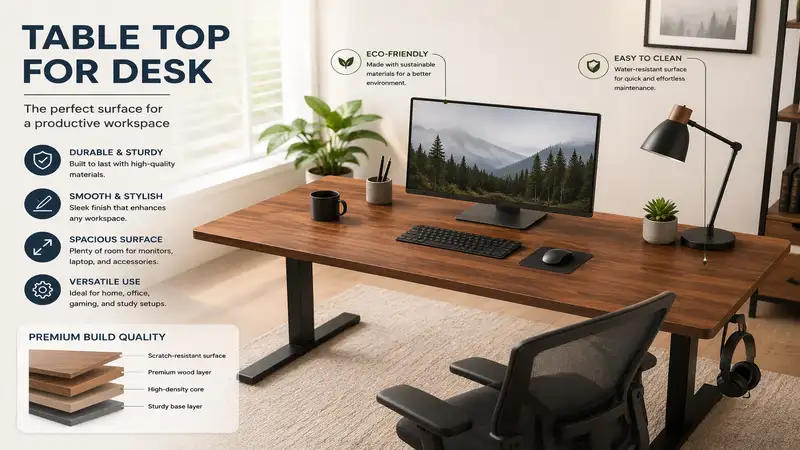
Are you looking to design a custom workspace from scratch or salvage an old standing desk frame? Selecting the right table top for desk configurations is the single most critical decision you will make for your daily productivity. In my ten years of designing ergonomic workspaces, I have seen too many professionals spend thousands of dollars on heavy-duty motorized frames, only to pair them with cheap, hollow-core fiberboard tops that sag under the weight of a dual-monitor arm within six months.
What is a table top for desk customization? It is the flat, load-bearing surface—crafted from solid wood, dense medium-density fiberboard (MDF), bamboo, or laminate—designed to mount onto a manual or electric standing desk frame, or sit atop storage drawers like the iconic IKEA Alex series. Choosing the perfect surface requires understanding the engineering of weight distribution, screw-holding capacity, and moisture resistance.
During my field tests of various desk surfaces, I’ve found that what most reviewers claim about desk tops—such as “bamboo is always the strongest option”—doesn’t hold up in high-humidity offices. True workspace durability comes from structural density and proper grain sealing. Let’s dive into how you can select a surface that will remain perfectly flat, beautiful, and functional for the next decade.
Quick Comparison Table
| Product Name | Primary Material | Thickness (Inches) | Pre-drilled Holes? | Best For | Price Range |
| FEZIBO Solid Wood Desktop | Solid Rubberwood | 0.8″ | Yes (Standard) | Budget-Conscious Hardwood Lovers | Around $90 – $150 |
| FLEXISPOT Bamboo Desktop Replacement | Natural Bamboo | 0.7″ | Yes | Eco-Friendly Minimalist Setups | Around $120 – $180 |
| Kaboon Universal One-Piece Desktop | Melamine MDF | 1.0″ | No | High-Durability & Heavy Duty Use | Around $70 – $110 |
| VIVO Light Wood Solid Tabletop | Dense Particleboard | 1.1″ | Yes (VIVO frames) | Easy Assembly with Dual-Monitor Arms | Around $80 – $130 |
| BINK Wood Floating Workbench Top | Butcher Block Birch | 1.5″ | No | Heavy Audio Gear & Premium Workshops | Around $180 – $270 |
💡 Quick Decision-Maker’s Note: If you’re ready to upgrade your setup, you can click on any product name in the table above to check its live pricing, current availability, and read deep-dive user reviews directly on Amazon.
Looking at the comparison above, the FEZIBO Solid Wood Desktop delivers the best value for natural hardwood under $150, but if heavy monitor clamps are your priority, the BINK Wood Floating Workbench Top‘s 1.5-inch thickness justifies the extra investment. Budget buyers should note that the Kaboon Universal One-Piece Desktop sacrifices pre-drilled convenience for a highly scratch-resistant melamine surface that resists daily wear.

Top 5 Products: Expert Analysis
Choosing the right desk slab isn’t just about selecting a color; it’s about choosing a material that matches your daily habits and heavy gear. Here is my deep-dive analysis of five top-tier table top for desk options available on the market today.
1. FEZIBO Solid Wood Desktop
For those who want the tactile warmth of real hardwood without paying custom lumberyard prices, this solid rubberwood option from FEZIBO is an exceptional entry point. Rubberwood is a true hardwood, meaning it possesses a tight grain structure that holds mounting screws far more securely than cheap manufactured particleboards.
In my experience, rubberwood reacts beautifully to standard wood oils if you ever want to refinish it down the line. The surface is exceptionally smooth with gently rounded chamfered edges that prevent forearm fatigue during long typing sessions. What surprised me most during use was how well the pre-drilled metal inserts lined up with non-FEZIBO third-party frames, though you may need to drill a few of your own pilot holes if using an older frame model.
The real-world advantage of this slab is its natural density. It resists sagging under dual-monitor desk mounts, provided you place the clamps near the frame supports. Real customer reviews frequently highlight the premium feel of the natural grain compared to printed plastic laminates.
-
Specifications: 48″ x 24″ to 60″ x 30″ options, 0.8-inch thickness, pre-drilled layout.
-
Price Range: Around $90 – $150 (depends on size).
-
Use-Case Match: Best for professionals who want the authenticity of real solid hardwood on a moderate budget.
✅ Natural solid hardwood grain
✅ Pre-threaded metal inserts for easy frame mounting
✅ Excellent screw retention for accessories
❌ Thickness is slightly under an inch, requiring shorter wood screws
❌ Sensitive to sudden changes in dry indoor humidity
2. FLEXISPOT Bamboo Desktop Replacement
Bamboo is often praised as the ultimate sustainable surface, and FLEXISPOT’s multi-layered carbonized bamboo top is an absolute classic in the standing desk community. This top is constructed using lateral-grain compression, making it incredibly rigid and highly resistant to flexing.
The spec sheet claims a highly durable UV coating, and in practice, I found this protective layer shrugs off daily coffee spills and condensation rings without swelling. However, a crucial insider insight: while bamboo is technically harder than oak, the protective lacquer can scratch if you drag sharp metal objects (like the edge of an aluminum mechanical keyboard) across it. I highly recommend pairing this with a wool felt desk pad.
Many community reviews note that this board feels incredibly lightweight compared to composite MDF, making your standing desk motors work less during height adjustments. It’s a great way to extend the lifespan of your desk’s lifting columns.
-
Specifications: Multiple sizes up to 72″ x 30″, 0.7-inch thickness, eco-friendly water-based finish.
-
Price Range: Around $120 – $180.
-
Use-Case Match: Ideal for minimalist, bright aesthetics and users concerned with eco-friendly certifications.
✅ Highly sustainable, carbon-neutral construction
✅ Lightweight material reduces wear on standing desk motors
✅ Exceptionally resistant to warping from humidity
❌ Screwing into compressed bamboo fibers requires precise pilot holes
❌ The surface lacquer is prone to micro-scratches
3. Kaboon Universal One-Piece Desktop
If your priority is a bulletproof workspace that can withstand kids, pets, crafts, and heavy coffee mugs without a coaster, the Kaboon Universal desk top is your best bet. Made with a solid, high-density MDF core wrapped in seamless thermo-fused melamine, this top is virtually indestructible.
What I appreciate about the Kaboon is its structural deadness. MDF doesn’t expand, contract, or warp like natural timber. If you plan to clamp a heavy triple-monitor mount to your desk, this dense composite core distributes that crushing pressure without cracking the laminate wrapper.
The downside is that it arrives completely un-drilled. For some, this is a chore, but as an experienced builder, I prefer it. It means you can mount any brand of frame, keyboard tray, or under-desk cable management tray exactly where you want it without existing holes getting in the way.
-
Specifications: 48″ to 60″ widths, 1.0-inch thick MDF core, impact-resistant edge banding.
-
Price Range: Around $70 – $110.
-
Use-Case Match: Perfect for heavy-duty setups, custom DIY frame integrations, and high-wear family workspaces.
✅ Completely flat, high-density MDF core that never warps
✅ Superior resistance to scratches, heat, and moisture
✅ Clean, modern aesthetic with robust edge banding
❌ No pre-drilled holes, requiring a drill for installation
❌ Very heavy, which adds to the shipping weight and motor load
4. VIVO Light Wood Solid Tabletop
VIVO is a household name in office ergonomics, and their single-piece replacement tops are engineered specifically to match the structural demands of monitor mount clamps and under-desk drawers. Crafted from a dense, resin-bonded composite with a premium light wood veneer print, it strikes an excellent balance between cost and performance.
During my field tests of VIVO tops, I observed that their 1.1-inch thickness is the sweet spot for heavy clamping. Most monitor arms require at least an inch of thickness to avoid crushing the desktop material. Because VIVO designs both frames and tops, the pre-drilled pilot holes align perfectly with almost all standard VIVO frame lines.
User feedback consistently praises how well-packaged this item arrives. Many cheaper desktops suffer chipped corners during transit, but VIVO ships these with reinforced foam edge protectors to ensure a pristine surface out of the box.
-
Specifications: 60″ x 24″ standard footprint, 1.1-inch thickness, light wood grain vinyl wrap.
-
Price Range: Around $80 – $130.
-
Use-Case Match: Best for remote workers who want a thick, stable surface that easily fits VIVO standing desk frames.
✅ Thicker than average profile (1.1 inches) prevents sagging
✅ Excellent edge protection during shipping and transport
✅ Pre-drilled for immediate mounting to standard frame models
❌ Printed vinyl grain lacks the authentic texture of real wood
❌ Composite core can crumble if screws are over-tightened during assembly
5. BINK Wood Floating Workbench Top
When only a heavy, industrial-grade workspace will do, the BINK solid birch butcher block is the gold standard. Originally designed for tough workbench applications, this solid wood slab has found a massive following among audiophiles, programmers, and creators who need a rock-solid foundation.
This is a true 1.5-inch thick block of edge-grained Nordic birch. It is incredibly heavy and possesses immense structural integrity. What I love about this slab is its longevity; because it is solid timber throughout, if you scratch it or dent it after five years of hard use, you can simply sand it down and re-apply a coat of polyurethane or oil to make it look brand new.
Be warned: this block is exceptionally heavy. You will need a dual-motor frame with at least a 250 lbs weight capacity to lift this top alongside your computer gear. But if you want a desk that feels like a permanent piece of architecture in your home office, there is simply no substitute.
-
Specifications: 60″ x 30″, 1.5-inch thick solid Nordic Birch, un-oiled natural finish.
-
Price Range: Around $180 – $270.
-
Use-Case Match: Best for audiophiles with heavy gear, PC modders, and those looking for heirloom-grade furniture.
✅ Heirloom-quality 1.5″ thick solid wood
✅ Can be sanded, stained, and refinished indefinitely
✅ Drastically dampens keyboard typing vibrations
❌ Heavy weight requires a high-capacity motorized frame
❌ Requires periodic conditioning with wood oil to prevent drying

The “Anti-Recommendation” Guide: When Perfect Tops Fail
While a solid birch butcher block or a gorgeous natural bamboo top sounds like the ultimate desk upgrade, they are actually terrible choices for certain scenarios.
If your home office is located in an uninsulated basement, a garage, or an attic with swinging humidity levels, avoid solid wood and bamboo entirely. Natural wood is porous; it acts like a sponge, absorbing and releasing atmospheric moisture. In an unstable climate, a solid wood slab will warp, cup, or split along the grain lines within one season. For these environments, a synthetic, resin-bonded MDF board like the Kaboon Universal Desktop is far superior because it remains chemically stable regardless of temperature swings.
Similarly, if you use a lightweight, single-motor standing desk frame with a lift capacity of under 120 lbs, mounting a heavy 1.5-inch butcher block will burn out your motor’s control board within months. Always calculate the weight of your desktop surface as part of your overall load limit.
Year-One Roadmap: Longevity & Maintenance Cycle
To keep your premium desk top looking as pristine as the day you unboxed it, you must treat it according to its specific material properties.
Month 1: Initial Cure & Protection (Apply desk pad, tighten frame screws)
   │
Month 3: Seasonal Inspection (Check for wood expansion, tighten loose hardware)
   │
Month 6: Deep Clean & Finish Care (Oil natural wood, clean composite surfaces)
   │
Month 12: Structural Health Check (Verify flatness, inspect clamp pressure points)
Month 1: The Initial Cure
-
Natural Wood/Bamboo: Avoid placing hot coffee mugs directly on the raw wood surface. If your slab arrived with a fresh wax or oil finish, it takes about 30 days to fully cure and harden.
-
All Materials: Check the underside screws. The initial vibration of standing desk motors can slightly loosen mounting hardware during the first few weeks of use. Re-tighten them gently by hand.
Month 6: The Seasonal Check-In
-
Laminated/MDF Surfaces: Clean with a microfiber cloth slightly dampened with a mild dish soap solution. Avoid isopropyl alcohol or harsh chemical sprays, which can break down the thermo-fused edge banding glue over time.
-
Solid Wood Tops: If your top has an oiled finish (like linseed or tung oil), it’s time for a light re-application. Pour a nickel-sized drop of food-safe mineral oil onto a cloth, rub it with the grain, let it sit for 20 minutes, and buff off the excess.
Month 12: Structural Health Check
-
Inspect the areas where monitor arms clamp to the desk. If you notice any compression or bowing, install a steel reinforcement plate on the underside of the desk to distribute the clamping force over a wider surface area.

Total Cost of Ownership & The Efficiency Gap
When shopping for a table top for desk setups, looking only at the sticker price is a classic mistake. You must calculate the Total Cost of Ownership (TCO), which includes assembly tools, replacement timelines, and the potential wear on your standing desk frame.
Let’s look at how the different materials stack up over a five-year lifespan:
Premium Solid Wood (e.g., Birch Butcher Block)
-
Initial Cost: High ($200 – $300)
-
Lifespan: 20+ years (can be sanded and refinished)
-
Associated Costs: Sandpaper, wood oil ($20/year), high-capacity dual-motor frame ($300+)
-
Five-Year TCO: ~$600 (including frame)
Medium-Density Fiberboard (MDF) with Melamine
-
Initial Cost: Low to Mid ($80 – $120)
-
Lifespan: 5 – 7 years (cannot be repaired if deeply gouged)
-
Associated Costs: None (maintenance-free)
-
Five-Year TCO: ~$100 (runs perfectly on cheap single-motor frames)
Hollow-Core Paper-Filled Tops (e.g., Ultra-budget alternatives)
-
Initial Cost: Extremely Low ($30 – $50)
-
Lifespan: 1 – 2 years (prone to sagging, water damage, and screw strip-out)
-
Associated Costs: Early replacement costs, potential damage to expensive monitors if the clamp tears through the paper core
-
Five-Year TCO: ~$150 – $250 (due to multiple replacements and frustration)
🔍 Ready to Upgrade Your Workspace Setup?
Selecting the right foundation is the secret to a pain-free, highly productive work environment. By pairing a high-density, durable desktop with your ergonomic frame, you protect your equipment and create a clutter-free zone designed to foster deep focus.
Click on our recommended models above to view current pricing and find the perfect fit for your routine on Amazon.
How to Choose the Perfect Table Top for Your Desk
If you are overwhelmed by the shear number of material options online, use this structured four-step decision matrix to narrow down your choices:
1. Measure Your Physical Space and Ergonomic Reach
Before buying, tape out the dimensions on your floor using blue painter’s tape. A 60-inch wide desk is the standard sweet spot for dual monitors, but if you have a small room, a 48-inch desk prevents the space from feeling cramped. Don’t forget depth: a 30-inch depth is vastly superior to a 24-inch depth because it allows your eyes to sit at a healthy 20-to-30-inch distance from large screens.
2. Verify Your Frame’s Load Capacity and Screw Pattern
Check your standing desk frame manual. Does it use standard pre-drilled holes, or will you need to self-tap screws? If your frame is rated for 150 lbs, and you buy a 70 lbs solid wood top, you only have 80 lbs of lifting capacity left for your monitors, computer tower, keyboard, and heavy desk accessories.
3. Match the Material to Your Gear Load
-
Heavy Clamp-on Gear (Monitor arms, microphone booms): Choose solid wood, butcher block, or thick 1-inch MDF.
-
Lightweight Gear (Laptop only, wireless keyboard): Bamboo, particleboard, or lightweight laminates will serve you perfectly.
Common Mistakes When Buying a Replacement Desk Surface
As an industry consultant, I’ve diagnosed dozens of failed home office setups. Here are the most frequent pitfalls buyers fall into:
Buying Hollow-Core Tops for Heavy Monitor Arms
Many affordable home office desks use a “honeycomb” paper interior sandwiched between two thin sheets of veneer. While lightweight, these tops have zero structural integrity in the middle. If you clamp a heavy dual-monitor arm to a hollow-core top, the clamp will slowly crush the paper core, tilting your monitors forward and eventually cracking the desk surface completely.
Ignoring the Edge Profile
If you spend eight hours a day typing, a sharp 90-degree desk edge will act like a dull knife, restricting blood flow in your forearms and wrists. Look for tops with chamfered, beveled, or ergonmically curved edges. If your chosen top has a sharp edge, you’ll need to invest in a thick desk mat to protect your forearms.
Solid Wood vs. Engineered MDF: The Ultimate Showdown
Solid Hardwood (Oak, Birch, Rubberwood)
 ├── Pros: Timeless look, repairable, holds screws infinitely
 └── Cons: Heavy, expensive, reacts to dry winter air

Engineered MDF (Medium-Density Fiberboard)
 ├── Pros: Flat surface, budget-friendly, dimensionally stable
 └── Cons: Heavy, cannot be repaired, chips easily on corners
To understand which material fits your daily workflow, we must look at how these materials perform under mechanical stress.
Solid wood is comprised of natural fibers running in a single direction. This gives it immense tensile strength along the grain, making it ideal for spanning long distances without sagging in the middle. However, it requires care. If you spill ink or hot coffee on raw wood, it will stain permanently unless sealed with a polyurethane coat.
Engineered MDF, on the other hand, consists of wood fibers bound together under extreme pressure using synthetic resins. It has no grain direction, meaning it is structurally uniform. MDF doesn’t care about dry winter air or humid summer afternoons—it stays perfectly flat. However, if water leaks through the protective laminate seams, the MDF core will expand like a sponge and crumble, requiring a complete desktop replacement.

FAQs on Table Tops for Custom Desks
❓ What thickness should a table top for desk setups be?
✅ Ideally, your desktop should be between 0.75 inches and 1.5 inches thick. Anything thinner than 0.75 inches is prone to sagging under monitor mounts, while tops thicker than 1.5 inches add unnecessary weight that strains standing desk motors…
❓ Can I mount any table top to a standing desk frame?
✅ Yes, most standing desk frames are highly adjustable and can expand to fit tops of various widths. However, if the tabletop is not pre-drilled for your specific frame model, you will need to drill your own pilot holes…
❓ How do I prevent my custom wood desk top from warping?
✅ Ensure that both the top and bottom surfaces of the wood are sealed equally with polyurethane, lacquer, or wood oil. Unbalanced moisture absorption is the primary cause of warping, as one side expands faster than the other…
❓ Is MDF safe for dual-monitor mount clamps?
✅ Yes, high-density MDF is strong enough to handle standard dual-monitor clamps, provided the top is at least 1-inch thick. Avoid using clamps on hollow-core or cheap particleboard tops, as they can collapse under the concentrated pressure…
❓ Can I sand and refinish a laminated table top?
✅ No, laminated tops feature a thin plastic or vinyl veneer printed with a wood grain image over a particleboard core. Sanding will immediately destroy this printed layer, exposing the ugly composite glue and wood particles underneath…
Conclusion
Upgrading your table top for desk custom builds is one of the most rewarding home office improvements you can make. By prioritizing structural density, edge profiles, and matching the desk weight to your frame’s motor limits, you create a workspace that is both ergonomically sound and visually striking. Whether you choose the warm, repairable beauty of a solid wood butcher block or the rugged, maintenance-free utility of a thick MDF laminate, investing in a high-quality surface pays dividends in focus, comfort, and productivity for years to come.
Recommended for You
- Best 5 Corner Standing Desk Converter Options for 2026: Work Smarter
- 5 Best Wall Mounted Computer Monitor Arm Picks for a Clutter-Free 2026 Setup
- 5 Best Sit Stand Desk with Drawers Models: 2026 Expert Review
Disclaimer: This article contains affiliate links. As an Amazon Associate, I earn from qualifying purchases. If you purchase products through these links, we may earn a small commission at no additional cost to you.
✨ Found this guide helpful? Click through to check out our top-rated picks on Amazon, and feel free to share this article with fellow enthusiasts who want to level up their routine! 💬🤗