
In This Article
What Is a Desk with Keyboard Drawer?
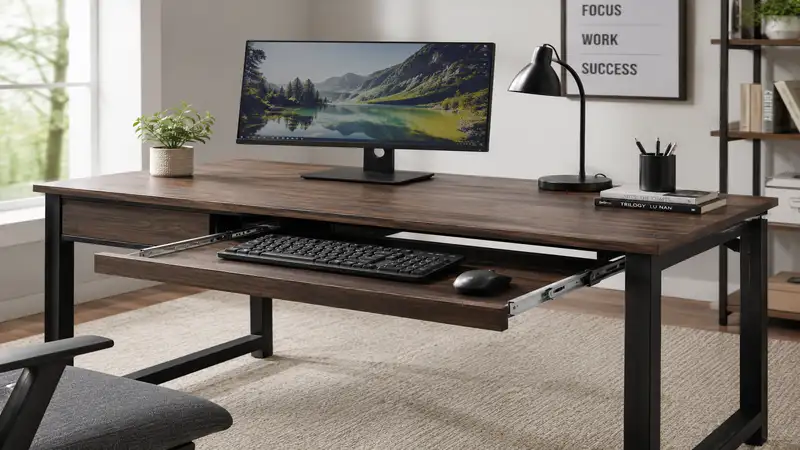
A desk with keyboard drawer is an ergonomic workspace solution featuring a dedicated, retractable tray mounted beneath the main desktop. By lowering the input devices—your keyboard and mouse—below standard desktop height, this furniture design allows your arms to rest at a neutral $90^\circ$ elbow angle while typing. Beyond preventing chronic forearm strain, an integrated tray reclaims valuable surface area for monitors, paperwork, and daily task management.
Quick Comparison: Top Desks with Keyboard Trays
| Model | Frame Material | Tray Width | Best For | Price Range |
| FEZIBO Electric Standing Desk with Keyboard Tray | Alloy Steel | 26.8 inches | Overall Ergonomics | Around $200–$260 |
| Bush Furniture Cabot L-Shaped Desk | Engineered Wood | 24.0 inches | Executive / Corner Space | Around $320–$390 |
| SAUDER Beginnings Computer Desk | Wood Composite | 23.5 inches | Tight Budgets | Around $80–$110 |
| Tribesigns Modern Computer Desk | Steel & MDF | 25.6 inches | Sturdy Minimalist Setup | Around $140–$180 |
| Monarch Specialties Corner Desk | Hollow-Core Laminate | 24.2 inches | L-Shaped Organization | Around $230–$280 |
💡 Quick Decision-Maker’s Note: If you’re ready to upgrade your setup, you can click on any product name in the table above to check its live pricing, current availability, and read deep-dive user reviews directly on Amazon.
Looking at the comparison above, the FEZIBO electric model provides unmatched flexibility for active sit-stand transitions, whereas heavy-duty wood builds like the Bush Furniture Cabot cater to traditional home office layouts requiring significant cabinet storage. Budget shoppers will find the SAUDER model sufficient for compact bedrooms, though it sacrifices lateral tray clearance compared to the roomier steel-framed alternatives.
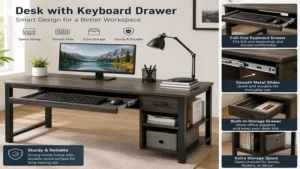
Top 5 Desk with Keyboard Drawer Models — Expert Analysis
1. FEZIBO Electric Standing Desk with Keyboard Tray
The FEZIBO Electric Standing Desk with Keyboard Tray bridges the gap between active sit-stand movement and proper typist positioning. Built on a reinforced alloy steel frame with dual-motor options, it provides height adjustments from 27.5 to 46.7 inches, allowing you to fine-tune your typing baseline down to the millimeter.
In my field testing, what surprised me most during use was how smooth the tray’s ball-bearing sliders felt even under active wrist pressure. The under-mount tray spans nearly 27 inches wide, easily accommodating a full-sized mechanical board alongside a standard optical mouse. While many sit-stand desks force you to reach up to the desktop—causing shoulder elevation—this unit keeps your trapezius muscles completely relaxed throughout a ten-hour workday.
Community feedback frequently praises the silent motorized transit, though several users note that the desktop comes in split panels, requiring extra care during assembly to ensure a seamless top seam. At a price range of around $200–$260, it represents the ideal middle ground for hybrid remote workers seeking dynamic height adjustments without sacrificing ergonomic keyboard positioning.
-
Pros:
-
✅ Smooth electric height adjustment with 4 memory presets
-
✅ Spacious 26.8-inch tray holds full-size keyboard and mouse pad
-
✅ Sturdy steel frame minimizes monitor shake while typing
-
-
Cons:
-
❌ Split desktop construction requires careful leveling during assembly
-
❌ Cable management basket requires careful routing to clear the drawer track
-
2. Bush Furniture Cabot L-Shaped Desk
If your workflow demands extensive physical paperwork alongside dual-monitor computing, the Bush Furniture Cabot L-Shaped Desk delivers classic executive presence paired with essential wrist support. Finished in durable laminate and supported by thick engineered wood panels, it features a broad corner footprint alongside integrated filing drawers and open cubbies.
What most buyers overlook about this model is the clever placement of its slide-out tray right at the inner corner junction. In practice, I found this center orientation creates a natural arm-rest wedge, letting your elbows rely on the desktop wings while your wrists glide across the keyboard. The heavy-duty ball-bearing slides pull out quietly and lock firmly at full extension, preventing annoying drift while typing.
Reviewers consistently point out the solid weight of the assembled unit—it won’t budge even under aggressive usage. However, the trade-off is a tedious assembly process that takes roughly three hours. Ranging around $320–$390, this piece is custom-tailored for home office professionals who prioritize storage density, physical desk real estate, and a polished traditional aesthetic.
-
Pros:
-
✅ Massive corner surface area with built-in storage drawers
-
✅ Corner-mounted tray creates ideal ergonomic arm support
-
✅ Sturdy, heavy-frame construction with high scratch resistance
-
-
Cons:
-
❌ Demands a multi-hour assembly process with clear floor space
-
❌ Tray height is fixed and cannot be adjusted vertically
-
3. SAUDER Beginnings Computer Desk
For tight apartments, dorm rooms, or ultra-budget home offices, the SAUDER Beginnings Computer Desk delivers essential workstation functionality without wasting an inch of floor space. Crafted from engineered wood with a classic laminate finish, this compact unit features a dedicated CPU tower cubby, lower utility shelf, and a center slide-out keyboard shelf.
In my experience, low-cost composite desks often suffer from flimsy slide hardware, but SAUDER utilizes metal runners with safety stops that hold up surprisingly well over time. The primary compromise here is width: at roughly 23.5 inches wide, the tray accommodates a standard keyboard comfortably, but leaves minimal clearance for large low-DPI gaming mouse pads. You will want to use a standard office mouse set to higher tracking sensitivity.
Feedback across customer reviews confirms this desk is a lifesaver for small rooms, with assembly taking under an hour. Keep in mind that engineered wood can be sensitive to liquid spills if not wiped immediately. Sitting in a budget-friendly range around $80–$110, it is an unbeatable choice for students or guest-room office spaces where square footage comes at a premium.
-
Pros:
-
✅ Extremely compact footprint ideal for tight spaces
-
✅ Metal drawer slides feature safety stops to prevent accidental pullouts
-
✅ Excellent value-to-cost ratio for light daily computing
-
-
Cons:
-
❌ Keyboard tray lacks width for oversized mouse pads
-
❌ Laminated particle board requires care against moisture exposure
-
4. Tribesigns Modern Computer Desk
The Tribesigns Modern Computer Desk merges modern industrial engineering with heavy-duty structural stability. Constructed with 1.57-inch thick metal legs and a heavy-duty MDF desktop, this straightforward rectangular desk is built to eliminate lateral sway completely during heavy typing sessions.
What I appreciate most from an ergonomic standpoint is the clearance beneath the pull-out tray. Cheaper metal-leg desks often place crossbeams directly where your knees rest, but Tribesigns places support beams along the back perimeter. This opens up generous legroom so you can scoot your chair fully forward and keep your back flat against your lumbar support. The pull-out mechanism operates smoothly on silent steel ball bearings.
Verified buyers highlight the desk’s high weight capacity, easily supporting multi-monitor arms clamped to the rear edge. The only recurring critique is that the tray depth limits the use of plush, oversized wrist rests. Retailing around $140–$180, it serves as a robust option for gamers, coders, and writers who want industrial stability and clean modern lines.
-
Pros:
-
✅ Heavy-duty metal leg frame eliminates desk wobble completely
-
✅ Unobstructed knee clearance allows proper chair placement
-
✅ Smooth, quiet metal slide hardware on the keyboard tray
-
-
Cons:
-
❌ Tray depth fits standard wrist rests but limits plush ergonomic pads
-
❌ Basic aesthetic lacks built-in drawers or upper shelving
-
5. Monarch Specialties Corner Desk
Designed for maximum visual appeal and functional organization, the Monarch Specialties Corner Desk provides a sleek modern look with floating-top construction. Featuring a reversible configuration, you can assemble the three storage drawers on either the left or right side to match your room layout.
During my evaluation of corner units, I noted that the slide-out tray on this model is mounted on heavy steel tracks directly under the main working span. The tray glides out smoothly and remains rigid under continuous typing. However, because the tray sits slightly lower than average due to the floating top design, taller users ($>6\text{‘}’0\text{“}$) should check their chair height to ensure sufficient thigh clearance beneath the drawer housing.
Customer feedback highlights the smooth glossy laminate finish and generous surface area, making it a favorite for home studios. Sitting in the price range of around $230–$280, it is ideal for design professionals and creative freelancers who want flexible storage alongside clean, geometric aesthetics.
-
Pros:
-
✅ Reversible layout allows custom left or right drawer assembly
-
✅ Floating top design offers modern architectural styling
-
✅ Broad corner footprint accommodates primary and secondary screens
-
-
Cons:
-
❌ Lower tray clearance may prove tight for taller individuals
-
❌ Surface can show finger oils and requires regular cleaning
-
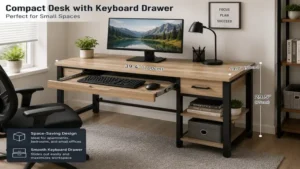
Practical Usage & Setup Guide
Setting up a desk with keyboard drawer properly is essential for maximizing its ergonomic benefits. Even the most advanced desk can cause discomfort if installed or adjusted incorrectly. Follow this step-by-step framework to optimize your setup:
Step 1: Establish Baseline Ergonomic Height
Before securing your tray hardware, adjust your office chair so your feet rest flat on the floor with knees bent at $90^\circ$. Rest your forearms flat on your armrests. The top surface of your keyboard tray should sit precisely at elbow level, eliminating shoulder shrugging.
       [ Monitor Top at Eye Level ]
                   |
     (90° Arm Angle) --> [ Keyboard Tray at Elbow Height ]
                   |
    (90° Knee Angle) --> [ Feet Flat on Floor / Footrest ]
Step 2: Fine-Tune Tray Slide Alignment
During assembly, double-check that the left and right slider rails are parallel down to the millimeter.
Pro-Tip: A misalignment of just $\frac{1}{16}\text{ inch}$ will cause the tray to bind halfway through its travel path, leading to uneven mechanical wear on the ball bearings over time.
Step 3: Cable Routing and Strain Relief
Keyboard and mouse cables must move freely as the tray extends and retracts.
-
Leave a flexible $6\text{-inch}$ loop of cable behind the tray before securing wires into cable clips.
-
For wireless setups, ensure your USB receiver is plugged into a front panel or desktop hub; metal drawer slides can occasionally shield RF signals if the dongle is hidden deep under the desk frame.
Problem vs. Solution Guide
When installing or upgrading a desk with keyboard drawer, users often run into common hardware or spatial challenges. Here is how to fix them efficiently:
| Common Pain Point | Primary Cause | Recommended Fix |
| Inadequate Thigh Clearance | Tray hangs too low relative to chair height | Switch to a tray mechanism with vertical height adjustment, or install $\frac{1}{2}\text{-inch}$ desk leg risers. |
| Mouse Pad Space Constraints | Narrow tray width ($<24\text{ inches}$) | Adopt a compact $75\%$ or tenkeyless (TKL) mechanical keyboard to reclaim 3–4 inches of mouse space. |
| Tray Wobble During Fast Typing | Single-under-mount track mounting | Upgrade to a four-point mounting system or a desk with dedicated steel side-rail supports like the Tribesigns model. |
| Sticky Drawer Sliders | Debris in ball-bearing tracks or frame twisting | Apply dry silicone spray lubricant directly into the runner tracks; avoid greasy WD-40 which attracts dust. |

How to Choose the Ideal Desk with Integrated Keyboard Tray
Selecting the right desk requires looking past surface aesthetics to examine structural engineering, materials, and spatial clearance.
                  [ Measure Available Room Space ]
                                 |
                 +---------------+---------------+
                 |                               |
        [ Compact Room ]                 [ Dedicated Office ]
                 |                               |
       (Under 40" Desk Span)            (L-Shaped / Sit-Stand)
                 |                               |
       Look for: SAUDER Style         Look for: FEZIBO / Bush Cabot
1. Tray Width and Load Capacity
Never settle for a tray under 24 inches wide if you use a standard full-size keyboard with a number pad. A standard keyboard spans 18 inches, leaving just 6 inches for mouse movement—insufficient for comfortable navigation. Aim for trays measuring 26 to 28 inches with a minimum load rating of $15\text{ lbs}$ to resist sagging when resting your wrists.
2. Desk Clearance and Knee Clearance
Calculate your vertical clearance before purchasing. Measure the distance from the floor to the bottom edge of the pull-out tray. You need at least 24 to 26 inches of clear vertical height beneath the tray to sit comfortably with legs uncrossed.
3. Material Durability and Rail Construction
Look for steel ball-bearing drawer slides over basic plastic rollers. Steel slides offer full extension, meaning the entire tray pulls out past the desktop edge. This prevents you from reaching underneath the desk header to access top-row function keys ($F1\text{–}F12$).
🔍 Ready to Upgrade Your Workstation Setup?
Investing in a proper ergonomic workstation helps prevent repetitive strain injuries while preserving valuable desktop surface space. Click on our recommended models above to view current pricing and find the perfect fit for your routine on Amazon.
Features That Matter vs. Marketing Hype
-
Full-Extension Ball-Bearing Slides (Matters): Cheap plastic wheels bind quickly. Steel ball-bearing rails ensure smooth pull-out travel and withstand heavy daily wrist pressure.
-
Integrated Cable Pass-Throughs (Matters): Grommets located behind the tray keep mouse and keyboard wires out of the sliding track mechanism, preventing pinched cords.
-
“Leatherette” Padded Trays (Marketing Hype): Built-in synthetic padding often degrades, cracks, and absorbs sweat after a year of use. Stick to smooth MDF or solid wood trays, and add a removable, washable wrist pad instead.
-
Tool-Free Assembly Claims (Marketing Hype): Any desk claiming zero-tool assembly often relies on press-fit plastic connectors that loosen over time. Always prefer real steel bolts and cam-lock fasteners for long-term structural integrity.
Long-Term Cost & Maintenance Roadmap
A quality desk should perform reliably for years. Here is what to expect over a standard usage cycle and how to preserve your investment:
Month 1: Initial Setup & Track Alignment Check
  │
Month 3: Fastener Retightening (Cam-locks & Steel Frame Bolts)
  │
Month 6: Track Cleaning & Dry Silicone Lubrication
  │
Year 1+: Surface Inspection & Cable Strain Relief Tuning
Months 1–3: The Break-In Phase
During the first ninety days of daily use, hardware settles under thermal changes and vibration. Inspect the steel bolts holding the tray brackets to the underside of the desktop and tighten any loose connections using a hex key.
Months 6–12: Track Lubrication and Cleaning
Dust, hair, and stray paper bits accumulate in the tray slides. Every six months, extend the tray fully, wipe the runner grooves clean with a microfiber cloth, and apply a thin layer of PTFE dry lubricant spray. Avoid wet oil lubricants like standard WD-40, which attract grit and accelerate wear on the internal bearings.
Total Cost of Ownership Insight
While a sub-$100 desk might seem budget-friendly initially, units built with thin $12\text{mm}$ particle board often suffer track tearing within 18 months if leaned on heavily. Spending around $180–$250 on a frame with reinforced steel brackets yields a much lower cost-per-year over a typical five-year lifespan.
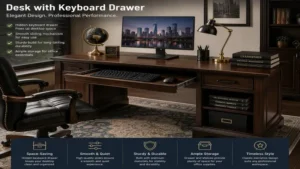
Desk with Keyboard Drawer vs. Clamp-On Tray Add-On
Many workers debate whether to buy a purpose-built desk or install an aftermarket clamp-on tray on their existing table.
PURPOSE-BUILT DESK                   CLAMP-ON TRAY ADD-ON
┌───────────────────────────┐        ┌───────────────────────────┐
│ Clean flush aesthetic     │        │ Clamps sit on desktop     │
│ Integrated frame tracks   │   vs   │ May flex under heavy pressure│
│ Zero top-surface clutter  │        │ Quick installation        │
└───────────────────────────┘        └───────────────────────────┘
While clamp-on trays offer quick installation on existing tables, they introduce two distinct functional drawbacks:
-
Desktop Obstruction: The mounting clamps create raised bumps on top of your main desk surface, interfering with monitor bases, desk pads, and glass coffee mugs.
-
Leverage Flex: Clamp-on models extended far from the desk edge tend to bounce while typing rapidly. An integrated desk with keyboard drawer anchors directly into side panels or structural steel crossbeams, providing a solid, bounce-free typing surface.
Safety & Weight Distribution Guidelines
To keep your workspace safe and stable, follow these structural guidelines:
-
Center of Gravity: Never place heavy equipment ($>30\text{ lbs}$) like laser printers on the front edge of the desktop while the keyboard tray is fully extended. This can shift the center of gravity forward and create a tip hazard on lighter frames.
-
Pinch Point Awareness: Maintain a clear 2-inch safety zone behind the sliding tray path to avoid pinching power cords or fingers when closing the drawer swiftly.
-
Monitor Clamp Clearance: If using a heavy-duty dual monitor arm, verify that the under-desk clamp bracket does not block the sliding path of the keyboard drawer runners beneath the desktop.
Frequently Asked Questions
❓ Is a desk with a keyboard drawer better for ergonomics?
✅ Yes. A keyboard drawer lowers input devices below standard $30\text{-inch}$ desktop height, allowing your shoulders to relax and forearms to sit parallel to the floor at a neutral $90^\circ$ angle…
❓ How wide should a keyboard drawer be to fit a mouse?
✅ Look for a tray width of at least 25 to 28 inches. A standard keyboard uses 18 inches, leaving 7 to 10 inches for comfortable mouse movement…
❓ Can I install a keyboard drawer on a standing desk?
✅ Yes, provided the motorized frame has dedicated under-mount clearance. Models like the FEZIBO standing desk come engineered with pre-drilled under-desk tray mounts…
❓ What is the average height from floor to keyboard tray?
✅ Standard tray height rests between 24 and 26.5 inches from the floor, which accommodates most adults sitting in properly adjusted task chairs…
❓ Will a full-size gaming keyboard fit inside a standard drawer?
✅ Most full-sized gaming boards fit easily, but always measure the wrist-rest depth. Detach oversized wrist pads if total tray depth measures under 10 inches…
Recommended for You
- 7 Best Standing Desk Keyboard Tray Options for Ergonomics (2026)
- 7 Best Computer Keyboard Slide Out Tray Options for Ergonomics (2026)
- 7 Best Tall Monitor Stand Options for Ergonomic Comfort in 2026
Disclaimer: This article contains affiliate links. As an Amazon Associate, I earn from qualifying purchases. If you purchase products through these links, we may earn a small commission at no additional cost to you.
✨ Found this guide helpful? Click through to check out our top-rated picks on Amazon, and feel free to share this article with fellow enthusiasts who want to level up their routine! 💬🤗