
In This Article
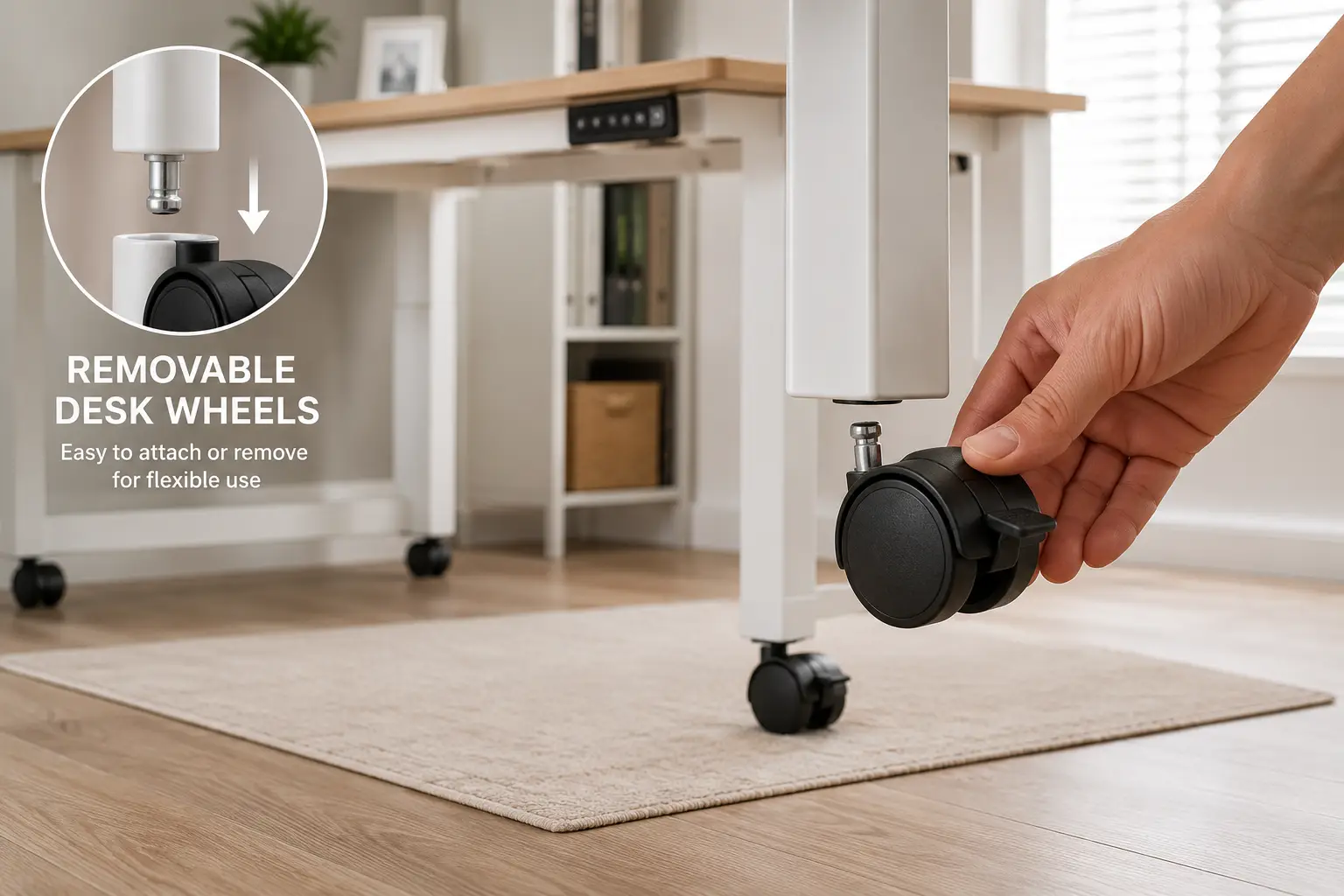
If you’ve ever tried to drag a fully loaded standing desk six feet to the left, you already know why removable desk wheels exist. A good set of casters turns a stationary slab of MDF and steel into something you can reposition in seconds — no lifting, no scraping the floor, no throwing your back out over a Monday morning rearrange. Removable desk wheels are swivel or locking caster wheels that attach to a desk’s leveling feet or leg base (usually via a threaded stem or a twist-on mount) and can be removed just as easily when you want the desk to sit flush and stable again.
That flexibility matters more than it sounds. Home offices double as guest rooms. Shared workspaces get reconfigured for meetings. Streamers, hobbyists, and small business owners move gear around constantly. And if you’re already invested in a height-adjustable desk, adding wheels is one of the cheapest upgrades you can make to it. The catch is that not all casters are created equal — wheel material, thread size, load capacity, and locking mechanisms vary a lot between brands, and picking the wrong set can mean a wobbly desk, a scratched floor, or wheels that simply don’t fit your frame.
This guide breaks down seven real, currently available options on Amazon, from budget-friendly universal fits to premium, warranty-backed sets built for daily use. You’ll get honest analysis of what each one does well, who it’s actually built for, and how to avoid the most common buying mistakes — no fluff, no invented reviews, just what the spec sheets and aggregated customer feedback actually show.
Quick Comparison: Removable Desk Wheels at a Glance
| Product | Wheel Size | Locking | Price Range | Best For |
|---|---|---|---|---|
| Stand Steady Attachable Desk Wheels | 2 in | All 4 lock | Under $40 | Easiest twist-on install |
| VIVO PT-ST-015C Casters | 1.5 in | Yes (brake) | $25–$35 | Budget universal replacement |
| VWINDESK M8 PU Casters | 2 in | Yes (brake) | $25–$40 | Quiet, all-around performance |
| JOYworker Lockable Casters | 2.5 in | Yes (brake) | $20–$35 | Rolling over cords/thresholds |
| Slipstick CB680 Rubber Casters | 3 in | Yes (brake) | $25–$40 | Heavy loads, carpeted floors |
| FlexiSpot W1 Casters | ~2 in | 2 of 4 lock | $30–$50 | Guaranteed FlexiSpot fit |
| Stand Up Desk Store Casters | 2 in | All 4 lock | $40–$60 | Warranty-backed, BIFMA-tested builds |
Looking at the table, the split comes down to fit versus flexibility: the FlexiSpot W1 Casters and the Stand Up Desk Store Casters are built (or tested) around specific desk ecosystems, while the VIVO PT-ST-015C Casters, VWINDESK M8 PU Casters, and JOYworker Lockable Casters use the widely adopted M8 threaded stem, which fits a much broader range of frames. If your priority is a guaranteed match, buy from the brand that made your desk; if you want the best price-to-performance ratio on a generic frame, the M8 universal options are the safer bet.
💬 Ready to see which caster fits your desk? Check current availability and confirm your frame’s stem size before you add to cart! 😊
The 7 Best Removable Desk Wheels: Expert Analysis
Below are seven real, currently sold products covering entry-level, mid-range, and premium options — plus a mix of wheel diameters and locking styles so there’s a realistic match for almost any desk.
1. Stand Steady Attachable Desk Wheels — fastest, tool-light install
The whole appeal of the Stand Steady set is how little effort it takes to get rolling: you remove the existing leveling feet and twist these on, no drilling and minimal fiddling required. That’s a meaningful advantage if you’ve never installed casters before and just want the desk mobile by the end of your lunch break.
Each of the four 2-inch wheels locks independently, which in practice means you can leave two wheels free for pivoting and lock the other two to anchor the desk while you type — useful if your desk sits near a doorway or high-traffic hallway. The polyurethane wheel surface is non-marring, so hardwood and laminate floors are safe from scuff marks, a detail cheaper rubber-tired casters sometimes skip.
Who it’s for: someone using a Stand Steady–branded frame (like the Tranzendesk line) who wants the simplest possible upgrade path, without hunting for the right thread size. Reviews consistently report that installation takes just a few minutes and that the locking mechanism is easy to engage even one-handed, though a handful of buyers note the wheels are purpose-fit for Stand Steady/Tranzendesk feet and may not thread onto other brands’ desks.
Pros:
- ✅ Twist-on install with no tools needed
- ✅ All four wheels lock individually
- ✅ Non-marring surface protects hardwood floors
Cons:
- ❌ Best fit is limited to Stand Steady–compatible frames
- ❌ 2-inch diameter struggles on thick carpet
Priced under $40, this is a fair value pick if your desk is already from a compatible brand — the convenience alone justifies the cost, though buyers with other frames should look elsewhere.
2. VIVO PT-ST-015C M8 Threaded Locking Caster Wheels — budget-friendly universal fit
The VIVO set uses a standard M8 threaded stem, which is the same mounting size used across a huge range of standing desk frames, TV carts, and mobile stands — not just VIVO’s own lineup. That universality is the headline feature here: buy once, and there’s a good chance it threads directly onto whatever leveling foot your desk already has.
Each 1.5-inch wheel combines a steel core with a rubber tread and a swivel-plus-brake mechanism, so you get 360-degree maneuverability with the option to lock it in place. The smaller wheel diameter keeps the added desk height modest, which matters if you’re already near the top of your monitor arm’s adjustment range.
Who it’s for: budget-conscious buyers replacing worn factory casters or adding mobility to a smaller desk, cart, or TV stand. Reviews consistently mention smooth, quiet rolling on hard floors and straightforward installation, with occasional feedback that the 1.5-inch wheel size feels undersized for heavier dual-motor desks loaded with monitors and equipment.
Pros:
- ✅ Universal M8 thread fits many desk brands
- ✅ Swivel-plus-brake locking on all four wheels
- ✅ Minimal added height keeps ergonomics intact
Cons:
- ❌ Smaller 1.5-inch wheel may feel underpowered on heavy desks
- ❌ Steel-and-rubber build is louder than polyurethane on tile
At around $25 to $35, this is one of the more affordable entries in this roundup, and it’s a smart value pick specifically because the M8 thread compatibility reduces your risk of buying the wrong part.
3. VWINDESK 2-Inch M8 PU Locking Caster Wheels — best all-around quiet performer
VWINDESK’s casters lean into polyurethane (PU) construction rather than rubber, and that single material choice changes the everyday experience more than you’d expect. PU wheels tend to roll more quietly and resist compression-set (that flat spot a wheel develops from sitting under load) better than softer rubber over time.
The 220-pound total capacity across a 360-degree swivel top plate means the set can comfortably support a mid-size standing desk with a monitor, laptop dock, and the usual desk clutter. The brake mechanism engages with a simple foot-tap, and the 2-inch diameter is a sensible middle ground — big enough to roll over small cable bumps, small enough to keep added height minimal.
Who it’s for: anyone who wants a genuinely quiet roll (open-plan offices and shared apartments benefit here) without stepping up to premium pricing. Reviews consistently highlight the smooth glide on hardwood and laminate, with some buyers noting that the plastic top-plate housing feels less substantial than the metal-bodied premium alternatives further down this list.
Pros:
- ✅ Polyurethane wheels roll noticeably quieter than rubber
- ✅ 220 lb total capacity covers most mid-size desks
- ✅ 360° swivel top plate for tight maneuvering
Cons:
- ❌ Plastic top-plate housing feels less premium than metal builds
- ❌ 220 lb ceiling may be tight for dual-monitor, heavy-equipment setups
In the $25 to $40 range, this is arguably the best value-for-money pick in the lineup if quiet operation is a priority — you’re paying a small premium over the cheapest options for a wheel material that pays it back in noise reduction.
4. JOYworker Lockable Stem Caster Wheels — best for rolling over cords and thresholds
JOYworker’s set stands out for wheel diameter: at 2.5 inches, these are noticeably larger than the Stand Steady or VIVO options, and that extra half-inch matters more than the spec sheet implies. Bigger wheels roll over small obstacles — a stray charging cable, a floor transition strip, a slightly uneven tile — with far less resistance than smaller wheels, which tend to catch and stall.
The nylon wheel material is on the harder end of the durometer scale, which trades a bit of ride softness for durability and load capacity; each caster is rated for 110 pounds, or 440 pounds across the set, which comfortably covers even a heavier dual-motor standing desk frame loaded with gear. The M8 metric thread keeps compatibility broad.
Who it’s for: buyers whose desk sits in a room with cable management on the floor, a rug-to-hardwood transition, or anything else that smaller wheels tend to snag on. Reviews consistently describe the rolling motion as smoother over obstacles than smaller-wheel competitors, though a few buyers mention that nylon transmits more rolling noise on hard flooring than polyurethane.
Pros:
- ✅ Larger 2.5-inch wheel clears cords and thresholds easily
- ✅ 440 lb combined load capacity across the set
- ✅ Broad M8 thread compatibility
Cons:
- ❌ Nylon construction is noisier than polyurethane on hard floors
- ❌ Added height is more noticeable due to larger wheel diameter
At roughly $20 to $35, this is a strong pick for anyone whose floor isn’t perfectly flat and open — the extra diameter genuinely earns its keep in real-world rolling.
5. Slipstick CB680 3-Inch Rubber Caster Wheels with Brake Locks — heaviest-duty, carpet-friendly option
The Slipstick set takes a different design approach entirely: rollerblade-style rubber wheels at a full 3 inches, mounted on a 3/8-inch threaded stem rather than the M8 metric standard used elsewhere in this list. That larger diameter and softer rubber tread combination is specifically built to handle carpet, which is where smaller hard-wheel casters tend to struggle the most — they sink in and drag instead of rolling.
Each wheel includes a brake lock, and the rollerblade-style tread (multiple narrow wheels stacked on a single axle rather than one wide wheel) distributes weight more evenly, which helps on soft or slightly uneven surfaces. This is the closest thing in this roundup to an industrial-style caster scaled down for furniture use.
Who it’s for: anyone working from a carpeted home office or a shared space where the desk needs to survive being pushed around by multiple people. Reviews consistently note that these roll noticeably better over carpet than standard rubber or PU casters, with occasional feedback that the imperial 3/8-inch stem (rather than metric M8) means measuring your existing mounting hardware carefully before ordering.
Pros:
- ✅ Rollerblade-style design handles carpet far better than standard wheels
- ✅ 3-inch diameter clears thick pile and low thresholds
- ✅ Individual brake locks on every wheel
Cons:
- ❌ Imperial 3/8-inch stem isn’t compatible with M8 metric mounts
- ❌ Larger diameter adds more height than 2-inch alternatives
Typically priced in the $25 to $40 range, this is the pick to make if your floor is carpeted and previous casters have felt like they were dragging instead of rolling — just double-check your stem size first.
6. FlexiSpot W1 Standing Desk Casters — official-brand fit for FlexiSpot desks
Buying casters directly from the desk manufacturer removes almost all of the guesswork, and that’s exactly what the FlexiSpot W1 set offers: it’s engineered specifically for FlexiSpot (and compatible Loctek-built) standing desk frames, so fitment issues are essentially a non-issue if that’s what you own.
The polyurethane wheels come in a set of four, with two designed to lock for stability and two left free-swiveling for easier repositioning — a deliberate compromise between a fully mobile desk and one that won’t drift while you’re standing and typing. Because it’s an official accessory rather than a generic replacement part, it’s also built to match the desk’s existing foot height and base footprint precisely.
Who it’s for: current FlexiSpot desk owners who don’t want to gamble on third-party compatibility, and who value having a single manufacturer to contact for warranty or fit questions. Reviews consistently describe the two-lock, two-free design as a sensible default for everyday use, though some buyers note that four fully lockable wheels (like the Stand Steady or VIVO sets) offer more stability for desks that get bumped frequently.
Pros:
- ✅ Guaranteed fit for FlexiSpot and compatible Loctek frames
- ✅ Two-lock, two-swivel design balances mobility and stability
- ✅ Backed directly by the desk manufacturer
Cons:
- ❌ Only 2 of 4 wheels lock, versus all 4 on several competitors
- ❌ Limited to FlexiSpot-compatible frames, not a universal fit
Direct pricing typically lands in the $30 to $50 range depending on retailer, and for existing FlexiSpot owners, the fit certainty alone makes this the lower-risk purchase compared to a generic universal caster.
7. Stand Up Desk Store 2-Inch Locking Casters — premium pick with warranty backing
Stand Up Desk Store’s casters are designed around their own line of electric standing desk frames, and the company backs the set with a limited lifetime warranty — a notably longer commitment than most caster manufacturers offer on what is, functionally, a small hardware accessory. The frames these casters attach to are BIFMA-certified for safety and durability, which is a meaningful signal that the overall desk-and-caster system has been through recognized third-party performance testing rather than just marketing claims.
All four 2-inch, non-marking wheels lock, and the company states plainly that adding the casters increases overall desk height by about 2 inches — worth factoring in if you’re tall or already near the top of your desk’s height range, since it can actually help very tall users reach a more comfortable typing height rather than being a pure downside. Weight capacity sits around 220 pounds.
Who it’s for: buyers who already own (or are considering) a Stand Up Desk Store frame and want a warranty-backed, tested accessory rather than a third-party guess. Reviews consistently praise the US-based customer support team for fast, detailed responses to fit and installation questions — a differentiator in a category where many competitors are resold through third-party marketplace listings with minimal support.
Pros:
- ✅ Limited lifetime warranty, longer than most competitors
- ✅ BIFMA-certified frame compatibility for tested durability
- ✅ US-based customer support for fit and warranty questions
Cons:
- ❌ Adds roughly 2 inches of height, which isn’t ideal for shorter users
- ❌ Premium price relative to universal M8 alternatives
At around $40 to $60, this sits at the top of the price range in this roundup, but the warranty and BIFMA-tested frame compatibility offer real peace of mind for buyers who plan to keep their desk mobile for years, not just a one-time rearrange.
Removable Desk Wheels Compared: Full Specs and Pricing
| Product | Wheel Material | Load Capacity | Thread/Mount | Price Range |
|---|---|---|---|---|
| Stand Steady Attachable Desk Wheels | Polyurethane | Not stated (light-medium duty) | Twist-on, brand-specific | Under $40 |
| VIVO PT-ST-015C Casters | Rubber + steel | ~200 lb (est., 4-wheel set) | M8 threaded | $25–$35 |
| VWINDESK M8 PU Casters | Polyurethane | 220 lb total | M8 threaded | $25–$40 |
| JOYworker Lockable Casters | Nylon | 440 lb total | M8 threaded | $20–$35 |
| Slipstick CB680 Rubber Casters | Rubber (rollerblade-style) | Heavy-duty rated | 3/8″ x 1″–16 UNC | $25–$40 |
| FlexiSpot W1 Casters | Polyurethane | Manufacturer-rated | Brand-specific | $30–$50 |
| Stand Up Desk Store Casters | Polyurethane, non-marking | 220 lb | Brand-specific, BIFMA-tested | $40–$60 |
The clearest pattern in this table is that load capacity and wheel diameter move together: the JOYworker Lockable Casters, with the largest wheel among the universal-fit options, also carries the highest published capacity, while smaller-wheel entries like the VIVO PT-ST-015C Casters are better suited to lighter desks. Note that “capacity” figures for unbranded manufacturer parts aren’t always independently published, so where a set doesn’t list an exact number, treat the desk frame’s own weight rating as the real ceiling — the casters rarely become the weak link before the frame itself does.
Removable Desk Wheels vs. Fixed Desk Feet: Which Wins for Your Workspace
Fixed feet (or leveling glides) are the default on almost every standing desk, and for good reason: they’re rock-solid, don’t add height, and eliminate the tiny amount of caster “creep” — the small circular drift a locked swivel caster can still make when nudged, since the wheel itself is locked but the swivel pivot point isn’t perfectly centered under the load. If your desk lives in one spot permanently, fixed feet are genuinely the better default.
| Factor | Removable Desk Wheels | Fixed Desk Feet |
|---|---|---|
| Mobility | High — reposition in seconds | None — requires lifting to move |
| Stability under typing | Good, with locks engaged | Best — zero drift |
| Added height | Typically +1.5 to +2 in | None |
| Best for | Shared spaces, frequent reconfiguration | Permanent, single-location setups |
The trade-off is straightforward: wheels win decisively for anyone who reconfigures a room, works from a studio apartment, or shares a workspace, while fixed feet win for a dedicated home office that never moves. A practical middle ground many buyers land on is running locking casters and simply engaging all the brakes once the desk is in its “home” position, which gets you the stability of fixed feet with the option to roll it away when needed. For more on how wheel and caster design affects rolling performance across different materials, see this overview of caster mechanics and wheel materials.
✨ Not sure if wheels or fixed feet fit your setup? Compare current listings side by side before you decide!
How to Install Removable Desk Wheels: A Step-by-Step Guide
Installing a set of removable desk wheels is one of the simpler DIY furniture upgrades, but rushing it is the most common way people end up with a wobbly desk. Here’s the process most casters in this roundup follow, start to finish.
First, confirm your mounting type before ordering anything — this single step prevents the majority of returns in this category. Most desks use either an M8 metric threaded stem (an 8mm bolt with roughly 1.25mm thread pitch) or a twist-on/friction-fit mount specific to the desk brand. Check your existing leveling foot or consult your desk’s manual; guessing wrong means reordering.
Next, empty the desk and, ideally, get a second person to help tip it safely on its side or fully lift it — desk frames with motors and full-width tabletops are heavier than they look, and working alone risks both the desk and your back. With the desk stabilized, remove the existing leveling feet by unscrewing or unclipping them, depending on your original hardware.
Thread or twist each caster into place, turning clockwise until it seats firmly against the leg base — don’t overtighten plastic threads, which can strip. Once all four are installed, set the desk upright and rock it gently at each corner to check for wobble; if one corner sits high, that caster likely isn’t fully seated. Finally, test the locking mechanism on each wheel individually before loading the desk with your monitor and equipment, so you catch any faulty units while the desk is still empty and easy to maneuver.
Real-World Scenarios: Matching Wheels to How You Work
Specs only tell part of the story — here’s how these picks map onto a few common situations. If you’re a graduate student sharing a 300-square-foot studio apartment, floor space is doing double duty as a desk area by day and a yoga or workout space by evening; the VIVO PT-ST-015C Casters or the budget-friendly JOYworker Lockable Casters make sense here, since you need the desk to roll against a wall in seconds without a large investment.
If you’re a freelance video editor running a dual-monitor setup with a dock, external drives, and an audio interface, weight and stability under a heavier load matter more than pure budget — the VWINDESK M8 PU Casters or the Stand Up Desk Store Casters are better matches, since both are rated to handle a fully loaded mid-to-large desk without the added risk of an underpowered wheel.
And if you’re setting up a small business’s shared coworking corner where three or four different people might use the same desk across a week, durability and lock reliability under repeated use become the priority. The Stand Up Desk Store Casters, with their BIFMA-certified frame testing and warranty backing, or the Slipstick CB680 Rubber Casters for carpeted coworking spaces, hold up better to that kind of rotating, heavier-than-average use than the lightest entry-level options.
Common Desk-Wheel Problems and How to Fix Them
Even a well-chosen set of casters can run into a handful of predictable issues. Here’s how to solve the ones that come up most often.
Problem: The desk still wobbles after installing wheels. This is almost always a seating issue rather than a defective product — one caster isn’t threaded in as far as the others. Remove all four, check the stem threads for debris or damage, and reinstall slowly, confirming each one seats at the same depth before standing the desk upright.
Problem: Wheels roll unevenly or the desk pulls to one side. Uneven flooring is the usual culprit, especially on older hardwood or where a rug edge sits under one corner. Swapping to a larger-diameter wheel, like the 2.5-inch JOYworker Lockable Casters or the 3-inch Slipstick CB680 Rubber Casters, often resolves this because bigger wheels are less sensitive to small floor irregularities.
Problem: A locked wheel still allows slight drift. This is the caster-creep effect mentioned earlier — the wheel itself is locked, but the swivel joint above it can still pivot slightly under lateral pressure. It’s mechanically normal, not a defect, and engaging all four locks (rather than just two) minimizes it noticeably.
Problem: Wheels are scuffing or denting the floor. Confirm the wheel material actually matches your flooring — hard nylon wheels like those on the JOYworker Lockable Casters are more likely to mark soft hardwood than polyurethane options like the VWINDESK M8 PU Casters. A floor mat under the desk solves this instantly if switching wheel material isn’t practical.
Problem: The desk sits noticeably higher after installing wheels. This is expected, not a fault — most casters in this roundup add 1.5 to 2 inches. If that pushes your desk above a comfortable typing height, re-check your chair height or standing-desk presets rather than assuming the casters are the wrong choice.
How to Choose Removable Desk Wheels: 7 Criteria That Matter
- Confirm your mounting type first. M8 threaded stems are the most common universal standard, but twist-on and imperial-thread mounts (like Slipstick’s 3/8-inch stem) exist too — measure before you buy.
- Match wheel diameter to your floor. Smaller 1.5–2 inch wheels suit smooth hardwood or tile; 2.5–3 inch wheels handle carpet, cords, and uneven transitions far better.
- Check the load rating against your fully loaded desk weight. Add the tabletop, monitor arm, monitors, and any equipment — don’t rely on the empty-frame weight alone.
- Decide how many wheels need to lock. Four-lock sets (like Stand Steady or VIVO) offer maximum stability; two-lock, two-swivel designs (like FlexiSpot’s W1) trade some stability for easier repositioning.
- Pick wheel material based on noise and floor sensitivity. Polyurethane rolls quieter and is gentler on hardwood; rubber and nylon trade some quiet for durability and load capacity.
- Factor in the added height. Most casters add 1.5–2 inches; this can help taller users but may require adjusting your standing-desk height presets either way.
- Weigh brand-specific fit against universal compatibility. Buying direct from your desk’s manufacturer (FlexiSpot, Stand Up Desk Store) removes fitment risk; universal M8 options save money if you’re comfortable measuring first.
Common Mistakes to Avoid When Buying Desk Casters
The single most common mistake is skipping the measurement step and ordering based on brand name alone — a caster that looks identical to your old one can use a completely different thread pitch or stem length, and that mismatch is the top reason for returns in this category. Take five minutes to check your existing hardware or your desk’s spec sheet before ordering.
A second frequent misstep is underestimating real-world load. Buyers often calculate capacity using just the tabletop and frame weight, forgetting that a full setup with two monitors, a laptop dock, and cable management can add 30 to 50 pounds beyond the bare desk. Undersized casters, like the smaller 1.5-inch options, can feel sluggish or compress unevenly under that extra weight over time.
Third, some buyers assume “locking” means the desk won’t move at all — but as covered above, a locked swivel caster can still exhibit minor creep under lateral force. If total immobility is the actual goal, fixed feet (or a caster set paired with floor stops) is the more appropriate solution, not just any locking caster.
Finally, don’t ignore floor compatibility. Buying hard nylon or rubber wheels for a softwood or luxury vinyl floor without checking the manufacturer’s floor-safety guidance can lead to avoidable marking over time — a small detail that’s easy to overlook when comparing specs on a product page.
What to Expect: Everyday Performance on Carpet, Hardwood, and Tile
Wheel material and hardness (measured on the Shore A durometer scale) drive almost everything about how a caster actually feels day to day, and the differences show up fastest on carpet. Harder wheels, like the nylon used in the JOYworker Lockable Casters, roll faster on smooth hard floors but tend to sink slightly into thick carpet pile, requiring more push force to get moving. Softer rubber and PU wheels, like those on the Slipstick CB680 Rubber Casters and VWINDESK M8 PU Casters, deform slightly at the contact point, which increases grip and control on carpet at a small cost to top rolling speed on hard floors — a well-documented trade-off in caster wheel durometer and material selection.
On hardwood and laminate, quiet operation becomes the more noticeable factor, especially in open apartments or shared offices. PU wheels are consistently the quietest of the materials in this roundup, which is one reason the VWINDESK M8 PU Casters and FlexiSpot W1 Casters stand out for shared or sound-sensitive spaces. On tile, wheel hardness matters less than floor evenness — grout lines can create a subtle bump-bump sensation on any small-diameter caster, which is where the larger wheels in this list, like the JOYworker Lockable Casters or Slipstick CB680 Rubber Casters, roll noticeably more smoothly.
📌 Want a smoother roll on your specific floor type? Compare wheel materials before you buy!
Safety, Regulations, and Standards for Desk Casters
Desk casters themselves aren’t subject to a dedicated federal regulation the way, say, clothing storage furniture is under the CPSC’s tip-over rules, but the broader furniture stability principles those rules are built on still apply in a practical sense: a wider, properly locked caster base reduces the chance of a loaded desk shifting or tipping under lateral force, which is part of why the CPSC’s furniture stability guidance consistently emphasizes stable bases and engaged locks as basic safety practice, especially in homes with kids or pets who might lean on furniture.
Where a more direct, furniture-specific standard does exist is through BIFMA (the Business and Institutional Furniture Manufacturers Association), whose voluntary but widely recognized testing protocols evaluate components like casters and swivel mechanisms through repeated cyclic testing meant to simulate years of real-world use. Products described as BIFMA-tested or BIFMA-certified, like the frames the Stand Up Desk Store Casters are designed for, have gone through structured lab testing for durability rather than relying solely on manufacturer claims — worth checking for if you’re outfitting a shared or commercial space rather than a single-person home office. You can review the scope of these BIFMA furniture safety and performance standards directly if you want the full technical picture.
Practically, the safety takeaway for most home buyers is simpler: always engage all available locks before sitting down to work, especially with kids or pets nearby, and avoid stacking wheeled casters onto a desk that’s already near or over its rated weight capacity.
Long-Term Cost and Maintenance
Removable desk wheels are a low-maintenance upgrade compared to most desk components, but they’re not entirely maintenance-free. Dust, hair, and small debris tend to accumulate around the swivel pivot and wheel axle over months of use, especially in carpeted rooms, and a buildup there is the most common cause of a caster that starts rolling less smoothly or locking less reliably over time. A quick wipe-down with a dry cloth every month or two, and an occasional check that the mounting stem hasn’t loosened, is generally enough to keep any of the sets in this roundup performing well for years.
In terms of total cost of ownership, the cheaper universal options — the VIVO PT-ST-015C Casters and JOYworker Lockable Casters — carry a real trade-off: at their price point, a worn or damaged wheel typically means replacing the full set rather than a single component, since individual replacement parts aren’t always sold separately. Premium, brand-backed options like the Stand Up Desk Store Casters cost more upfront but include warranty coverage that can offset a full replacement if a wheel fails prematurely, which matters more the longer you plan to keep the same desk. For a desk that’s expected to stay in daily use for five-plus years, that warranty coverage can end up being the cheaper option over the full ownership period, even though the sticker price is higher on day one.
Frequently Asked Questions
❓ Do removable desk wheels fit any standing desk?
❓ How much height do desk casters typically add?
❓ Can I install removable desk wheels myself without tools?
❓ Are locking desk casters enough to keep a desk from moving while I type?
❓ Do desk wheels damage hardwood or laminate floors?
Conclusion
Removable desk wheels solve a genuinely common problem — a desk that’s too heavy or awkward to move without help — but the right set depends heavily on your specific desk, floor, and how often you actually plan to reposition it. If you want the simplest possible upgrade and already own a compatible frame, the Stand Steady Attachable Desk Wheels or the brand-matched FlexiSpot W1 Casters remove nearly all the guesswork. If budget and universal fit matter most, the VIVO PT-ST-015C Casters and JOYworker Lockable Casters cover that ground well, with the JOYworker set edging ahead for anyone dealing with cords or uneven flooring.
For carpeted rooms, the Slipstick CB680 Rubber Casters are the clear standout, while the VWINDESK M8 PU Casters offer the best balance of quiet operation and mid-range pricing for hard floors. And if you’re buying for the long haul, want tested durability, and don’t mind paying a bit more upfront, the Stand Up Desk Store Casters bring warranty backing and BIFMA-tested frame compatibility that the budget options simply don’t offer.
Whichever set you choose, the two things worth double-checking before you click “buy” are your desk’s exact mounting thread and your floor type — get those two details right, and any of the seven options above should serve you well for years of easy, low-effort desk repositioning.
✨ Ready to make your workspace fully mobile? Browse the current listings above and pick the caster set that matches your desk and floor. 🛒
Recommended for You
- 7 Best Manual Crank Standing Desks (2026 Picks)
- 7 Best Executive Sit Stand Desk Models for Executive Offices (2026)
- 72×30 Desk Guide: 5 Best Large Desks Tested in 2026
Disclaimer: This post contains affiliate links. As an Amazon Associate, I earn from qualifying purchases made through these links, at no additional cost to you.
✨ Found this article helpful? Share it with someone who needs it! 💬🤗