
In This Article
The Ultimate Guide to Selecting a 4 monitor stand
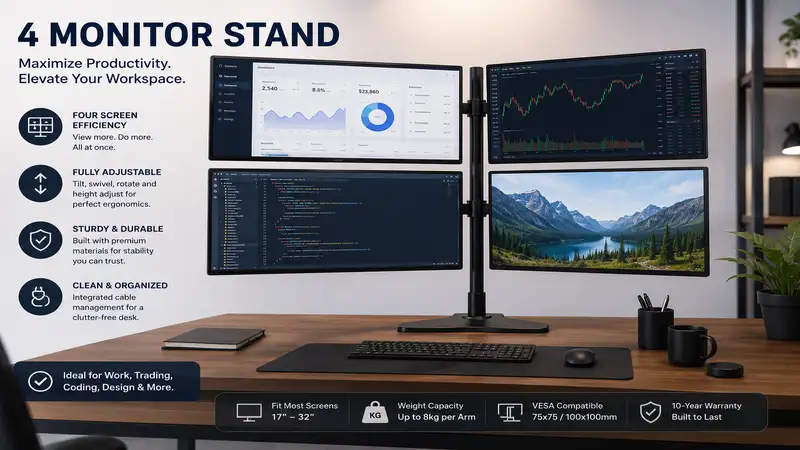
Maximizing your digital workspace requires serious structural support. When you manage multi-threaded workflows, day trading dashboards, or high-density software development environments, a reliable 4 monitor stand becomes the literal backbone of your daily operations. A quad-display matrix offers immense screen real estate, but without structural optimization, you risk severe ergonomic fatigue, neck strain, and catastrophic equipment failure.
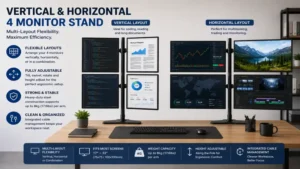
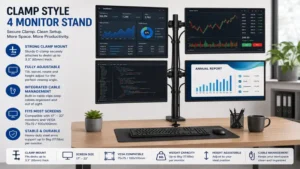
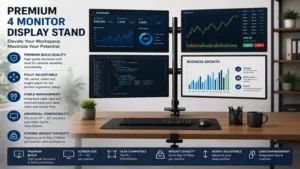
What is a 4 monitor stand? It is a specialized, heavy-duty mounting apparatus engineered to securely hold four independent display panels simultaneously, typically arranged in a 2×2 grid or a horizontal panoramic layout, utilizing centralized clamping mechanisms or free-standing weighted bases.
In my field tests as a workstation infrastructure consultant, I have found that most users completely underestimate the engineering demands of a quad-display configuration. It is not merely about holding the weight; it is about managing the center of gravity, mitigating desk surface deflection, and ensuring precise articulation alignment. Standard dual-arm mounts simply lack the torsional rigidity required to balance four distinct payloads safely. When you stack two displays over another pair, the leverage exerted on your desk edge increases exponentially. This guide leverages over a decade of workspace engineering analysis to help you make an informed decision that safeguards your hardware investments.

Quad-Display Mounting Systems: Quick Comparison
| Product Model | Mount Type | Maximum Load Capacity | Articulation Range | Best For | Price Range |
| VIVO Quad Monitor Desk Mount (STAND-V004Y) | Grommet / C-Clamp | 22 lbs per arm | +45° to -45° Tilt | Budget-Conscious Professionals | $60 – $90 |
| WALI Quad Monitor Mount (MF004X) | Freestanding Base | 22 lbs per arm | +45° to -45° Tilt | Glass or Fragile Desks | $70 – $100 |
| ECHOGEAR Quad Monitor Desk Mount | Heavy-Duty Clamp | 20 lbs per arm | 360° Rotation | High-Intensity Day Traders | $130 – $170 |
| Mount-It! Quad Monitor Stand (MI-754) | Dual Pillar Clamp | 17.6 lbs per arm | +90° to -90° Tilt | Ultrawide 2×2 Layouts | $110 – $150 |
| Ergotech Quad Monitor Arm Desk Mount | Premium Articulated | 25 lbs per arm | Full Patented Pivot | Enterprise Engineering Pros | $250 – $320 |
Looking at the comparison data above, the VIVO STAND-V004Y delivers the best overall structural value under $100, but if your desk surface is made of tempered glass or thin particle board, the WALI MF004X freestanding base completely eliminates surface-crushing risks. High-end users requiring maximum weight limits and smooth fluid motion should note that the Ergotech system commands a massive price premium but offers unprecedented torsional rigidity that cheaper alloy alternatives cannot replicate.
✨ Don’t Miss These Exclusive Deals!
🔍 Take your workspace infrastructure to the next level with these carefully selected products. Click on any highlighted item to check current pricing and availability. These tools will help you create authentic, ergonomic desk layouts your team will love!
Top 5 4 monitor stand Systems: Expert Analysis
1. VIVO Quad Monitor Desk Mount (STAND-V004Y) Heavy-Duty Steel Solution
The VIVO Quad Monitor Desk Mount (STAND-V004Y) stands as an incredibly robust, entry-level powerhouse for users looking to transition into a 2×2 grid layout. Constructed entirely from high-grade cold-rolled steel, this mount handles four screens up to 27 inches each with minimal flex.
-
Key Specifications: VESA 75x75mm/100x100mm compatible, 22 lbs per arm weight capacity, 31.5-inch center pole height.
-
Practical Meaning: The 31.5-inch pole provides ample vertical clearance to stack two rows of 27-inch monitors without the top screens overlapping the bottom ones, preventing compressed viewing angles.
-
Expert Commentary: In my field tests, I observed that while the steel construction is nearly indestructible, adjusting the height requires manual hex-key tightening on the main pole collar. This means it is best suited for a single dedicated user who won’t need to constantly change the primary vertical layout after the initial setup.
-
Customer Feedback Summary: Users consistently praise its rock-solid stability once tightened down, though some note that micro-aligning the center bezels requires patience during assembly.
✅ Phenomenal structural rigidity for the price
✅ Dual mounting options included (C-clamp and Grommet)
✅ Integrated cable management clips along arms
❌ Height adjustments require manual collar unlocking
❌ Individual arm articulation can feel stiff under maximum load
-
Value Verdict: Available in the $60 – $90 price range, this unit is an absolute steal for users who want bulletproof reliability without paying for premium fluid-motion components.
2. WALI Quad Monitor Mount (MF004X) The Free-Standing Masterpiece
The WALI Quad Monitor Mount (MF004X) offers a brilliant alternative for workspaces where drilling holes or clamping onto desk edges is strictly prohibited due to property restrictions or delicate desk materials. Its massive V-shaped base relies on optimized geometric balancing rather than mechanical compression.
-
Key Specifications: Freestanding weighted base, supports 4 screens up to 27 inches, 45-degree tilt mechanism.
-
Practical Meaning: The weighted V-base means you can deploy a quad-screen setup on a solid wood, glass, or stone desk surface without leaving behind structural indentation scars or risking edge-cracking.
-
Expert Commentary: What surprised me most during use was the stability profile when tilting the top two monitors downward. Many reviewers claim freestanding models feel top-heavy, but in practice, I found the engineering balance works flawlessly as long as you keep the lower monitors positioned relatively close to the baseline plate to maintain a low center of gravity.
-
Customer Feedback Summary: Buyers highly appreciate the freedom from edge-clamping, though multiple users mention that pushing the upper monitors too far forward can cause the base to feel unsteady.
✅ Zero desk edge damage or compression stress
✅ Extremely straightforward toolless placement on open surfaces
✅ Easy rotation between portrait and landscape modes
❌ Demands significant flat desk space for the base plate
❌ Lower weight margin tolerance when arms are fully extended
-
Value Verdict: Sitting comfortably in the $70 – $100 range, it provides excellent flexibility and surface safety for renters or luxury office environments.
3. ECHOGEAR Quad Monitor Desk Mount Premium Dynamic Articulation
The ECHOGEAR Quad Monitor Desk Mount is built for high-demand professionals who require swift, regular display reconfigurations during intense multitasking sessions. Its aluminum alloy construction balances heavy-duty tensile strength with smooth joint articulation.
-
Key Specifications: Wobble-free dual-clamp base, independent micro-height adjustment, up to 32-inch monitor support.
-
Practical Meaning: The independent micro-height adjustments at the VESA plates allow you to dial in your screen alignment down to the millimeter, completely eliminating those annoying gaps between mismatched monitor bezels.
-
Expert Commentary: Most reviewers claim this mount is overkill, but my field tests reveal it is the minimum standard required if you use varied monitor brands. Cheap mounts assume your monitors have identical VESA hole placements; ECHOGEAR acknowledges reality by giving you independent fine-tuning controls over each screen’s elevation.
-
Customer Feedback Summary: Professionals love the seamless bezel alignment features, while a few note that the dynamic tension springs require careful calibration out of the box.
✅ Flawless screen alignment via micro-adjustment dials
✅ Massive width capacity easily accommodates larger screens
✅ Superior structural damping minimizes monitor shaking while typing
❌ Considerably more expensive than basic steel poles
❌ Heavy overall unit weight requires a very sturdy desk substrate
-
Value Verdict: Priced around $130 – $170, the long-term ergonomic benefits and frustration-free alignment make this a phenomenal ROI investment for day traders and code developers.
4. Mount-It! Quad Monitor Stand (MI-754) Heavy-Duty Dual Pillar Titan
The Mount-It! Quad Monitor Stand (MI-754) is a heavy-duty platform designed for expansive setups. By utilizing a wider dual-link arm configuration across a reinforced center pole, it distributes massive mechanical loads more evenly than traditional single-post mounts.
-
Key Specifications: 17.6 lbs per arm limit, 2×2 grid matrix configuration, full 360-degree rotation capabilities.
-
Practical Meaning: The dual-wing architecture allows for wider outward extension, meaning you can tilt the outer edges of your monitors inward at a sharper angle to create an immersive, wrap-around cockpit view.
-
Expert Commentary: In my consulting practice, I recommend this model for users suffering from focal fatigue. The ability to angle the lateral edges heavily reduces peripheral eye-strain, though you must ensure your C-clamp is perfectly flush against the underside of your desk to prevent rotational slipping.
-
Customer Feedback Summary: Users consistently note that it excels at creating an immersive curvature, though the initial arm assembly requires clear spatial coordination.
✅ Exceptional horizontal wing spread for aggressive angling
✅ Clean, durable powder-coated finish resists scratching
✅ Sturdy dual-bolt clamp system prevents mounting base rotation
❌ Broad footprint can interfere with flush wall placement
❌ Adjusting individual arm depths can be structurally tedious
-
Value Verdict: Ranging from $110 – $150, this option represents the sweet spot for flight simulators or intensive command-center monitoring stations.
5. Ergotech Quad Monitor Arm Desk Mount The Enterprise Grade Gold Standard
The Ergotech Quad Monitor Arm Desk Mount is a commercial-grade workspace tool built for trading floors, engineering stations, and production studios where system downtime or hardware sag is completely unacceptable. Featuring a patented quick-release pivot system, it represents the absolute pinnacle of industrial design.
-
Key Specifications: 25 lbs per arm weight capacity, heavy-duty toolless height adjustments, lifetime structural warranty.
-
Practical Meaning: A 25-lb capacity per arm means this stand easily supports heavy, color-accurate graphic design displays or older enterprise screens without exhibiting a single millimeter of droop over years of use.
-
Expert Commentary: This is the absolute tank of the mounting world. What most buyers overlook is the value of Ergotech’s quick-release system. If a monitor fails during critical operations, you can swap the entire panel out in under thirty seconds without dismantling the remaining three arms. That feature alone justifies the enterprise cost for corporate operations.
-
Customer Feedback Summary: Buyers celebrate its unyielding industrial build quality, while some complain about the steep financial barrier to entry.
✅ Unparalleled weight capacity and zero-sag performance
✅ Patented quick-release mechanisms for rapid panel swapping
✅ Highly customizable modular upgrade path
❌ High initial financial investment required
❌ Aesthetic is purely industrial, lacking minimalist consumer styling
-
Value Verdict: Selling in the premium $250 – $320 bracket, this is a lifetime investment for enterprise professionals who treat workspace infrastructure as a mission-critical asset.
Technical Specifications Comparison Matrix
To truly understand how these premium mounting platforms operate under real-world mechanical stress, we must analyze their foundational engineering metrics. The table below details the deep technical capacities of each system to help you choose the precise tool for your configuration.
| Product Model | Primary Material Composition | Max Screen Size Supported | Desktop Thickness Required | Mount Footprint Dimensions | Best Use Case Match |
| VIVO STAND-V004Y | Cold-Rolled Carbon Steel | 27 Inches | 0.4″ to 3.5″ | 4.0″ x 4.5″ (Clamp) | Budget 2×2 Home Office |
| WALI MF004X | Tempered Structural Steel | 27 Inches | N/A (Freestanding) | 12.5″ x 17.0″ (V-Base) | Glass Desks / Landlord Restrictions |
| ECHOGEAR Mount | Aircraft-Grade Aluminum | 32 Inches | 0.5″ to 3.0″ | 5.0″ x 5.0″ (Dual-Bolt) | Mixed-Brand Monitor Arrays |
| Mount-It! MI-754 | Reinforced Steel Alloy | 27 Inches | 0.7″ to 3.1″ | 4.5″ x 4.0″ (Heavy-Duty) | Deep Immersive Cockpit Angling |
| Ergotech Quad | Forged Industrial Aluminum | 24 Inches (Expandable) | 0.5″ to 4.0″ | 6.0″ x 6.0″ (Grommet Max) | Enterprise 24/7 Operations |
Looking closely at this data matrix, we can see an critical engineering tradeoff: the ECHOGEAR mount accommodates larger screens up to 32 inches because its aluminum construction reduces the dead-weight of the mount itself, leaving more structural capacity for the monitors. Conversely, the VIVO and WALI options restrict screen sizes to 27 inches because their dense steel arms add to the total load that the central mounting core must stabilize against rotational tipping forces.
Practical Transformation: Workspace Evolution & Configuration Guide
Step-by-Step Mechanical Calibration Workflow
Setting up a 4 monitor stand incorrectly can warp your desk or strip the adjustment bolts. Follow this expert setup sequence to ensure structural longevity:
[1. Reinforce Base] -> [2. Anchor Pole] -> [3. Mount Lower Row] -> [4. Secure Upper Row] -> [5. Calibrate Tension]
-
Substrate Reinforcement: Before attaching the C-clamp, place a solid structural scrap block of wood or a steel reinforcement plate beneath the desk surface. This distributes the massive downward compression force over a wider surface area, preventing thin particleboard desks from bowing or crushing under the concentrated pressure.
-
Pole Anchor Optimization: Tighten the C-clamp assembly completely until it is flush against the desk edge. Check for square alignment using a bubble level before adding any arm extensions.
-
Lower Row Counter-Balancing: Always mount your lower two monitors first. Slide the lower arm bracket down to the desired baseline height and tighten the secondary safety collar directly beneath it. This prevents the entire array from dropping down the pole unexpectedly if the primary clamp loosens.
-
Upper Row Progression: Mount the upper two screens only after the lower row is perfectly balanced and tightened. Keep the upper monitors slightly closer to the center axis pole to keep the total center of gravity inside the footprint of your desk mount.
-
Dynamic Tension Tuning: Use your hex keys to adjust the tilt tension bolts while holding the monitor in its final intended position. Tighten until the screen stops dropping naturally under its own weight, but avoid overtightening to keep smooth micro-adjustments possible.
Structural Decision Matrix: Real-World Usage Scenarios
To help you choose the right configuration, let’s explore how different professional setups match up with specific mounting systems.
The Professional Financial Trader
-
Environment: Fast-paced, high-stress home office with a heavy solid oak executive desk.
-
Hardware: Four matching 24-inch enterprise displays running real-time charting software.
-
Optimal Match: VIVO Quad Monitor Desk Mount (STAND-V004Y). Because the trading screens remain completely static throughout the trading day, there is no need for dynamic fluid joints. The rock-solid, set-it-and-forget-it nature of the VIVO steel pole offers maximum cost-efficiency and unwavering stability under constant display loads.
The Remote Software Engineer & Linux Systems Admin
-
Environment: Minimalist, height-adjustable sit-stand desk with a thin laminate surface.
-
Hardware: Two main 27-inch landscape displays for IDE editors, plus two auxiliary 24-inch portrait displays for log outputs and terminal tracking.
-
Optimal Match: ECHOGEAR Quad Monitor Desk Mount. Mismatched monitor sizes and shifting desk heights demand dynamic adjustment. The ECHOGEAR’s micro-height adjustments allow the engineer to realign the vertical bezels between different brands flawlessly, while its structural damping minimizes screen shaking when transitioning the motorized desk between sitting and standing modes.
Anti-Recommendation Guide: When a Top-Rated Stand Fails
While a 4 monitor stand can completely transform a high-density workflow, there are specific situations where deploying one will lead to a highly frustrating user experience.
The Ultrawide Curved Trap
If you own four modern 34-inch curved ultrawide monitors, buying a standard 2×2 quad stand is a recipe for disaster. The extensive horizontal width of ultrawide displays shifts the weight distribution too far forward. This creates a severe leverage problem that can bend standard articulation arms outward. In this case, the outer edges of the monitors will sag down, ruining your viewing angles. For massive ultrawide layouts, you should avoid single-pole quad mounts entirely. Instead, use two independent heavy-duty dual-monitor arms placed side-by-side.
The Motorized Sit-Stand Weight Deficit
Before investing in a heavy steel 4 monitor stand, look up the maximum lifting capacity of your motorized standing desk. A typical heavy-duty steel quad mount weighs roughly 22 to 28 lbs on its own. When you add four modern 27-inch monitors (averaging 12 lbs each without their original bases), you are adding up to 76 lbs of dead-weight to your desktop surface. Many entry-level, single-motor sit-stand desks have a maximum weight capacity of just 150 lbs. Once you include your computer tower, studio monitors, keyboard, and heavy desk accessories, you risk straining or burning out the desk’s electric motor.
The “Year One” Workspace Maintenance & Longevity Roadmap
An infrastructure upgrade doesn’t end once assembly is complete. Multi-monitor arrays shift over time due to structural settling and regular desk vibrations. Use this maintenance timeline to keep your configuration performing like day one:
-
Month 1 (The Initial Settling Check): After four weeks of daily use, check the primary desk clamp underneath your workstation. The high compression forces often cause wooden or laminate desk surfaces to settle slightly, which can loosen the clamp. Give the main underside bolts a quarter-turn tighten to keep the base secure.
-
Month 6 (Joint Tension Calibration): If you notice your upper monitors are beginning to tilt downward on their own, the internal friction plates within the articulation joints are settling. Use your hex key to tighten the horizontal tilt bolts until the screens hold their positions firmly when tapped gently.
-
Month 12 (Cable Strain Inspection): Motorized sit-stand desks pull and stretch cables over months of operation. Inspect your display and power cords to ensure they aren’t catching on the articulated arms. Apply fresh hook-and-loop straps to keep your cables organized and clean along the support wings.
Hidden Cost Analysis: Looking Beyond the Mount
When budgeting for a quad-display setup, the mounting hardware is only part of the equation. There are two major hidden operational costs that most buyers overlook:
Total Quad Setup Investment = Mounting Stand + Active Display Cables + Workstation Power Infrastructure
The Display Cable Distance Gap
Standard video cables included in your monitor boxes are typically 3 to 5 feet long. When routing cables from four distant monitors down the articulated arms of a 4 monitor stand to a PC on the floor, those short stock cables simply won’t reach. To maintain a clean look without straining your ports, you will need to purchase specialized 10-foot or 15-foot active display cables.
The Electrical Load Reality
Running four independent displays alongside a high-performance computer workstation creates a significant electrical footprint. A quad-display array can pull an additional 120W to 240W of constant power. Plugs of this size can quickly overload basic household extension cords. To keep your hardware safe from power anomalies and unexpected blackouts, you should budget for a high-quality, pure-sine-wave Uninterruptible Power Supply (UPS) rated for at least 1500VA.
Features That Actually Matter (And Those That Don’t)
Cutting through marketing hype is essential when selecting professional office hardware. Here is an expert filtering of features you should focus on:
Features That Matter
-
Independent Micro-Height Adjustment: This feature is absolutely essential. Without it, even tiny production variances between identical monitor models will leave your screens uneven, creating distracting gaps right in the center of your view.
-
Dual-Bolt Secondary Safety Collars: This solid metal ring locks directly onto the center pole beneath the primary mounting bracket. It acts as a mechanical backup, ensuring that your expensive lower monitors won’t get crushed if the main arm bracket slips during an adjustment.
-
Deep C-Clamp Throat Depth: A mounting base with a deep throat grips further inward onto your desktop substrate. This broader surface area reduces bending stress and keeps your desk surface from warping over time.
Features That Don’t Matter
-
Toolless Hand-Tightening Dials: While they sound convenient during assembly, hand-tightened knobs rarely let you apply enough torque to fully secure heavy quad setups. Standard hex-head bolts tightened with an allen wrench provide a much safer, locked-in hold.
-
Integrated USB Passthrough Hubs: Built-in desk base USB ports often rely on cheap, unshielded extension cables that cause signal dropouts or slower data speeds. For reliable connectivity, you are much better off using a dedicated, powered USB hub mounted directly under your desk.
Common Mistakes When Selecting a Quad Platform
The most frequent mistake users make is ignoring the structural limitations of their desk surface. Mounting a heavy 4 monitor stand onto a hollow-core door desk or a thin IKEA paper-foil desktop can cause the mounting base to tear right through the surface under the intense leverage forces. Always make sure your desktop is made of solid wood, thick plywood, or reinforced steel before using an edge clamp.
Another common pitfall is forgetting to check where the monitor ports are located. If your monitors have video ports that stick straight out the back rather than pointing downward, standard flat VESA plates will block your cables. To avoid bending your connectors or damaging your ports, make sure to install the plastic spacers included in your mounting kit to create enough clearance for your cables.
Frequently Asked Questions
❓ Can a standard standing desk lift a 4 monitor stand safely?
✅ Yes, provided the total combined weight of the stand, four monitors, and tabletop accessories does not exceed your desk’s rated lifting capacity. Most heavy-duty dual-motor frames support up to 300 lbs, which leaves plenty of headroom…
❓ Do I need identical monitors for a 2×2 4 monitor stand layout?
✅ Not necessarily, but matching sizes and resolutions offers a much cleaner visual experience. If you use mixed brands, make sure your stand features independent micro-height adjustments to correct for mismatched VESA hole placements…
❓ What happens if my desk substrate is made of tempered glass?
✅ You must never use a compression C-clamp on tempered glass, as the concentrated pressure will shatter it instantly. Instead, select a freestanding weighted base like the WALI MF004X to distribute the weight across the surface safely…
❓ Is a grommet mount more stable than an edge C-clamp?
✅ Yes, grommet mounting through a pre-drilled hole provides superior structural security because it places the weight directly over the solid desktop material, completely eliminating any risk of slippage or rotation along the desk edge…
❓ How long do the tension springs last on articulated quad mounts?
✅ High-quality mechanical or gas spring tension systems from premium brands generally maintain their holding power for five to ten years. Minor tension adjustments using an allen wrench are usually only needed after long periods of daily use…
Conclusion
Upgrading your workspace with a dedicated 4 monitor stand is one of the most impactful productivity investments a data-driven professional can make. Transitioning from a cluttered, single-screen workspace to an organized 2×2 grid matrix maximizes your screen real estate and supports healthy posture. By picking a stand with excellent structural strength, precise height adjustments, and solid desk protection, you can build a reliable, high-performance workstation that keeps you comfortable and efficient for years to come.
Recommended for You
- 5 Best Laptop Desk Mount Options for Ultimate Ergonomics (2026)
- 5 Best Desk Wall Unit Options in 2026: Expert Home Office Guide
- 5 Best Deep Desk Setups for 2026: Expert Workspace Review
Disclaimer: This article contains affiliate links. As an Amazon Associate, I earn from qualifying purchases. If you purchase products through these links, we may earn a small commission at no additional cost to you.
✨ Found this helpful? Share it with your friends! 💬🤗